When people think about document forgery, they often imagine an altered original document, a fake signature, or a cleverly changed date. But what happens when investigators do not have the original? Can a photocopy still reveal signs of manipulation?
The answer is yes—sometimes a photocopy can provide valuable forensic clues about a questioned document. Although a photocopy cannot preserve every feature of the original, forensic document examiners can analyze its visible characteristics, printing patterns, handwriting features, alterations, and inconsistencies to determine whether a document deserves closer examination.
What Is Forensic Document Examination?
Forensic Document Examination (FDE) is the scientific examination of documents to determine their authenticity, origin, alterations, and other relevant characteristics. Examiners may investigate handwriting, signatures, inks, paper, printing methods, erasures, additions, obliterations, and other features.
Original documents are always preferred because they contain information that may disappear during copying or scanning. However, when the original is unavailable, a photocopy may still preserve enough visual evidence to raise questions about authenticity.
What Can a Photocopy Reveal?
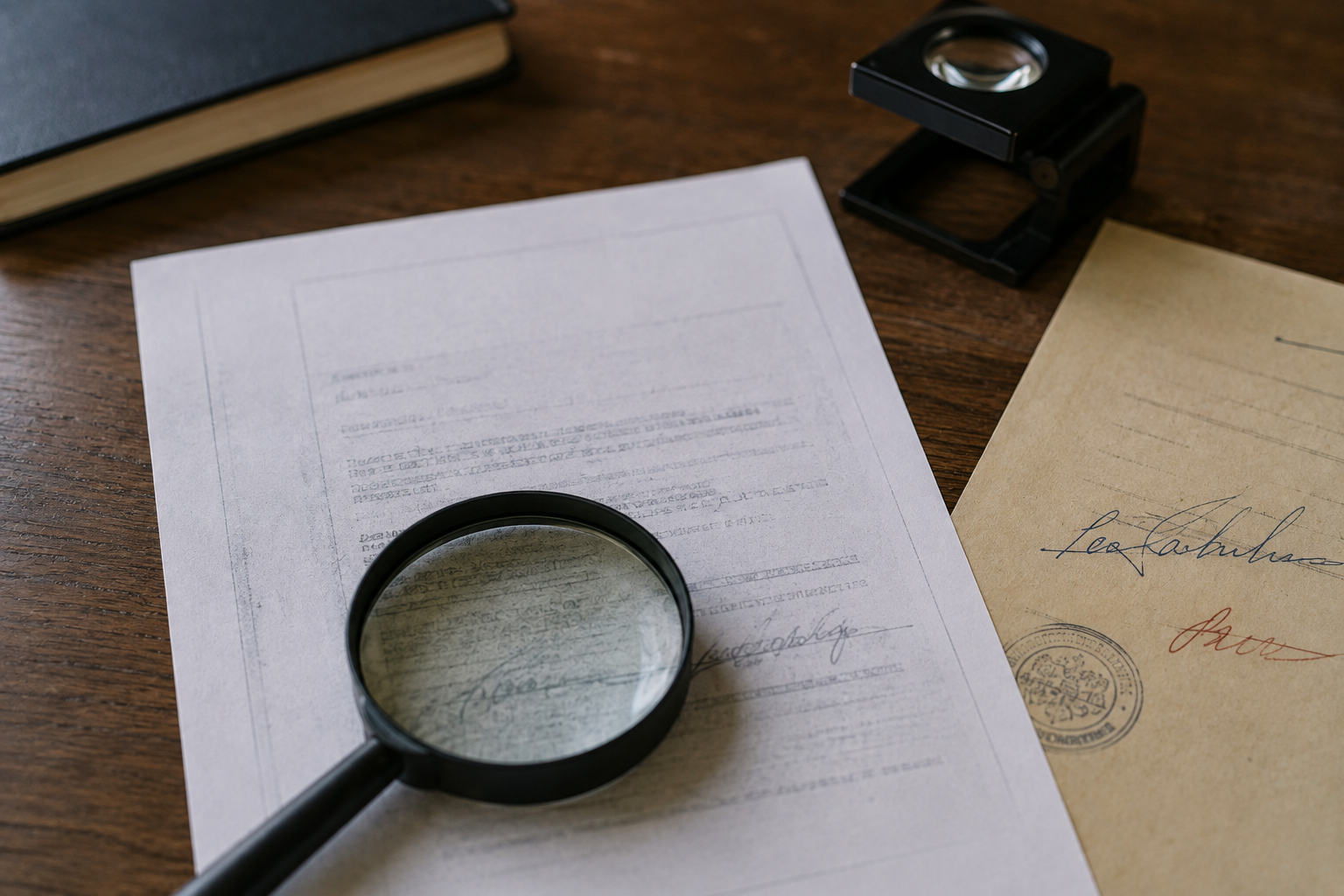
A photocopy essentially captures the visual appearance of a document. While it cannot reproduce all microscopic or chemical characteristics, several important features can remain visible.
Alterations and Erasures
One of the most important clues can be an apparent alteration to the document. Changes in numbers, dates, names, amounts, or other entries may produce differences in writing quality, spacing, alignment, or character formation.
For example, a changed digit may appear darker, differently positioned, or inconsistent with surrounding characters. An examiner can compare the questioned character with other characters on the document to identify unusual patterns.
Physical erasures may also leave visible traces such as disturbed paper fibers, uneven writing surfaces, or remnants of previous writing. However, photocopying can sometimes reduce or completely hide subtle evidence of erasure.
Handwriting and Signatures
Handwriting examination can still be possible from a photocopy, particularly when the writing is clear and sufficiently detailed.
An examiner may study characteristics such as letter formation, slant, spacing, proportions, connecting strokes, pen lifts, and overall writing habits. Signatures can also be compared with known genuine specimens.
However, a photocopy may distort fine details such as pressure patterns, ink flow, pen impressions, and very small stroke characteristics. Therefore, conclusions based only on a photocopy may have limitations.
Inconsistent Printing
Different portions of a document may have been produced using different printers or printing processes. Differences in font appearance, character shape, alignment, spacing, toner distribution, and print quality may provide useful clues.
For instance, if one section of a document appears noticeably different from the rest, it may indicate that information was added or replaced later.
A photocopy can preserve some of these visual differences, although it may also introduce its own distortion.
Cut-and-Paste or Composite Documents
Modern document fraud can involve physically combining information from different documents before making a copy. A photocopy may sometimes reveal irregular alignment, inconsistent spacing, unusual borders, or differences in text placement.
In digitally manipulated documents, inconsistencies in fonts, formatting, resolution, margins, and image quality may also become apparent. These observations do not automatically prove fraud, but they can provide important investigative leads.
Sequence and Layout Clues
The position of signatures, stamps, handwritten entries, printed text, and other elements can sometimes raise questions about how a document was created.
For example, a signature appearing unusually close to a printed line, an irregularly positioned stamp, or inconsistent alignment between different sections may warrant further examination.
Determining the actual sequence in which different entries were made, however, is much more reliable when the original document is available.
What a Photocopy Cannot Tell You
A photocopy has significant limitations. It is essentially a reproduction, not the original evidence.
An examiner generally cannot reliably assess certain features such as the original paper fibres, ink chemistry, indentation, toner composition, microscopic stroke details, or the physical interaction between writing and paper.
Specialized examinations using techniques such as ultraviolet or infrared illumination, microscopy, ink analysis, and electrostatic detection of indentations are generally more meaningful when performed on the original document.
This is why forensic experts usually recommend preserving and submitting the original whenever possible.
Can a Photocopy Prove a Forgery?
This is an important distinction.
A photocopy may reveal indications of alteration or inconsistency, but those observations do not necessarily establish forgery by themselves.
Forensic document examination involves evaluating multiple characteristics rather than relying on a single suspicious feature. An examiner considers the quality of the questioned material, available comparison specimens, reproduction processes, and the specific question being investigated.
In many cases, a photocopy can be used for a preliminary assessment. If significant inconsistencies are identified, investigators may then seek the original document or additional evidence.
Why Original Documents Matter
Original documents preserve information that may be lost during reproduction. They allow examiners to study details at different magnifications and under specialized lighting.
The original may reveal overwritten strokes, indentations, ink differences, paper characteristics, erasure marks, or other features that simply do not appear in a photocopy.
Therefore, if a document is suspected to be fraudulent, it should be handled carefully and protected from unnecessary writing, folding, marking, stapling, or other alterations.
The Role of Technology
Technology has significantly expanded the capabilities of forensic document examination. High-resolution imaging, digital microscopy, specialized lighting, and image enhancement can help examiners visualize features that are difficult to observe with the naked eye.
Digital examination can also help identify inconsistencies in scanned or printed documents. However, enhanced images must be interpreted carefully. Image processing can make features easier to see, but it cannot recreate information that was never captured in the original reproduction.
The Bottom Line
So, can a photocopy expose a forgery? Absolutely—but with limitations.
A photocopy can preserve valuable clues relating to handwriting, signatures, alterations, printing inconsistencies, formatting, and document layout. These clues can help forensic examiners identify suspicious features and guide further investigation.
However, a photocopy should not automatically be treated as equivalent to the original. Important forensic information may be lost during copying, scanning, compression, or printing.
When authenticity matters—whether in a legal document, certificate, agreement, financial record, identity document, or handwritten statement—the original should be preserved and examined whenever possible.
Ultimately, forensic document examination is not about simply asking whether a document “looks fake.” It is about systematically studying the evidence, identifying inconsistencies, comparing relevant features, and determining what the available evidence can scientifically support.
A photocopy may not tell the whole story—but sometimes, it can reveal the first clue that something is not quite right.



Post comments (0)