An IP address is one of the most commonly misunderstood pieces of digital information. People often assume that an IP address can reveal someone’s exact location, identity, or even everything they do online. While an IP address is useful in cybersecurity and digital forensics, its capabilities are more limited than popular movies and social media posts suggest.
Understanding the difference between fact and fiction is important for anyone interested in IP address tracking, digital forensics, or online privacy.
What Is an IP Address?
An Internet Protocol (IP) address is a numerical identifier associated with a device or network connection communicating over the internet. IPv4 addresses, such as 192.168.1.10, and IPv6 addresses serve different technical purposes, but neither should automatically be interpreted as a person’s permanent digital identity.
Public IP addresses are generally associated with an internet connection and may be assigned by an Internet Service Provider (ISP). Private IP addresses are used within local networks and normally cannot be directly used to identify someone on the public internet.
For technical background, the Internet Assigned Numbers Authority (IANA) provides authoritative information about Internet number resources.
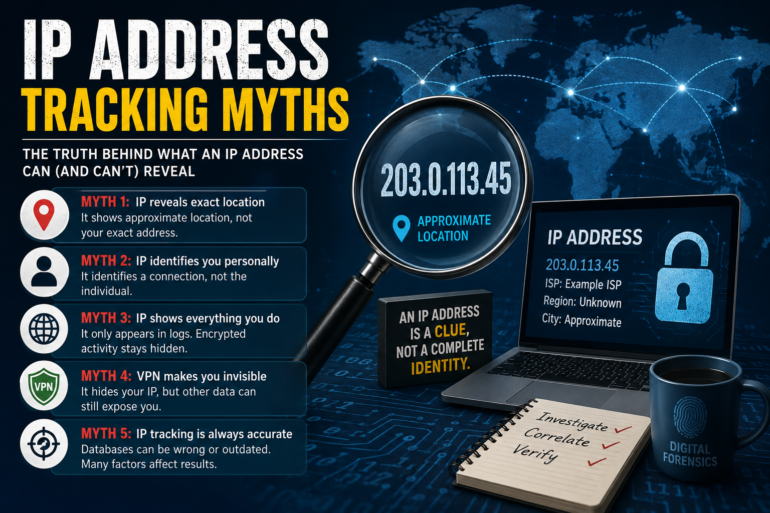
Myth 1: An IP Address Reveals Someone’s Exact Location
This is probably the most common IP tracking myth.
An IP address can sometimes provide an approximate geographical location, such as a country, region, or city. However, IP geolocation is not equivalent to GPS tracking.
The location shown by an IP database may correspond to an ISP’s registered infrastructure, a data center, a regional network, or another location associated with the address. Mobile networks and VPNs can make geographical attribution even more complicated.
Therefore, saying that an IP address proves that a person was physically present at a specific house or building would generally be an overstatement.
Myth 2: An IP Address Directly Identifies a Person
An IP address normally identifies a network connection or endpoint—not automatically the individual using it.
For example, several people in the same household may use the same public IP address. Similarly, businesses, universities, hotels, and public Wi-Fi networks can have many users behind one public IP address.
In a forensic investigation, an IP address may become significantly more useful when combined with other evidence. ISP records, timestamps, account information, device artifacts, authentication logs, and other network records may help investigators establish attribution.
This is why IP address investigation should be treated as a process of correlation rather than simply looking up an IP address.
Myth 3: An IP Address Shows Everything Someone Does Online
An IP address does not automatically provide a complete history of someone’s online activities.
It can appear in server logs, firewall logs, authentication records, and other network infrastructure. However, the information available depends on what systems recorded the connection and what records are retained.
Modern websites and applications also use encryption extensively. An IP address alone does not normally reveal the contents of encrypted communications.
Investigators therefore need to examine multiple sources of digital evidence rather than relying exclusively on an IP address.
Myth 4: Using a VPN Makes Someone Completely Anonymous
Another widespread misconception is that a VPN makes a person completely untraceable.
A VPN can hide a user’s public IP address from websites and services they access directly, replacing it with the VPN server’s IP address. However, VPN usage does not eliminate every potential source of identifying information.
Depending on the circumstances, investigators may examine VPN records, account information, device artifacts, browser data, payment information, timestamps, endpoint logs, or other evidence.
The Electronic Frontier Foundation (EFF) provides useful resources explaining online privacy and the limitations of anonymity technologies.
Myth 5: IP Tracking Is Always Accurate
IP geolocation databases are useful, but they are not infallible.
Addresses can be reassigned, databases can contain outdated information, and network configurations can produce unexpected geographical results. Proxies, VPNs, carrier-grade NAT (CGNAT), cloud services, and mobile networks can further complicate attribution.
For this reason, IP address tracking should always be interpreted within its technical context.
How IP Addresses Are Actually Used in Digital Forensics
In digital forensic investigation, an IP address can serve as an important investigative lead.
An examiner may correlate an IP address with:
- Connection timestamps
- Server and firewall logs
- ISP records
- Login and authentication records
- Email headers
- Cloud service logs
- Device artifacts
- Account activity
- Network infrastructure records
The strongest conclusions usually come from corroboration. An IP address by itself may establish that a particular network connection was associated with an online activity at a particular time, but additional evidence may be required to determine who actually performed the activity.
The Bottom Line
The biggest misconception surrounding IP addresses is that they are a digital equivalent of a person’s identity card or GPS tracker. They are neither.
An IP address can be valuable evidence in cybercrime investigation and digital forensics, but its meaning depends heavily on context, timestamps, network architecture, data retention, and supporting evidence.
So, when it comes to IP address tracking myths, remember one important principle: an IP address is a clue, not automatically a complete identity. Accurate attribution requires technical analysis and corroboration from multiple sources of digital evidence.




Post comments (0)