Ink Differentiation in Forensic Document Examination is an important process used to determine whether two similar-looking inks have the same or different chemical compositions. Have you ever wondered whether two pens that produce exactly the same shade of blue or black ink can actually be distinguished? To the naked eye, two handwritten entries on a document may appear identical. However, their chemical composition, dye formulation, and physical properties may be entirely different.
1. Why Do Similar-Looking Inks Need Scientific Examination?
Different pen manufacturers may use similar colours and formulations to produce inks that look almost identical. Even pens from the same manufacturer can contain different ink formulations depending on their model, production batch, or manufacturing period.
For example, two blue ballpoint pens may produce nearly identical writing on paper. However, one may contain a particular combination of dyes and solvents, while the other may contain an entirely different chemical composition.
These differences may not be visible to the human eye but can sometimes be detected through specialised forensic techniques.
The primary objective of forensic ink examination is to identify distinguishable characteristics between ink samples and assess whether the inks can be differentiated scientifically.
2. Scientific Techniques Used for Ink Differentiation
Forensic document examiners use various non-destructive and destructive techniques to examine ink samples. The choice of technique depends on the nature of the document, the amount of ink available, and the purpose of the examination.
A. Visual Examination Under Different Light Sources
The first step generally involves examining the document under normal, oblique, ultraviolet (UV), and infrared (IR) illumination.
Different inks may respond differently to various light sources because of differences in their optical properties.
-
UV examination: Certain inks may show different fluorescence or absorption characteristics under ultraviolet illumination.
-
IR examination: Some inks absorb or reflect infrared radiation differently, helping distinguish inks that appear similar in visible light.
-
Oblique lighting: Can help reveal physical characteristics such as ink deposits, surface disturbances, and writing impressions.
B. Video Spectral Comparator (VSC)
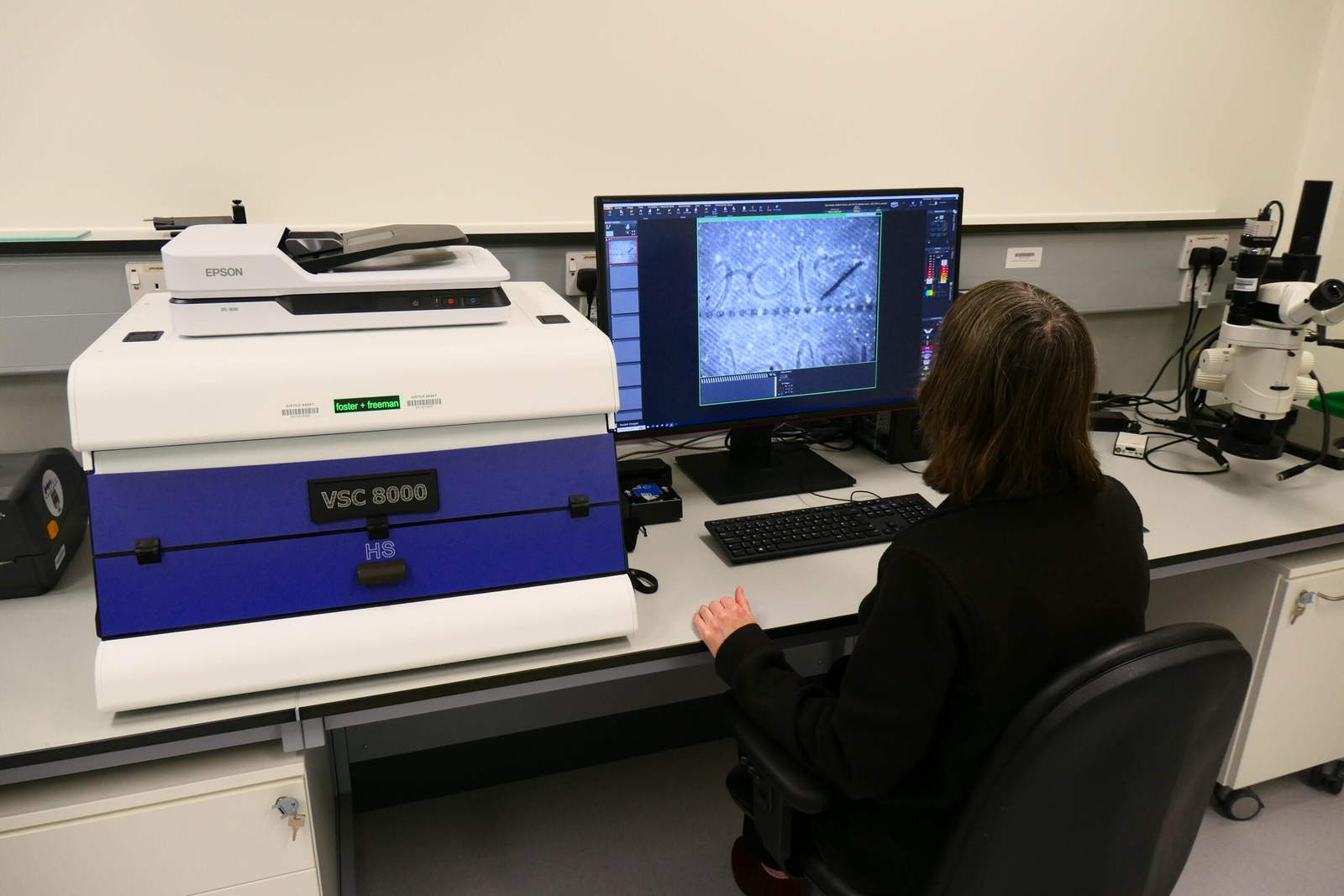
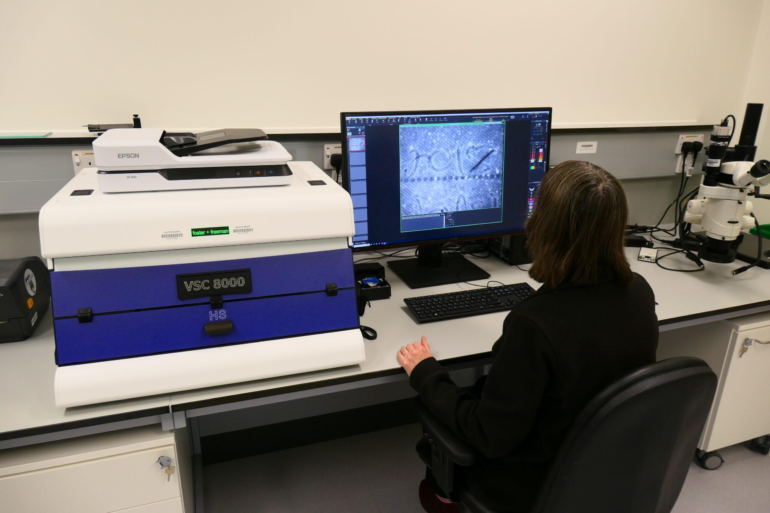
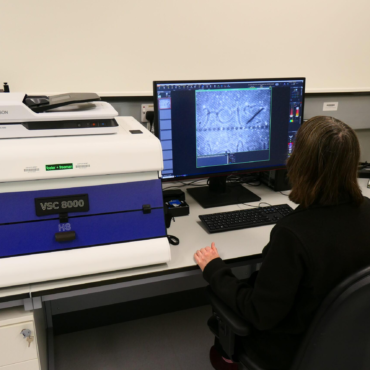
A Video Spectral Comparator (VSC) is an important instrument used in questioned document examination. It allows examiners to observe and compare the optical behaviour of inks under different wavelengths of light.
By examining ink responses under different illumination and filtration conditions, an examiner may identify differences that are not visible during ordinary visual inspection.
A VSC can be particularly useful when investigating suspected alterations, additions, or entries made using different writing instruments.
C. Thin Layer Chromatography (TLC)
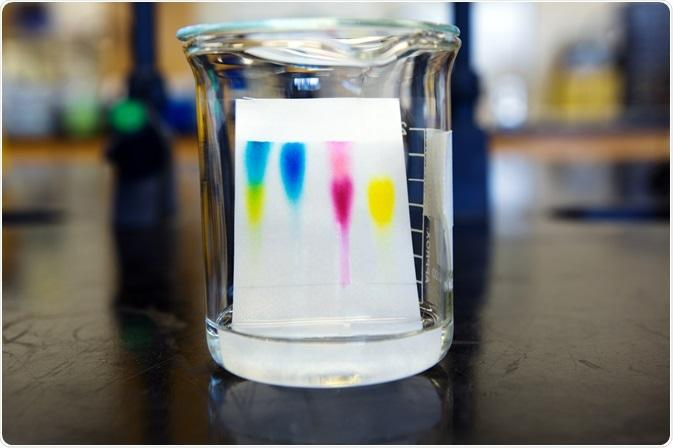
Thin Layer Chromatography (TLC) is a widely recognised analytical technique used for forensic ink comparison.
In this method, a very small quantity of ink is extracted from the document and placed on a specialised chromatographic plate. A suitable solvent is then allowed to travel through the plate, separating the ink components according to their different chemical interactions and movement rates.
The resulting separation produces characteristic patterns or bands.
If two ink samples produce different chromatographic patterns, this may indicate that they have different dye compositions.
However, identical TLC patterns do not necessarily prove that two inks came from the same pen or source.
High-Performance Liquid Chromatography (HPLC)
HPLC is an advanced analytical technique that provides more detailed separation of ink components. It is particularly useful when conventional methods do not provide sufficient differentiation.
It helps separate and analyse individual chemical components present in ink samples. The resulting chromatographic profiles can be compared to identify differences in their chemical composition.
E. Spectroscopic Techniques
Spectroscopic methods, including UV-Visible Spectrophotometry and Fourier Transform Infrared Spectroscopy (FTIR), can provide additional information about ink composition.
-
UV-Visible Spectrophotometry: Examines how ink absorbs light at different wavelengths and helps compare the colourant composition of different samples.
-
FTIR Spectroscopy: Helps identify certain chemical components, including binders and other non-colourant materials present in ink.
Combining different analytical techniques can improve the ability to distinguish between similar-looking inks.
National Center for Forensic Science+2
3. Can Two Inks Be Identified as Coming from the Same Pen?
This is one of the most important questions in forensic ink examination.
Suppose two handwritten entries on a legal agreement appear to have been written using the same blue ballpoint pen. After examination, the forensic expert identifies differences in their chromatographic patterns.
This may indicate that the two entries were made using distinguishable ink formulations.
However, there is an important scientific limitation: finding no detectable difference between two ink samples does not establish that they originated from the same pen.
Different manufacturers may use similar ink formulations, and even inks from the same manufacturer may have similar chemical profiles.
Therefore, forensic experts generally distinguish between inks that are scientifically distinguishable and those that cannot be differentiated using the methods applied.
4. Importance of Ink Differentiation in Legal Investigations
Ink differentiation can play an important role in examining disputed documents and investigating suspected alterations.
Some common applications include:
-
Document Alteration: Identifying whether additional words, dates, or amounts were written using a different ink.
-
Cheque Fraud: Examining whether the amount or payee details may have been altered.
-
Agreement Disputes: Comparing inks used in different sections of an agreement.
-
Questioned Signatures: Examining whether the ink used for a disputed signature differs from other writing on the document.
-
Will and Property Disputes: Investigating suspicious additions or modifications in handwritten documents.
It is important to remember that ink differentiation alone cannot establish who wrote an entry or exactly when it was written. Such conclusions require additional examination and supporting evidence.
5. Limitations of Forensic Ink Examination
Although modern forensic techniques can provide valuable information, ink examination has certain limitations.
The age and condition of the document, paper characteristics, environmental exposure, ink degradation, and the availability of sufficient sample material can influence the examination.
Furthermore, some techniques, particularly TLC, require removing a very small quantity of ink from the document. Therefore, non-destructive examination is generally preferred before proceeding with destructive analytical methods.
The selection of appropriate techniques must be based on the case requirements and scientific suitability.
National Center for Forensic Science+1
Conclusion
Two inks that appear identical to the naked eye may have completely different chemical compositions. Through techniques such as Video Spectral Comparison, Thin Layer Chromatography, UV-Visible Spectrophotometry, and FTIR, forensic experts can identify differences that are otherwise invisible.
Ink differentiation is not simply about comparing colours; it is about examining the scientific and chemical characteristics of writing materials.
In Questioned Document Examination, even a small difference in ink composition can provide valuable investigative information. However, the findings must always be interpreted carefully, scientifically, and within the limitations of the examination.
At Hawk Eye Forensic, scientific examination of questioned documents plays an important role in understanding the authenticity and integrity of documentary evidence.

Post comments (0)