When investigators find a footprint at a crime scene, it may look like nothing more than a mark left behind by a shoe. But to a forensic examiner, that impression can contain a surprising amount of information.
A footprint can help investigators understand what type of footwear was used, how a person moved, the direction they travelled, and potentially whether a particular shoe was involved in a crime. In some circumstances, footwear impressions can even contribute to reconstructing events at a crime scene.
Footwear evidence is therefore much more than simply determining someone’s shoe size. It is a valuable form of physical evidence that can connect a person, object, and location.
What Is Footwear Evidence?
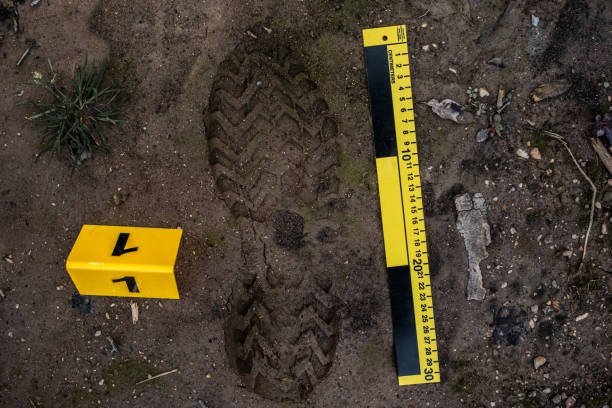
Footwear evidence refers to impressions or marks produced by shoes, boots, sandals, or other footwear. These impressions may be found on a variety of surfaces, including soil, mud, dust, blood, sand, carpets, floors, and other materials.
Investigators may encounter three common forms of footwear impressions:
- Visible impressions—easily seen because the sole has deposited a substance such as blood, mud, paint, or dust.
- Plastic impressions – three-dimensional impressions formed when footwear presses into a soft surface such as mud, soil, or snow.
- Latent impressions – impressions that are not immediately visible and may require special lighting, photography, or enhancement techniques.
Each type can provide useful information depending on how it was formed and preserved.
Shoe Size Is Only the Beginning
One of the most obvious features of a footwear impression is its approximate length and width. These measurements can help investigators estimate the size of the footwear.
However, shoe size alone rarely identifies a particular person. Many people can wear the same size and model of shoe.
The real forensic value often comes from examining the details of the outsole.
The tread pattern can indicate the brand, model, design, or general type of footwear. Investigators can compare a crime-scene impression with reference impressions from a suspected shoe.
But there is another important layer of information: individual characteristics.
Wear Patterns Can Tell a Story
Shoes change as they are used.
The tread gradually becomes worn down, but the wear is not necessarily uniform. A person may place more pressure on particular parts of the foot while walking. As a result, areas of the outsole can wear differently.
For example, an examiner may observe greater wear on:
- The heel
- The outer edge
- The inner edge
- The toe area
- Specific tread blocks
These patterns can become useful during comparison because they may distinguish one particular shoe from another shoe of the same model.
A new shoe may have a common manufacturing pattern. After months of use, however, it can develop a combination of wear characteristics that makes the impression more informative.
Accidental Marks: The Hidden Clues
Footwear can also acquire accidental characteristics during use.
A small cut, crack, missing tread block, embedded stone, or unusual damage can leave a corresponding feature in an impression.
These are sometimes referred to as accidental or randomly acquired characteristics.
Imagine hundreds of people owning the same shoe model. Most shoes will initially have very similar outsole patterns. But one shoe may develop a small cut across a tread block.
If that same unusual feature appears in an impression from a crime scene, it may provide an important point of comparison.
This is why forensic footwear examination involves much more than matching a general tread design.
Footprints Can Reveal Movement
Footwear impressions can also help investigators study how a person moved through a scene.
A sequence of footprints may provide information about:
- Direction of travel
- Approximate walking path
- Changes in direction
- Walking versus running
- Stride characteristics
- Areas where a person stopped or turned
The spacing between successive impressions can sometimes provide clues about movement. Investigators may also examine the orientation of individual impressions and the overall pattern created by a sequence.
For example, a series of widely spaced impressions with different orientation may indicate rapid movement or a change in direction.
However, such interpretations must be made cautiously. Surface conditions, footwear type, individual walking style, and environmental factors can all influence an impression.
Can Footprints Reveal Height or Weight?
This is one of the more interesting questions in footwear forensics.
Researchers have investigated relationships between foot length, footwear dimensions, stride, and body characteristics. In some situations, footprint evidence may provide approximate estimates or investigative clues about a person’s physical characteristics.
However, these estimates are not precise identification tools.
A footprint should therefore not be treated as a simple formula for determining someone’s exact height or weight. Forensic conclusions should be based on the quality of the evidence and validated scientific methods rather than assumptions.
The Surface Matters
The same shoe can produce very different impressions depending on the surface.
A muddy surface may preserve detailed three-dimensional information, while a hard floor may produce only a faint trace.
Investigators therefore need to document the scene carefully before attempting to recover an impression.
Photography is usually an essential first step. Scale markers should be used so that the dimensions of the impression can be accurately documented.
Depending on the circumstances, investigators may use techniques such as electrostatic lifting, gel lifting, chemical enhancement, or casting to recover footwear impressions.
For three-dimensional impressions in soil or other soft materials, casting materials can preserve the shape and depth of the impression for further examination.
Footwear Evidence and Crime Scene Reconstruction
Footwear impressions can become particularly valuable when several impressions are considered together.
A single footprint may provide limited information. A series of impressions, however, can help investigators reconstruct a person’s movement through a scene.
For example, investigators may determine that someone:
Entered a location → moved toward a particular area → stopped → changed direction → left through another route.
When combined with other evidence such as fingerprints, DNA, CCTV footage, bloodstains, or digital evidence, footwear impressions can contribute to a broader reconstruction of events.
This demonstrates an important principle in forensic science: evidence rarely works in isolation.
How Forensic Examiners Compare Footwear
A footwear examiner may compare questioned impressions with test impressions made from a known shoe.
The examination can consider:
- Class characteristics – features shared by shoes of the same design or manufacturing type.
- Wear characteristics – changes produced through use.
- Accidental characteristics – cuts, scratches, missing pieces, or other acquired features.
- Overall correspondence – whether the observed features are consistent between the questioned impression and known footwear.
The examiner must also consider the quality and completeness of the crime-scene impression. A partial or distorted impression may limit what can reasonably be concluded.
Why Proper Collection Matters
A poorly collected footprint can lose valuable information permanently.
Investigators should avoid walking through areas containing impressions and should photograph them before attempting recovery. The location, orientation, condition, and surrounding circumstances should also be documented.
The impression should be preserved using an appropriate recovery method based on the surface and type of evidence.
This is where proper crime scene investigation procedures and footwear impression collection kits become important.
The Bigger Picture
Footprints may seem ordinary because people leave them everywhere. At a crime scene, however, an ordinary footprint can become an important piece of forensic evidence.
It can provide clues about footwear type, tread design, wear, accidental damage, movement, and possible connections between a shoe and a scene.
Most importantly, footwear evidence demonstrates how forensic science can extract information from seemingly insignificant traces.
A footprint is not simply a mark showing where someone stood.
It can be a record of movement, a signature of wear, and sometimes a link between a person and a crime scene.
Final Thought
The next time you see a footprint, look beyond its size.
The pattern, the worn areas, the tiny cuts, the missing tread, the direction, and even the way a series of impressions moves across a surface may tell a much larger story.
In forensic science, sometimes the smallest traces can leave the biggest clues.


Post comments (0)