Introduction
The first hour after a crime scene is discovered is often referred to as the “golden hour” of investigation. During this critical period, investigators work quickly to secure, assess, document, and preserve evidence before it can be altered, contaminated, or destroyed. The actions taken in these first sixty minutes can significantly influence the success of the entire investigation and any future court proceedings.
Why the First Hour Matters
Crime scenes are dynamic environments. Weather conditions, human activity, and the passage of time can all affect evidence. Footprints may fade, fingerprints may be smudged, and digital devices may continue to receive or overwrite data. Therefore, investigators follow strict procedures to ensure that evidence remains intact and reliable.
Step 1: Ensuring Safety and Providing Medical Assistance
The first priority at any crime scene is safety. Responding officers assess the scene for immediate threats such as:
- Armed suspects
- Hazardous materials
- Fire or electrical risks
- Explosive devices
If victims are injured, emergency medical services are called immediately. Saving lives always takes precedence over preserving evidence.
However, officers and medical personnel attempt to minimize disturbance to the scene whenever possible.
Step 2: Securing and Isolating the Crime Scene
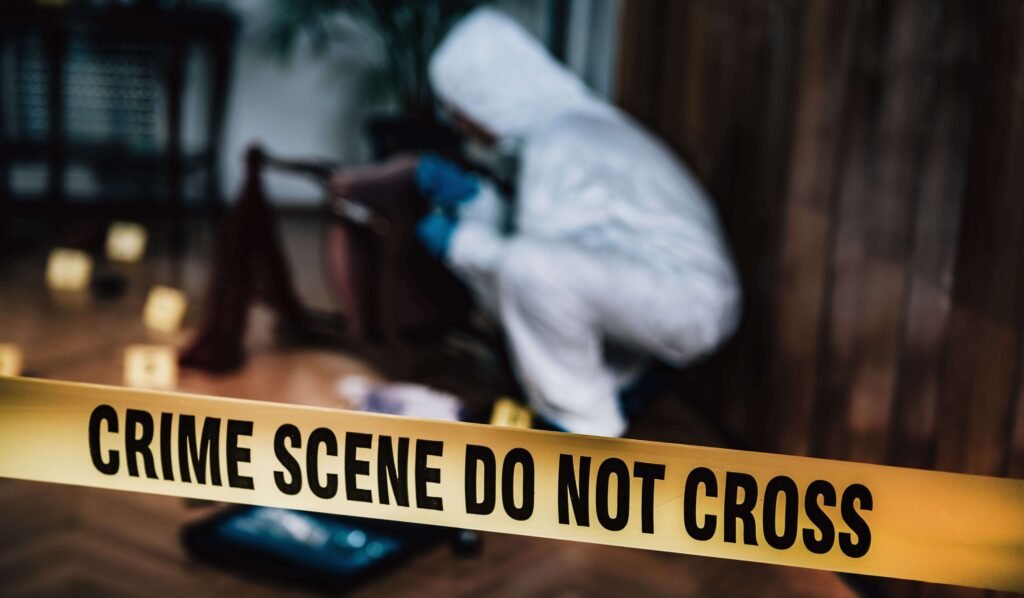
Once safety concerns are addressed, officers establish a secure perimeter around the area. Crime scene tape, barricades, or physical guards may be used to prevent unauthorized access.
The purpose of scene security is to:
- Protect evidence from contamination
- Restrict entry to authorized personnel only
- Preserve the original condition of the scene
- Maintain control over movements within the area
Investigators often create multiple zones, including:
- Inner crime scene
- Outer security perimeter
- Command or staging area
Step 3: Detaining and Separating Witnesses
Witnesses present at the scene are identified and separated as soon as possible. This prevents them from influencing one another’s recollections.
Officers gather preliminary information such as:
- What happened
- When it occurred
- Who was present
- Any suspicious observations
These initial statements may later be compared with formal interviews conducted during the investigation.
Step 4: Identifying and Preserving Fragile Evidence
Certain types of evidence can disappear quickly if not protected immediately. Investigators conduct a preliminary assessment to identify fragile or transient evidence, including:
- Footprints
- Tire impressions
- Bloodstain patterns exposed to weather
- Gunshot residue
- Digital devices connected to networks
- Trace evidence such as hair and fibers
Protective measures may include tents, covers, barriers, or immediate photography.
Step 5: Establishing Scene Documentation
Before anything is moved, investigators begin documenting the scene.
Photography
Photographs are taken from multiple perspectives:
- Overall scene views
- Mid-range photographs
- Close-up images of evidence
Scale markers may be placed next to evidence for size reference.
Videography
Video recordings help capture the layout and relationships between objects within the scene.
Sketching
Crime scene sketches are prepared to document:
- Overall scene layout
- Location of evidence
- Position of victims and objects
- Entry and exit points
- Measurements and distances
Sketches provide a clear visual representation of the scene and complement photographs and investigative notes.
Notes
Investigators record:
- Time of arrival
- Weather conditions
- Lighting conditions
- Observations
- Actions taken
Detailed notes often become crucial during courtroom testimony.
Step 6: Conducting the Initial Walk-Through
The lead investigator performs a systematic walk-through of the crime scene.
The objectives include:
- Understanding the overall scene
- Identifying possible evidence locations
- Determining search strategies
- Recognizing entry and exit points
- Developing preliminary theories
Importantly, investigators avoid making final conclusions at this stage. The walk-through is primarily for observation and planning.
Step 7: Creating a Crime Scene Log
Every individual entering or leaving the scene is recorded in a crime scene log.
The log typically includes:
- Name
- Agency or department
- Entry time
- Exit time
- Purpose of entry
This documentation helps maintain the integrity and chain of custody of evidence.
Step 8: Searching for Physical Evidence
After documentation and planning, investigators begin systematic evidence searches.
Common search methods include:
- Grid search
- Spiral search
- Line search
- Zone search
Evidence commonly sought includes:
- Fingerprints
- Biological evidence
- Weapons
- Documents
- Fibers and hairs
- Electronic devices
- Tool marks
Each item is located, documented, photographed, and marked before collection.
Step 9: Beginning Evidence Collection
Evidence collection starts with the most vulnerable items.
Investigators use appropriate packaging methods:
- Paper bags for biological evidence
- Evidence envelopes for trace materials
- Specialized containers for sharp objects
- Anti-static packaging for digital devices
Every item receives a unique identification number and is documented carefully.
Step 10: Establishing Chain of Custody
Investigators establish the chain of custody from the moment they recover evidence at the crime scene.
Documentation records:
- Who collected the evidence
- Date and time of collection
- Location found
- Packaging details
- Every subsequent transfer
A properly maintained chain of custody ensures that evidence remains admissible in court.
Common Mistakes Investigators Must Avoid
During the first hour, mistakes can have lasting consequences.
Common errors include:
- Allowing unauthorized access
- Failing to photograph evidence before collection
- Improper packaging
- Incomplete documentation
- Cross-contamination of biological evidence
- Premature assumptions about the incident
Professional crime scene management minimizes these risks through standardized procedures and training.
Conclusion
The first hour of a crime scene investigation is one of the most important phases of the entire forensic process. Investigators must balance safety, evidence preservation, documentation, and information gathering while maintaining strict procedural standards. By securing the scene, protecting fragile evidence, and carefully documenting and collecting critical clues, investigators build a strong foundation for the case and help deliver justice through scientific evidence.



Post comments (0)