In forensic investigations, scientific findings only become meaningful evidence when they are presented and explained effectively before a court of law. A forensic expert may prepare a technically sound report, but the value of that report depends on how clearly and credibly the expert explains the findings during court proceedings.
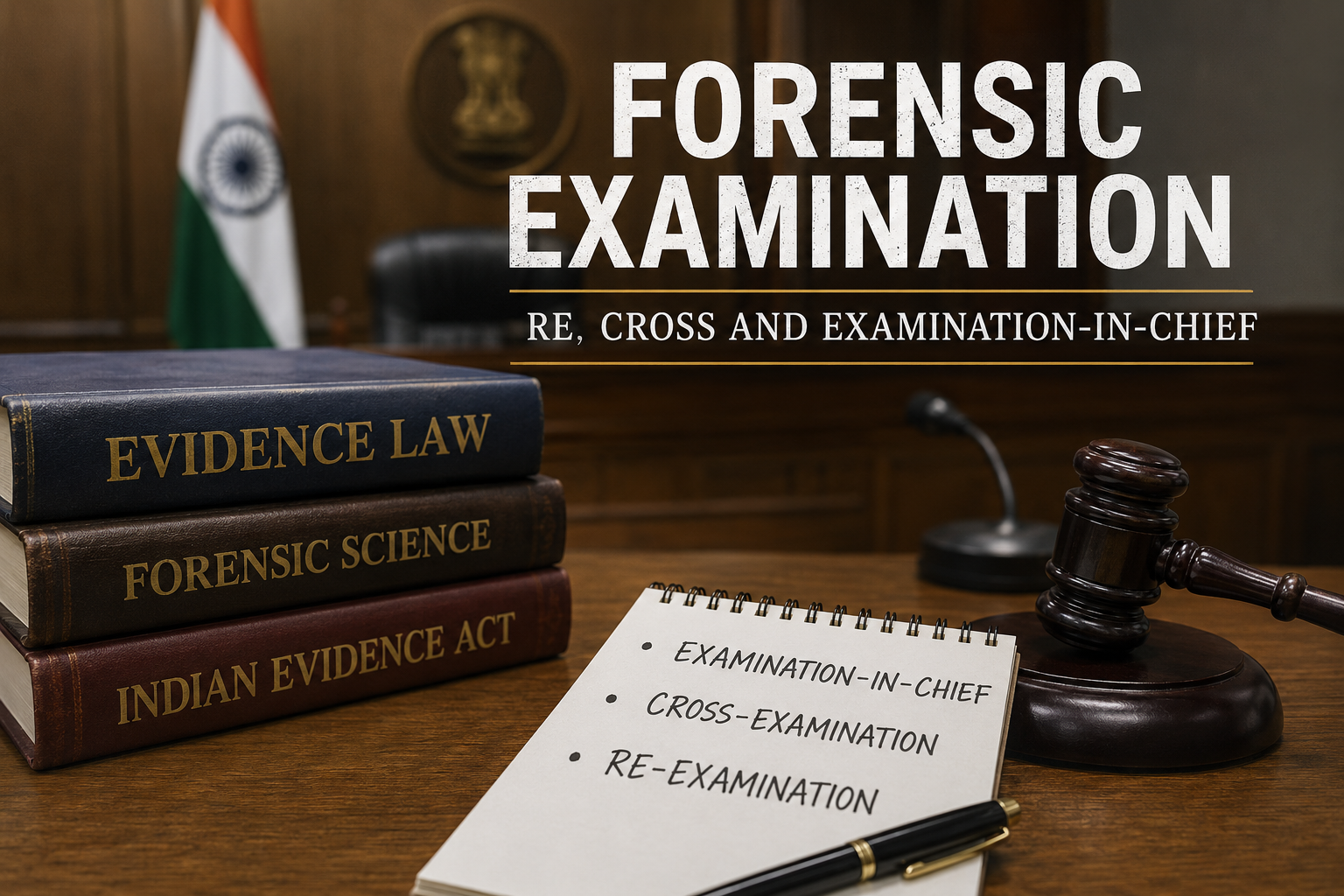
When a forensic expert appears as a witness, they are examined through three distinct stages: Examination-in-Chief, Cross-Examination, and Re-Examination. Each stage serves a specific legal purpose and helps the court evaluate the reliability, accuracy, and impartiality of the expert’s testimony.
Understanding these three forms of examination is essential for forensic professionals, law students, investigators, and legal practitioners.
What is Witness Examination?
Witness examination is the process through which a witness gives evidence before a court under oath. In forensic cases, expert witnesses present scientific opinions based on laboratory examinations, crime scene analysis, or technical investigations.
Unlike ordinary witnesses, forensic experts provide expert opinions based on specialized knowledge, education, training, and experience. Their responsibility is not to support either party but to assist the court by presenting unbiased scientific evidence.
The examination of a witness generally consists of three stages:
- Examination-in-Chief
- Cross-Examination
- Re-Examination
Each stage has different objectives and procedures.
Examination-in-Chief:-
Examination-in-Chief is the first stage of witness examination. During this stage, the witness is questioned by the party who called them to testify.
For forensic experts, this usually means answering questions from the prosecution or the party that requested their expert opinion.
Purpose
The primary objectives of Examination-in-Chief are:
- Introduce the witness to the court.
- Establish the witness’s qualifications and expertise.
- Present scientific findings.
- Explain laboratory methods used.
- Describe observations and conclusions.
- Introduce forensic reports into evidence where permitted.
What Questions Are Asked?
Typical questions include:
- Please state your name and qualifications.
- What is your current designation?
- What evidence did you receive for examination?
- What scientific methods were used?
- What were your findings?
- Can you explain your conclusions?
These questions allow the expert to present their opinion in a structured and understandable manner.
Leading Questions
Generally, leading questions are not permitted during Examination-in-Chief because they suggest the desired answer.
For example:
Incorrect:
“Your examination confirmed that the signature was forged, didn’t it?”
Correct:
“What conclusion did you reach after examining the questioned signature?”
Example:
Suppose a handwriting expert examined disputed signatures.
During Examination-in-Chief, the expert may explain:
- Documents received
- Comparison procedure
- Microscopic observations
- Pen pressure analysis
- Natural variations
- Final opinion
The goal is to educate the court on how the conclusion was reached.
Cross-Examination:-
Cross-Examination is conducted by the opposing party after Examination-in-Chief is completed.
Its purpose is to test the credibility, accuracy, consistency, and reliability of the witness’s testimony.
Objectives
Cross-Examination aims to:
- Verify the accuracy of expert findings.
- Challenge scientific conclusions.
- Identify inconsistencies.
- Test the expert’s competence.
- Examine possible bias.
- Clarify doubtful statements.
- Explore limitations in the examination.
Nature of Questions
Unlike Examination-in-Chief, leading questions are generally allowed during Cross-Examination.
Examples include:
- Isn’t it true that the sample was partially damaged?
- You did not personally collect the evidence, correct?
- There were only limited comparison specimens available?
- The examination cannot identify the writer with absolute certainty.
Such questions help determine whether the expert’s conclusions remain reliable under scrutiny.
Importance for Forensic Experts
A forensic expert should remain:
- Calm
- Objective
- Professional
- Honest
- Scientific
Experts should answer only what is asked and avoid speculation or opinions beyond their area of expertise.
If a question cannot be answered with certainty, it is appropriate to state that the available evidence does not permit a definitive conclusion.
Example
A fingerprint examiner may be asked:
“Were all latent fingerprints suitable for comparison?”
The expert should truthfully explain that only fingerprints with sufficient ridge detail can be compared and that poor-quality impressions may not permit identification.
This demonstrates scientific integrity rather than weakness.
Re-Examination:-
Re-Examination occurs after Cross-Examination.
The witness is questioned again by the party who originally called them.
Purpose
Re-Examination aims to:
- Clarify issues raised during Cross-Examination.
- Explain misunderstood answers.
- Remove confusion.
- Restore context to technical evidence.
It is not intended to introduce entirely new evidence unless the court permits it.
Typical Questions
Examples include:
- Could you explain what you meant by “limited sample quality”?
- Does partial damage necessarily invalidate your conclusion?
- Can you clarify the scientific significance of the observed similarities?
These questions help ensure that the court fully understands the expert’s testimony.
Example
During Cross-Examination, a defense lawyer may suggest that a damaged document makes handwriting comparison unreliable.
During Re-Examination, the prosecution may ask:
“Does damage always prevent forensic handwriting examination?”
The expert can explain that although damage may reduce the amount of available information, sufficient identifying characteristics may still allow a reliable opinion depending on the condition of the document.
Comparison of the Three Stages:
| Feature |
Examination-in-Chief |
Cross-Examination |
Re-Examination |
| Conducted By |
Party calling the witness |
Opposing party |
Party calling the witness |
| Purpose |
Present evidence |
Test credibility |
Clarify testimony |
| Leading Questions |
Generally not allowed |
Generally allowed |
Generally not allowed |
| Main Focus |
Scientific findings |
Reliability and consistency |
Clarification of disputed points |
Best Practices for Forensic Expert Witnesses
A forensic expert should always:
- Review the case file thoroughly before appearing in court.
- Understand every conclusion in the forensic report.
- Explain scientific concepts in simple language.
- Avoid technical jargon unless necessary.
- Answer only the question asked.
- Remain impartial and unbiased.
- Admit limitations when appropriate.
- Never exaggerate the certainty of scientific findings.
- Maintain professionalism under challenging questioning.
- An expert witness serves the court, not the party that engaged them.
Importance in the Justice System
Proper witness examination ensures that forensic evidence is carefully evaluated before influencing judicial decisions. Examination-in-Chief allows the expert to present scientific findings, Cross-Examination tests the strength and credibility of those findings, and Re-Examination provides an opportunity to clarify technical issues that may have been misunderstood.
Together, these stages help the court assess the reliability of forensic evidence while safeguarding the fairness of the trial. They reinforce the principle that expert testimony should be objective, transparent, and based on sound scientific methodology.
Conclusion
Examination-in-Chief, Cross-Examination, and Re-Examination form the foundation of expert testimony in court. For forensic professionals, understanding these stages is just as important as mastering laboratory techniques. A well-prepared expert who communicates clearly, remains impartial, and supports every opinion with scientific reasoning can significantly assist the court in reaching informed and just decisions.
Whether the case involves fingerprints, questioned documents, DNA, digital evidence, or crime scene analysis, effective courtroom examination ensures that forensic science fulfills its primary purpose—helping the justice system uncover the truth.



Post comments (0)