As cyberattacks become more sophisticated, organizations need security mechanisms that do more than simply detect suspicious activity. An Intrusion Prevention System (IPS) is an important cybersecurity technology designed to identify potentially malicious network activity and take action to stop it before it causes significant damage.
From malware infections and vulnerability exploitation to unauthorized access attempts, an IPS provides an additional defensive layer between attackers and critical systems.
Focus Keyphrase: Intrusion Prevention System
Secondary Keyphrases: IPS in cybersecurity, network intrusion prevention, intrusion detection and prevention, network security, cyber threat prevention
What Is an Intrusion Prevention System?
An Intrusion Prevention System (IPS) is a security solution that monitors network traffic to identify suspicious or malicious activity and automatically responds according to predefined security policies.
An IPS is generally deployed inline with network traffic, meaning packets pass through it before reaching their intended destination. When potentially malicious traffic is identified, the IPS may block packets, terminate connections, restrict communication, or generate alerts for security teams.
According to the National Institute of Standards and Technology (NIST), intrusion detection and prevention technologies can help organizations monitor events occurring within systems and networks and analyze them for signs of possible security incidents.
How Does an IPS Work?
An IPS continuously examines network traffic and compares observed activity against detection rules, known attack patterns, behavioral baselines, or other analytical criteria.
The process generally involves:
1. Traffic Monitoring: Network packets passing through the IPS are continuously inspected.
2. Threat Detection: The system analyzes traffic for known attack signatures, protocol anomalies, suspicious behavior, and other indicators of malicious activity.
3. Automated Prevention: When malicious activity meets configured detection criteria, the IPS can automatically take preventive action.
4. Alert Generation: Security teams may receive alerts containing information about the detected activity for further investigation.
For example, if an attacker attempts to exploit a known vulnerability in an internet-facing server, a properly configured IPS may recognize characteristics of the exploit and block the associated traffic.
Common IPS Detection Techniques
Modern intrusion prevention systems can use multiple detection techniques.
Signature-based detection identifies known threats by comparing network activity against predefined signatures. It can be highly effective against recognized attacks but depends on continuously updated signatures.
Anomaly-based detection looks for deviations from established normal network behavior. This approach may help identify previously unknown or unusual activity, although poor tuning can produce false positives.
Policy-based detection identifies activities that violate organizational security policies or predefined rules.
Some modern security platforms also incorporate behavioral analytics and machine learning to improve detection capabilities.
The Cybersecurity and Infrastructure Security Agency (CISA) provides cybersecurity guidance and resources that organizations can use when developing broader network defense and incident-response strategies.
IDS vs IPS: What Is the Difference?
An Intrusion Detection System (IDS) and an Intrusion Prevention System (IPS) are closely related, but their responses differ.
An IDS primarily detects suspicious activity and generates alerts, allowing security personnel to investigate. An IPS can detect suspicious activity and automatically attempt to block or prevent it because it typically operates inline.
A simple way to understand the difference is:
IDS = Detect and alert
IPS = Detect and take preventive action
Organizations may use both capabilities as part of a broader defense-in-depth cybersecurity strategy.
Types of Intrusion Prevention Systems
Different IPS technologies may be deployed depending on the environment and security requirements. A Network-Based IPS (NIPS) monitors network traffic for suspicious activity, while a Host-Based IPS (HIPS) protects individual endpoints or servers by monitoring activity affecting a specific host.
Other specialized approaches can focus on wireless environments or particular forms of network behavior.
Many next-generation firewalls also integrate intrusion prevention functionality alongside application control, threat intelligence, URL filtering, and other security capabilities.
Why Is an IPS Important for Cybersecurity?
An effective Intrusion Prevention System can reduce an organization’s exposure to network-based attacks by identifying and blocking certain threats before they reach vulnerable systems.
Potential benefits include:
- Real-time monitoring and automated threat prevention
- Protection against known exploits and malicious network activity
- Reduced exposure of vulnerable systems
- Improved visibility into suspicious network traffic
- Faster response to certain cyber threats
- Additional security alongside firewalls and endpoint protection
However, an IPS should not be considered a complete cybersecurity solution. Organizations still require patch management, endpoint security, access controls, secure configurations, logging, vulnerability management, backups, and incident-response procedures.
The MITRE ATT&CK framework is also useful for understanding adversary tactics and techniques that defensive technologies may need to detect or mitigate.
IPS and Digital Forensics
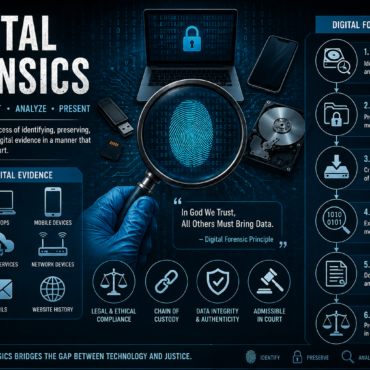
Intrusion prevention systems can also provide valuable information during digital forensic investigations and incident response. IPS alerts and logs may contain source and destination IP addresses, timestamps, network protocols, triggered signatures, connection information, and details about suspected attacks.
Investigators can correlate these records with firewall logs, endpoint artifacts, authentication logs, packet captures, and SIEM data to reconstruct an incident.
For example, during an investigation into a compromised server, IPS records may help determine when suspicious traffic occurred, which system was targeted, and what detection rule was triggered. However, an IPS alert alone should not automatically be treated as conclusive proof of compromise; it must be validated against other available evidence.




Post comments (0)