Introduction
In every criminal investigation, evidence plays a crucial role in uncovering the truth, identifying suspects, and ensuring justice. Evidence helps investigators reconstruct events, establish links between victims and suspects, and present reliable facts in court. Without proper evidence, even the most serious crimes can remain unsolved. From fingerprints and bloodstains to digital records and witness statements, every piece of evidence contributes to the investigative process.
Understanding the different types of evidence is essential for students, forensic professionals, law enforcement officers, and anyone interested in criminal justice. This article explores the major types of evidence used in criminal investigations and their significance in forensic science.
What is Evidence?
Evidence refers to any material, object, statement, or information that can prove or disprove facts related to a crime. It helps investigators answer important questions such as:
- What happened?
- When did it happen?
- Who was involved?
- How was the crime committed?
- Why was the crime committed?
Evidence must be properly collected, preserved, documented, and analysed to maintain its integrity and admissibility in court.
Major Types of Evidence in Criminal Investigations
Physical Evidence:
Physical evidence includes any tangible object found at a crime scene. It is one of the most important forms of evidence because it can directly connect a suspect, victim, and crime scene.
Examples of Physical Evidence:
- Weapons
- Clothing
- Broken glass
- Bullets and cartridge cases
- Footwear impressions
- Fibres and hair
- Paint chips
Importance:
- Physical evidence provides objective information and can often be scientifically analyzed. For example, fingerprints on a weapon may identify the person who handled it.
Collection Methods:
- Investigators carefully photograph, package, and label physical evidence to avoid contamination.
- Different packaging materials are used depending on the nature of the evidence.
Biological Evidence
Biological evidence originates from living organisms and is commonly used for DNA analysis.
Examples
- Blood
- Saliva
- Semen
- Hair roots
- Skin cells
- Tissue samples
Importance
- DNA profiling has revolutionized forensic science. Even tiny biological samples can identify individuals with high accuracy.
Common Applications
- Identifying suspects
- Confirming victim identity
- Establishing family relationships
- Linking suspects to crime scenes
Precautions
Biological evidence must be dried and packaged in paper containers to prevent moisture buildup and degradation.
Trace Evidence
Trace evidence consists of small materials transferred during contact between people, objects, or environments. According to Locard’s Exchange Principle, every contact leaves a trace.
Examples
- Hair
- Fibers
- Soil
- Glass fragments
- Gunshot residue
- Pollen
- Paint particles
Importance
- Although microscopic, trace evidence can establish connections between suspects, victims, and crime scenes.
Example
- Fibres from a suspect’s clothing found on a victim may indicate physical contact between them.
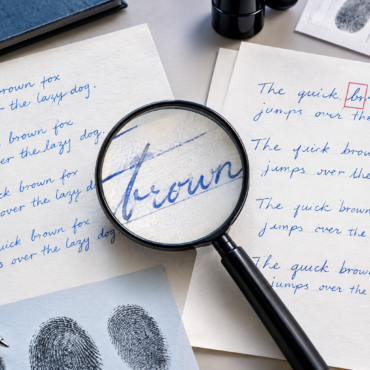
Documentary Evidence
Documentary evidence includes written or printed materials that may provide information related to a crime.
Examples
- Contracts
- Letters
- Cheques
- Passports
- Threat notes
- Medical records
- Digital printouts
Importance
- This type of evidence is especially important in fraud, forgery, and financial crimes.
Forensic Examination
Questioned document examiners analyze:
- Handwriting
- Signatures
- Ink
- Paper
- Printing methods
- Alterations or erasures
Digital Evidence
With the rise of technology, digital evidence has become increasingly significant in modern investigations.
Examples
- Mobile phones
- Emails
- CCTV footage
- Social media messages
- GPS data
- Computer files
- Internet browsing history
Importance
- Digital evidence can reveal communication patterns, locations, timelines, and criminal intent.
Challenges
- Digital evidence is fragile and can be altered easily. Investigators use specialized forensic tools to recover and preserve electronic data.
Testimonial Evidence
Testimonial evidence refers to statements made by witnesses or victims under oath.
Examples
- Eyewitness testimony
- Victim statements
- Expert witness opinions
Importance
- Witness accounts help investigators understand events and identify suspects.
Limitations
- Human memory can be inaccurate or influenced by stress, fear, or suggestion.
- Therefore, testimonial evidence is often supported by physical or scientific evidence.
Circumstantial Evidence
Circumstantial evidence indirectly suggests a fact or event without directly proving it.
Example
- If a suspect’s fingerprints are found inside a locked room where a crime occurred, it may suggest their presence at the scene.
Importance
- Although indirect, circumstantial evidence can be extremely powerful when multiple facts point toward the same conclusion.
Difference from Direct Evidence
- Direct evidence: Directly proves a fact (e.g., CCTV footage showing the crime)
- Circumstantial evidence: Requires logical inference
Direct Evidence
Direct evidence directly establishes a fact without requiring interpretation.
Examples
- Video recordings of a crime
- Audio recordings
- Confessions
- Eyewitness observations
Importance
- Direct evidence can strongly support a case, but its reliability must still be verified.
Class Evidence and Individual Evidence
Evidence can also be categorised based on its ability to identify a source.
Class Evidence
Class evidence links an item to a group rather than a specific individual.
Examples
- Blood type
- Shoe size
- Fiber type
Importance
- It narrows down possible suspects but does not uniquely identify one person.
Individual Evidence
Individual evidence can identify a single unique source.
Examples
- DNA profile
- Fingerprints
- Handwriting characteristics
Importance
- This evidence provides strong identification and is highly valuable in court.
Importance of Proper Evidence Handling
Improper handling can destroy or contaminate evidence, reducing its value in court.
Therefore, investigators follow strict procedures during:
- Recognition
- Collection
- Packaging
- Labeling
- Preservation
- Transportation
- Documentation
Maintaining the chain of custody is also essential. It records every person who handled the evidence from collection to courtroom presentation.
Role of Forensic Science in Evidence Analysis
Forensic science combines scientific methods with criminal investigations to analyze evidence accurately.
Different forensic disciplines specialize in different evidence types:
- Forensic biology: DNA and biological evidence
- Fingerprint examination: Latent print analysis
- Toxicology: Drugs and poisons
- Ballistics: Firearms examination
- Digital forensics: Electronic data analysis
- Questioned document examination: Forgery analysis
These scientific examinations help investigators establish facts objectively.
Conclusion
Evidence forms the foundation of every criminal investigation. Whether physical, biological, digital, or testimonial, each type of evidence contributes valuable information that helps uncover the truth. Proper recognition, collection, preservation, and analysis are essential to maintain the integrity of evidence and ensure justice.
Advancements in forensic science continue to improve the accuracy and reliability of evidence analysis, making criminal investigations more efficient and scientifically sound. Understanding the various types of evidence not only helps forensic professionals but also increases public awareness about the importance of scientific investigation in the criminal justice system.




Post comments (0)