In today’s digital age, encryption has become a standard security feature across smartphones, laptops, cloud platforms, and messaging applications. While encryption protects user privacy and sensitive information from cybercriminals, it also creates significant obstacles for digital forensic investigators attempting to recover evidence during criminal investigations.
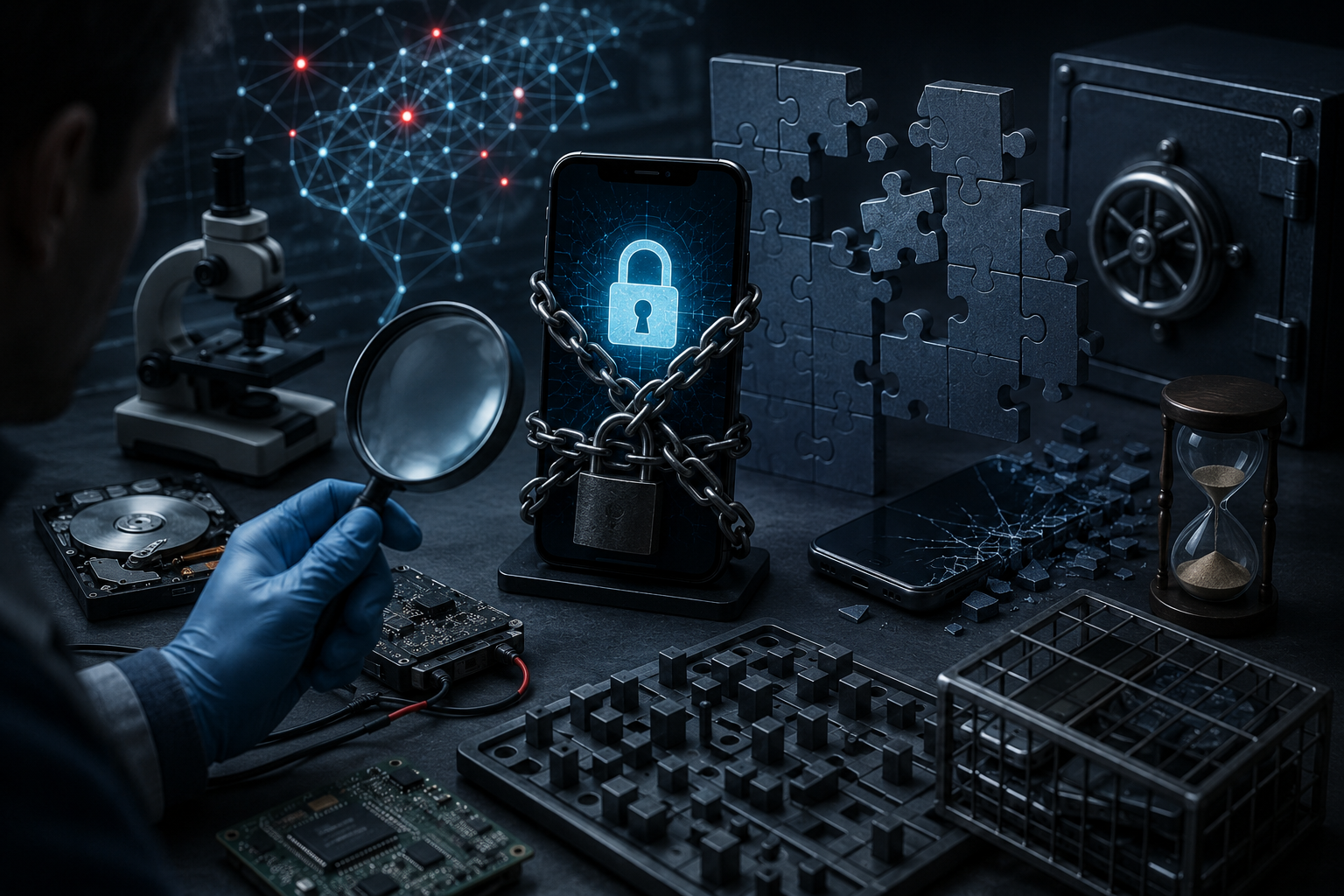
From locked smartphones to encrypted hard drives and secure messaging platforms, investigators often encounter situations where crucial evidence exists but cannot be easily accessed. As technology advances, the complexity of encrypted environments continues to grow, making encrypted device investigations one of the most demanding areas in digital forensics.
What is Device Encryption?
Encryption is a security process that converts readable data into coded information using mathematical algorithms. Only users possessing the correct decryption key, password, PIN, or biometric authentication can access the original data.
Modern devices commonly use:
- Full Disk Encryption (FDE)
- File-Based Encryption (FBE)
- End-to-End Encryption (E2EE)
- Hardware-backed encryption chips
- Secure enclaves and trusted execution environments
Popular operating systems such as Android, iOS, Windows, and macOS now enable encryption by default, significantly improving data security.
Why Encryption Creates Challenges for Investigators
Digital forensic investigations depend heavily on data accessibility. When devices are encrypted, investigators may possess the physical device but remain unable to access the stored information.
Some common investigative difficulties include:
1. Password and PIN Protection
Strong passwords, complex alphanumeric passcodes, and multi-factor authentication systems drastically reduce the chances of successful brute-force attacks.
Modern devices may:
- Limit password attempts
- Trigger temporary lockouts
- Permanently erase data after repeated failures
- Use biometric fallback restrictions
Even advanced forensic tools may fail against properly secured devices.
2. Hardware-Based Security
Many modern smartphones contain dedicated security chips designed specifically to protect encrypted data.
Examples include:
- Apple Secure Enclave
- Android Trusted Execution Environment (TEE)
- TPM chips in computers
These hardware protections isolate encryption keys from the operating system, preventing investigators from extracting keys directly from storage memory.
3. End-to-End Encrypted Applications
Applications such as secure messaging platforms increasingly use end-to-end encryption, ensuring that only communicating users can read messages.
Even service providers may not possess access to:
- Chats
- Voice calls
- Shared files
- Backup content
As a result, investigators often cannot retrieve communication data from cloud servers or providers.
Live vs Dead Forensics Challenges
Investigators frequently face a critical decision during seizure:
Live Acquisition
If the device is powered on and unlocked:
- Investigators may capture volatile memory
- Active sessions and decrypted files may be accessible
- Temporary encryption keys could remain in RAM
However, improper handling can alter evidence or trigger security mechanisms.
Dead Acquisition
If the device is powered off:
- Encryption keys may no longer be accessible
- Full-disk encryption becomes far more difficult to bypass
- Traditional imaging methods may become ineffective
This makes timing and handling procedures extremely important during evidence collection.
Cloud Encryption Complications
Modern investigations often extend beyond physical devices into cloud environments.
Challenges include:
- Encrypted cloud backups
- Jurisdictional legal barriers
- Multi-country data storage
- Remote wiping capabilities
- Limited provider cooperation
Even when investigators obtain legal authorization, accessing encrypted cloud data may still remain technically impossible.
Anti-Forensic Techniques
Suspects may intentionally use anti-forensic methods to obstruct investigations.
Common examples include:
- Hidden encrypted containers
- Secure deletion tools
- Self-destructing messaging apps
- Steganography
- Remote wipe features
- Decoy operating systems
These techniques increase investigative complexity and may delay evidence recovery significantly.
Legal and Ethical Concerns
Encrypted device investigations raise important legal and ethical debates worldwide.
Questions often include:
- Should suspects be compelled to reveal passwords?
- Does forced decryption violate privacy rights?
- How should investigators balance privacy and public safety?
- What are the limits of lawful access?
Different countries maintain different legal standards regarding compelled decryption and digital privacy rights.
Emerging Forensic Approaches
To address encryption challenges, forensic experts continue developing new investigative methods.
Some approaches include:
Memory Forensics
Analyzing volatile memory (RAM) may help recover:
- Active encryption keys
- Session tokens
- Decrypted fragments
- Running processes
Chip-Off and Hardware Analysis
Investigators may attempt:
- NAND extraction
- JTAG analysis
- Hardware-level examination
However, these methods are risky and often ineffective against modern encryption systems.
Exploit-Based Access
Specialized forensic vendors occasionally use:
- Zero-day vulnerabilities
- Bootloader exploits
- Custom unlocking techniques
These methods are highly technical, expensive, and legally sensitive.
The Future of Encryption and Forensics
As privacy awareness grows, encryption technologies will likely become even stronger and more widespread. Artificial intelligence, secure hardware, and decentralized communication systems may further complicate future investigations.
At the same time, digital forensic professionals must continue adapting through:
- Advanced forensic research
- Legal collaboration
- Improved incident response procedures
- Specialized training
- International cooperation
The balance between privacy and lawful investigation will remain one of the defining challenges of modern digital forensics.
Conclusion
Encrypted devices represent one of the greatest obstacles in contemporary digital forensic investigations. While encryption plays a critical role in protecting user privacy and cybersecurity, it also limits investigators’ ability to access potentially vital evidence.
Successful encrypted device investigations require not only advanced technical expertise, but also careful legal consideration, proper evidence handling, and continuous adaptation to evolving technologies. As encryption standards strengthen, the digital forensics community must innovate responsibly to meet the growing investigative challenges of the digital world.



Post comments (0)