A document can look perfectly genuine at first glance and still contain subtle signs of manipulation. Altered signatures, modified dates, copied seals, inconsistent fonts, and digitally edited text can all turn an authentic-looking document into a questionable one. But what happens when a forensic examiner does not have the original document?
Can a fake document still be identified?
Yes—but with important limitations. A forensic document examiner can often identify suspicious features from a photocopy, scan, photograph, or digital reproduction. However, the level of certainty depends heavily on the quality of the available copy and the type of examination required.
What Makes a Document “Fake”?
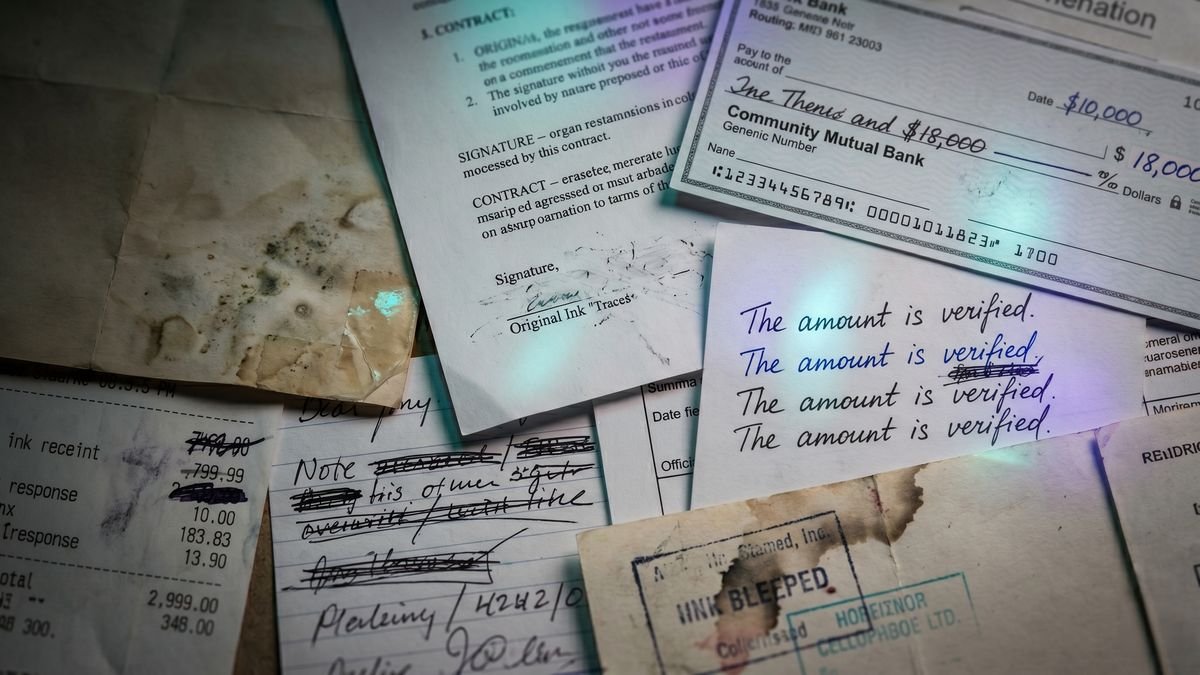
A fake document does not necessarily mean that the entire document was fabricated. In forensic document examination, questioned documents may involve several types of irregularities, including:
- A completely fabricated document
- An altered genuine document
- A forged signature
- Changed dates, amounts, or names
- Added or removed text
- Imitated stamps or seals
- Substituted pages
- Digitally manipulated documents
- Printed copies of altered originals
Sometimes the document itself is genuine, but information within it has been changed. This is why forensic examination focuses not only on whether a document “looks real” but also on how it was produced and whether its features are consistent.
Can a Scan or Photocopy Reveal Forgery?
A reproduction can reveal many visible inconsistencies.
For example, an examiner may notice differences in the following:
- Font and spacing: A particular word may have a different font, size, thickness, or alignment from the surrounding text.
- Baseline and alignment: Added text may sit slightly higher or lower than the original text.
- Ink or printing differences: Different portions may have variations in darkness, texture, or printing characteristics.
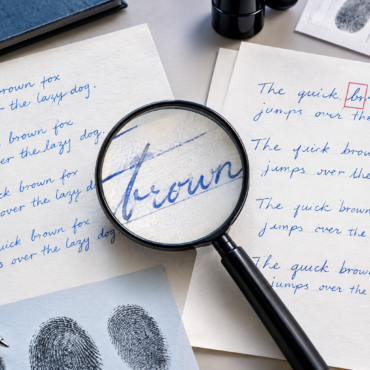
- Signature appearance: A questioned signature may show unusual hesitation, unnatural pen movements, tremors, or differences from known genuine signatures.
- Stamps and seals: A seal may appear distorted, digitally reproduced, or inconsistent with other impressions.
- Layout inconsistencies: Margins, line spacing, paragraph positioning, or page formatting may indicate that information was inserted later.
These observations can help an examiner determine whether a document requires further investigation.
However, a scan cannot preserve every feature of the original. This is where the limitations become important.
What Cannot Be Reliably Determined From a Copy?
Some forensic examinations require the physical document
For example, determining whether two writings were produced with the same ink may require chemical or optical examination of the original. Similarly, identifying alterations involving erasure, overwriting, indentation, paper disturbance, or sequence of writing may be difficult—or impossible—from a low-quality photocopy.
The original document can contain evidence that disappears during reproduction.
A photocopier or scanner may change the following:
- Ink colour and density
- Fine-line details
- Pressure characteristics
- Paper texture
- Indentations
- Erasures
- Fluorescence or other optical responses
- Microscopic printing characteristics
Therefore, an examiner should never automatically conclude that an examination of a copy is equivalent to an examination of the original.
The Importance of Image Quality
Not all digital copies are equally useful.
A high-resolution scan can preserve significantly more information than a photograph taken under poor lighting. A compressed image from a messaging application may lose fine details that could have been important to examination.
For preliminary assessment, the examiner may consider the following:
- Resolution
- Image sharpness
- Lighting
- Colour accuracy
- Compression
- Cropping
Whether the entire document is visible
Whether multiple pages are available
A clear, full-page scan is generally much more useful than a screenshot of a document.
Even then, conclusions must be based on what the available material actually demonstrates.
Digital Documents Create Another Challenge
Modern document fraud is not limited to paper.
Documents are frequently created and edited using word processors, graphic-design software, PDF editors, and image-manipulation applications. A digital file may contain information that is not visible on the printed page.
Depending on the circumstances, examination may involve the following:
- Metadata
- File properties
- Creation and modification information
- Digital signatures
- Embedded objects
- Font information
- Layer structures
- Editing history, where available
- PDF structure
- Image compression characteristics
However, metadata should not be treated as absolute proof. It can sometimes be changed, removed, or affected by software and file-transfer processes.
The strongest forensic conclusions generally come from combining multiple independent observations rather than relying on a single digital characteristic.
What About Forged Signatures?
Signature examination is one of the most commonly encountered areas of questioned document examination.
Even without the original document, a visible signature may reveal suspicious characteristics such as:
- Unnatural hesitation
- Poor line quality
- Tremors
- Unusual proportions
- Incorrect letter formations
- Differences in connecting strokes
- Unusual starting or ending strokes
- Lack of natural rhythm
However, comparing a questioned signature requires appropriate, genuine reference signatures. A person’s signature naturally changes over time, and differences alone do not automatically prove forgery.
A proper examination considers natural variation as well as significant similarities and differences.
Can AI or Software Detect a Fake Document?
Technology can assist with document examination, particularly in image enhancement, comparison, pattern recognition, and detection of visual inconsistencies.
Software may help enlarge areas of interest, adjust image characteristics, compare signatures, or identify differences between documents.
But software output should not automatically be treated as a forensic conclusion.
A forensic examiner must interpret the findings in context. An algorithm may identify a difference, but determining whether that difference resulted from fraud, scanning, printing, ageing, or normal variation requires professional judgment.
Why the Original Still Matters
The original document is often the most valuable piece of evidence.
It allows the examiner to study features that may not survive copying or scanning. Depending on the case, examination of the original may involve microscopy, different lighting conditions, ink examination, indentation analysis, paper examination, sequence analysis, or otherdocument detection specialized techniques.
For this reason, if a document is involved in a legal, employment, financial, academic, or criminal matter, the original should be preserved carefully.
Avoid writing on it, folding it unnecessarily, laminating it, stapling additional material to it, or exposing it to conditions that could damage evidence.
So, Can a Fake Document Be Identified Without the Original?
The answer is sometimes—but not always conclusively.
A copy, scan, or photograph can provide valuable clues and may reveal obvious inconsistencies. In some cases, these observations may be sufficient to raise serious concerns about authenticity.
But when the examination depends on physical characteristics of the document—such as ink, paper, indentations, erasures, or other microscopic features—the original may be essential.
The distinction is important: detecting suspicious features is not always the same as proving forgery.
A forensic document examiner therefore evaluates the available evidence, determines what examinations are possible, identifies limitations, and reports conclusions based on observable findings rather than assumptions.
Final Takeaway
A document does not become trustworthy simply because it looks professional, carries a stamp, contains a signature, or arrives as a PDF.
Forensic document examination goes beyond appearance. It examines consistency, structure, handwriting, signatures, printing, alterations, and—where available—the physical characteristics of the original document.
If the original is unavailable, a high-quality scan or photograph can still be useful for a preliminary forensic assessment. But when authenticity must be established with greater certainty, obtaining and preserving the original document is usually the best approach.
In forensic science, even a small inconsistency can raise an important question. But answering that question requires the right evidence, the right examination methods, and careful interpretation.


Post comments (0)