When a document is burned, torn, soaked, faded, or otherwise damaged, it may appear that its evidentiary value has been destroyed. In reality, forensic document examination can sometimes recover surprisingly useful information from documents that have suffered severe damage. Even when words are no longer clearly visible, traces of ink, paper fibres, impressions, printing methods, or document structure may remain.
Damaged documents can be important in investigations involving fraud, forgery, financial crimes, arson, blackmail, threats, disputed signatures, and other criminal or civil matters. The condition of the document may make examination difficult, but damage does not necessarily mean that all evidence has disappeared.
What Happens When a Document Is Burned?
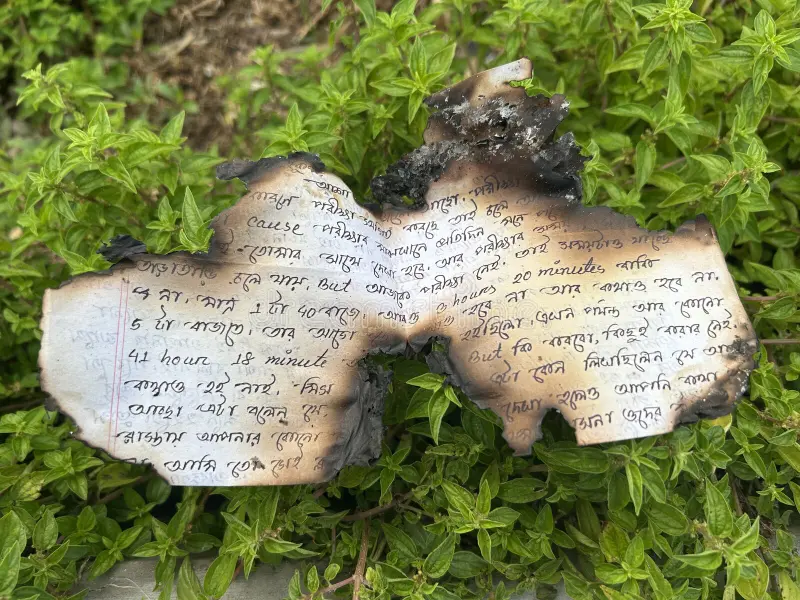
Fire affects documents in several stages. Paper exposed to heat may first become discoloured, then brittle, charred, and eventually reduced to ash. Ink and printing materials can also undergo chemical and physical changes.
However, different parts of a document may experience different levels of heat. A partially burned document may therefore contain areas that are relatively well preserved alongside severely charred sections.
The edges of a document may burn first, while portions protected by folds, attachments, envelopes, or other sheets can survive. These surviving areas may contain letters, numbers, signatures, stamps, or other identifying features.
This variation in damage is one reason forensic examination should be attempted before assuming that a document is useless.
Can Writing Be Recovered From Burnt Documents?
In some cases, yes. Forensic examiners may use specialised lighting, microscopy, imaging techniques, and other laboratory methods to examine damaged writing.
Different wavelengths of light, including ultraviolet (UV) and infrared (IR), can sometimes reveal differences between ink and paper that are not easily visible under ordinary illumination. The effectiveness of these techniques depends on the type of ink, paper, degree of burning, and other factors.
For heavily charred material, examination may focus not only on visible writing but also on surviving physical characteristics. Even when complete words cannot be recovered, fragments of letters, numbers, or patterns may provide useful investigative information.
What About Torn or Shredded Documents?
Burning is not the only method used to destroy documents. Torn or shredded documents may also contain recoverable evidence.
Fragments can sometimes be examined for:
- Matching paper edges
- Printing characteristics
- Handwriting or signatures
- Ink features
- Paper type and composition
- Document layout
- Staple, pin, or binding marks
- Indented writing
- Security features
If multiple fragments are recovered, examiners may attempt to determine whether they originated from the same document. Physical edge matching can be particularly useful when irregular tear patterns correspond between fragments.
Even small pieces can sometimes help reconstruct the original document when combined with other evidence.
Can Faded or Washed Documents Be Examined?
Documents may also be damaged by water, chemicals, sunlight, age, or deliberate attempts to remove writing.
Fading does not necessarily eliminate all information. In some situations, specialised imaging can enhance differences between writing and the underlying paper. Examination under different lighting conditions may reveal information that is difficult to see with the naked eye.
Similarly, chemical alterations may leave residues or changes in the paper that indicate that an erasure or alteration occurred.
The objective of forensic examination is not simply to “make the writing visible.” It is to determine what information remains and whether scientifically reliable conclusions can be drawn from it.
Indented Writing: Evidence That May Not Be Visible
One of the most interesting forms of document evidence is indented writing.
When someone writes on a sheet of paper, pressure from the writing instrument can sometimes leave impressions on sheets underneath. The original writing may later be removed, but these impressions can remain.
Specialised examination techniques can sometimes reveal such indentations. This may help investigators determine whether a particular sheet was written on while another document was positioned beneath it.
Indented writing can be particularly valuable when the visible contents of the original document have been destroyed or removed.
What Can Forensic Document Examiners Determine?
Depending on the condition of the material, forensic document examination may help address questions such as:
- Is the damaged material part of a particular document?
- Can any handwriting or signature characteristics be observed?
- Are different fragments likely to have originated from the same sheet?
- What type of printing process was used?
- Are there signs of alteration, erasure, or overwriting?
- Can the sequence of writing or printing be investigated?
- Are there identifiable ink or paper characteristics?
- Can portions of the original text be recovered or interpreted?
However, forensic science has limitations. An examiner cannot guarantee that destroyed information can always be recovered. Extremely high temperatures, prolonged burning, complete shredding, chemical destruction, or severe physical degradation may eliminate critical evidence.
A scientifically responsible examination must therefore distinguish between what can be observed, what can reasonably be inferred, and what cannot be determined.
Why Proper Handling Matters
Damaged documents are often fragile. Burnt paper can crumble with minimal handling, while wet paper can tear easily. Attempting to unfold, clean, glue, flatten, or reconstruct a damaged document without proper procedures may destroy valuable evidence.
Investigators should preserve the material in its recovered condition as much as possible and document its location and condition before examination.
Photographs, packaging information, recovery circumstances, and chain-of-custody records can also become important when the evidence is later presented in court.
Technology Is Changing Document Examination
Modern forensic document examination increasingly combines traditional methods with advanced imaging and analytical techniques. High-resolution photography, microscopy, multispectral imaging, and computer-assisted image enhancement can help examiners investigate damaged documents from different perspectives.
Importantly, digital enhancement does not mean that an examiner can simply “recreate” missing information. Enhancement techniques can improve the visibility of existing information, but they cannot reliably manufacture evidence that has been completely destroyed.
The strongest conclusions come from combining multiple observations rather than relying on a single image or technique.
The Evidence May Be Damaged, Not Destroyed
A document does not have to remain perfectly readable to be forensically significant. A partial signature, a distinctive printing feature, a matching torn edge, an indentation, or a surviving ink pattern may contribute to an investigation.
This is why damaged documents should not automatically be discarded as worthless. Their condition may make examination challenging, but even limited surviving information can sometimes help establish what happened.
Conclusion
Burnt, torn, faded, soaked, or otherwise damaged documents can still provide valuable forensic evidence. The possibility of recovery depends on the nature and extent of the damage, the materials involved, and the examination methods available.
Forensic document examination demonstrates an important principle of evidence analysis: damage does not always mean destruction. What appears to be an unreadable piece of paper may still contain microscopic, chemical, physical, or structural clues.
When handled carefully and examined using appropriate forensic techniques, damaged documents can sometimes tell investigators far more than the visible page initially suggests.


Post comments (0)