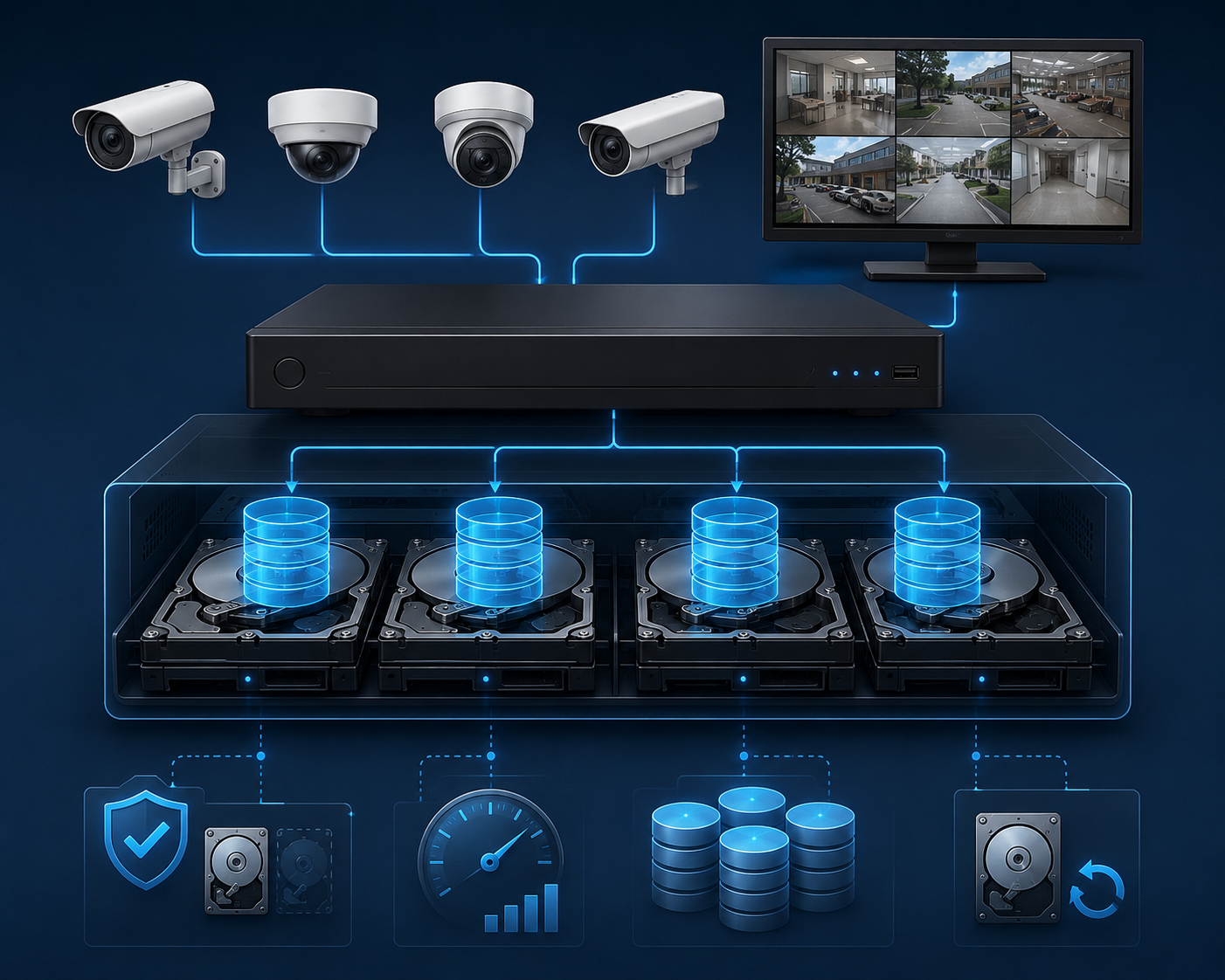
Modern surveillance systems generate massive amounts of video data every day. From homes and offices to airports and smart cities, CCTV cameras continuously record footage that may later become critical evidence in investigations. To manage this large volume of data securely and efficiently, many Network Video Recorders (NVRs) use RAID technology.
In digital forensics, understanding RAID in NVR systems is essential because investigators often encounter surveillance storage configurations during evidence acquisition and analysis.
What is RAID?
RAID stands for Redundant Array of Independent Disks. It is a storage technology that combines multiple hard drives into a single logical unit to improve:
- Data redundancy
- Storage performance
- Fault tolerance
- Capacity management
Instead of relying on a single hard drive, RAID distributes data across multiple disks based on a specific configuration called a RAID level.
What is an NVR?
An NVR (Network Video Recorder) is a device used in IP-based surveillance systems to record and manage video footage from network cameras.
Unlike DVR systems that process analog signals, NVRs work with digital video streams over a network. Because surveillance footage is continuously recorded, storage reliability becomes extremely important.
This is where RAID plays a major role.
Why RAID is Used in NVR Systems
Surveillance environments require storage systems that can:
- Operate continuously 24/7
- Handle multiple camera streams simultaneously
- Prevent data loss during hardware failure
- Store footage for long retention periods
RAID helps achieve these goals by improving reliability and storage efficiency.
Key Benefits of RAID in NVR
1. Data Protection
If one hard drive fails, RAID can preserve the recorded footage depending on the RAID level used.
2. Increased Storage Capacity
Multiple disks combine to provide larger storage space for high-resolution video recordings.
3. Better Performance
RAID can improve read/write speeds, helping NVRs manage recordings from multiple cameras smoothly.
4. Reduced Downtime
Certain RAID configurations allow the system to continue functioning even after a disk failure.
Common RAID Levels Used in NVRs
Different RAID levels offer different balances between performance, capacity, and redundancy.
RAID 0 – Striping
How it Works
Data is split across multiple drives.
Advantages
- High performance
- Full storage utilization
Disadvantages
- No fault tolerance
- Failure of one disk causes complete data loss
Use in NVR
Rarely recommended for forensic-sensitive environments because footage recovery becomes extremely difficult after disk failure.
RAID 1 – Mirroring
How it Works
Identical data is written to two drives simultaneously.
Advantages
- Excellent redundancy
- Simple recovery process
Disadvantages
- Storage capacity reduced by half
Use in NVR
Common in small surveillance systems where evidence preservation is critical.
RAID 5 – Striping with Parity
How it Works
Data and parity information are distributed across multiple disks.
Advantages
- Good balance of performance and redundancy
- Efficient storage utilization
Disadvantages
- Rebuild process can be slow
- Multiple disk failures may cause data loss
Use in NVR
Widely used in medium to large surveillance environments.
RAID 6 – Double Parity
How it Works
Similar to RAID 5 but stores double parity information.
Advantages
- Can survive failure of two disks
- Better fault tolerance
Disadvantages
- Slightly slower write performance
- Requires more storage overhead
Use in NVR
Preferred in high-security installations where uninterrupted evidence retention is important.
RAID 10 – Mirroring + Striping
How it Works
Combines RAID 1 and RAID 0 features.
Advantages
- High performance
- Strong redundancy
Disadvantages
- Expensive due to multiple disks
Use in NVR
Used in enterprise-grade surveillance systems.
RAID in Digital Forensics
When forensic investigators examine surveillance systems, RAID configurations create unique challenges.
Key Forensic Considerations
1. Disk Order Matters
Incorrect disk sequencing can corrupt reconstructed data.
2. RAID Parameters are Critical
Investigators must identify:
- RAID level
- Stripe size
- Disk sequence
- Parity rotation
3. Proprietary File Systems
Many NVR manufacturers use custom storage formats that require specialized forensic tools.
4. Live Acquisition Risks
Improper shutdown or acquisition may damage RAID metadata.
5. Deleted Footage Recovery
Recovering deleted surveillance footage from RAID-based NVRs can be complex but possible using forensic reconstruction techniques.
Challenges in RAID-Based NVR Investigations
Investigators may encounter several difficulties:
- Damaged or failed drives
- Missing RAID metadata
- Encrypted recordings
- Proprietary NVR operating systems
- Large storage volumes
- Fragmented video data
These challenges often require advanced forensic software and careful evidence handling procedures.
Best Practices for Forensic Handling of RAID NVRs
Preserve Original Evidence
Never analyze original drives directly.
Document Everything
Record:
- Disk labels
- Port positions
- RAID settings
- System screenshots
Create Bit-by-Bit Images
Acquire forensic images of all drives individually.
Use Write Blockers
Prevent accidental modification of evidence.
Verify Hash Values
Ensure data integrity throughout the investigation.
Popular Forensic Tools for RAID Analysis
Investigators commonly use tools such as:
- EnCase
- FTK
- X-Ways Forensics
- Magnet AXIOM
- UFS Explorer
- R-Studio
These tools help reconstruct RAID arrays and recover surveillance footage.
Future of RAID in Surveillance Systems
As surveillance systems evolve toward:
- 4K and 8K recording
- AI-powered analytics
- Cloud integration
- Smart city infrastructure
storage demands will continue to increase. RAID technology will remain essential for maintaining reliable and secure video evidence storage.
Conclusion
RAID in NVR systems plays a vital role in ensuring reliable surveillance storage and evidence preservation. For digital forensic investigators, understanding RAID structures is crucial for successful acquisition, reconstruction, and analysis of surveillance footage.
Whether dealing with a small office CCTV setup or a large-scale enterprise surveillance network, RAID knowledge helps investigators recover critical evidence while maintaining forensic integrity.
As surveillance technology continues to advance, RAID-based forensic analysis will become even more important in modern digital investigations.


Post comments (0)