Blog

194 Results / Page 11 of 22

Background

todayMay 26, 2026

close

Blog Neerav Jindal

File Allocation Methods: The Backbone of Data Storage

Every file stored on a computer occupies space on a storage device such as a hard disk or SSD. But have you ever wondered how the operating system keeps track of where each file is stored? This is where file allocation methods come into play. These methods define how files ...

todayMay 25, 2026

close

Blog vanshika

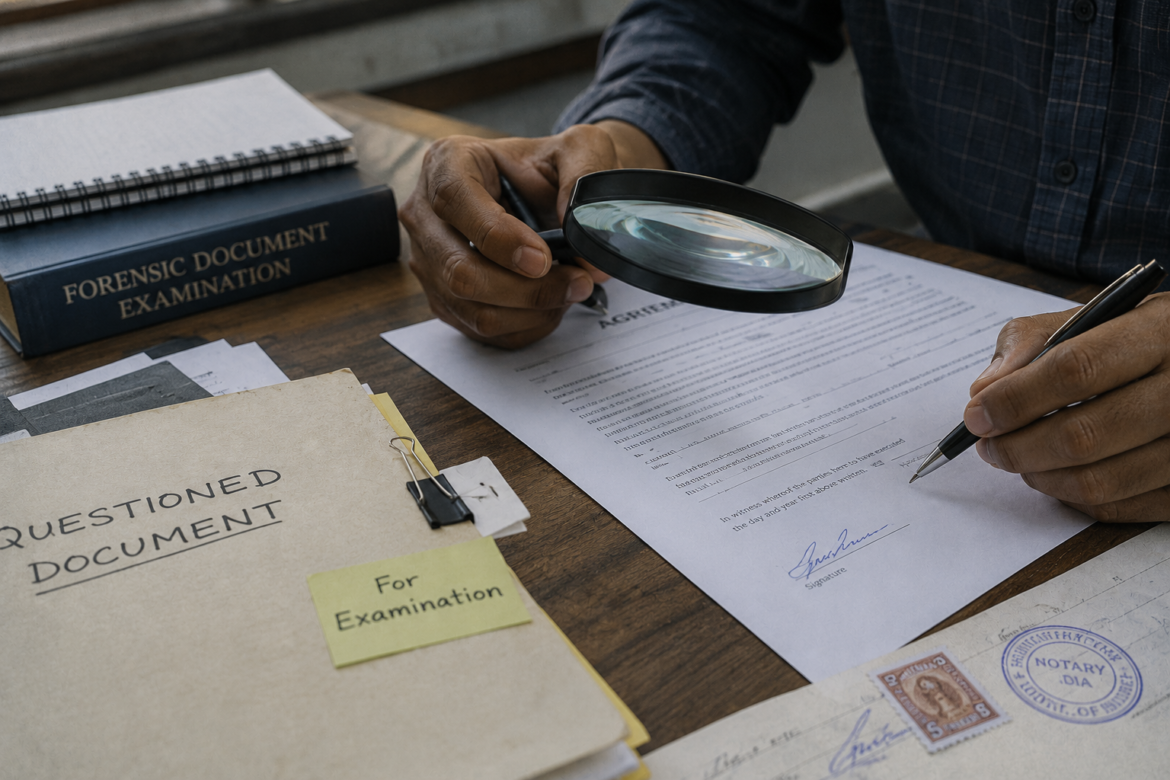
The Science Behind Signature Verification

Introduction Signatures have long been used as a symbol of identity, consent, and authorisation. From banking transactions and legal agreements to passports and business contracts, signatures continue to play a vital role in everyday life. However, with the increasing cases of forgery and document fraud, verifying the authenticity of signatures ...

todayMay 25, 2026

close

Blog Neerav Jindal

Photomicrography vs Microphotography: What’s the Difference?

In forensic science, precision documentation plays a critical role in evidence examination and courtroom presentation. Two terms often confused in imaging science are photomicrography and microphotography. Although they sound similar, they refer to entirely different processes. Understanding the distinction is essential, especially in questioned document examination, trace evidence analysis, and ...

todayMay 23, 2026

close

Blog vanshika

Common Mistakes That Destroy Crime Scene Evidence

Introduction Crime scene evidence plays a crucial role in modern criminal investigations. Every fingerprint, bloodstain, footprint, digital device, or handwritten note collected from a scene has the potential to uncover the truth and help investigators reconstruct events accurately. However, evidence is extremely fragile. A single mistake at the crime scene ...

todayMay 22, 2026

close

Blog Neerav Jindal

MBR vs GPT in Digital Forensics: Understanding Disk Partition Structures

In digital forensics, understanding disk partitioning schemes is essential for accurate evidence acquisition, analysis, and recovery. Two of the most common partitioning standards encountered during forensic investigations are MBR (Master Boot Record) and GPT (GUID Partition Table). Although both define how data is organized on storage devices, they differ significantly ...

todayMay 22, 2026

close

Blog vanshika

Digital Dust: The Silent Witness

Introduction Forensic science has traditionally been associated with fingerprints, bloodstains, firearms, and DNA evidence collected from physical crime scenes. However, in the modern digital era, investigators are increasingly encountering a new form of invisible evidence: “digital dust.” Every online action, electronic interaction, deleted file, location ping, and even metadata fragment ...

todayMay 19, 2026

close

Blog vanshika

Skyjacking: The Future of Drone Crime

Introduction Drones have rapidly evolved from simple recreational devices into powerful tools used in photography, agriculture, surveillance, military operations, logistics, and law enforcement. However, as drone technology grows more advanced, cybercriminals are also finding new ways to exploit its vulnerabilities. One of the most serious emerging threats is skyjacking—the unauthorised ...

todayMay 19, 2026

close

Digital Forensics + Blog + Mobile Forensic + Computer Forensics Neerav Jindal

Anti-Forensics Techniques Criminals Use

In today’s digital world, criminals are becoming increasingly sophisticated in hiding their tracks. As forensic experts develop advanced tools to recover and analyze evidence, offenders respond with anti-forensics techniques—methods specifically designed to obstruct digital investigations. Anti-forensics is the practice of manipulating, concealing, or destroying digital evidence to make forensic analysis ...

todayMay 16, 2026

close

Blog vanshika

How Fingerprints Solved a Real-Life Criminal Case

Introduction  Fingerprint evidence has always played a major role in criminal investigations for more than a century. Even with advanced techniques in DNA analysis, CCTV surveillance, and digital forensics, fingerprints remain one of the most reliable forms of identification. Every person has unique ridge patterns on their fingers, making fingerprints ...