Introduction
In today’s legal landscape, documents play a crucial role in proving facts, establishing ownership, validating agreements, and determining the authenticity of evidence. Whether it is a disputed signature on a property agreement, a forged cheque, an altered will, or a fabricated business contract, questioned documents can significantly influence the outcome of both civil and criminal proceedings. This is where forensic document examination becomes an essential part of the justice system.
A forensic document examiner uses scientific methods and specialized tools to determine the authenticity of documents, identify alterations, detect forgeries, and provide expert opinions that can withstand judicial scrutiny. Their findings often become vital evidence in courts, helping judges and investigators reach fair and informed decisions.
What is Forensic Document Examination?
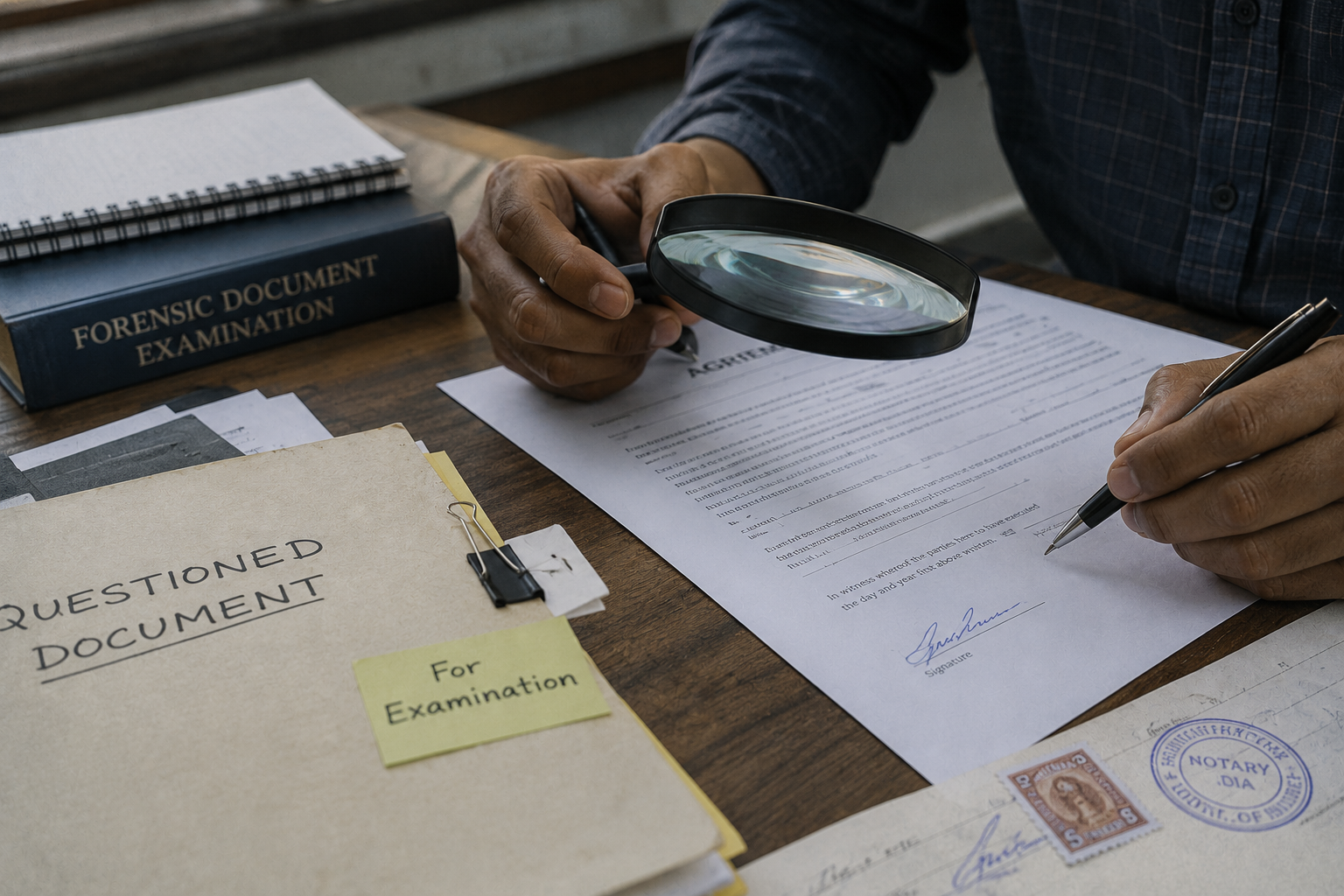
Forensic document examination is the scientific analysis of questioned documents to determine their authenticity, origin, and integrity. It involves examining handwritten documents, printed materials, signatures, stamps, inks, papers, and digital printouts to identify any signs of forgery or manipulation.
The objective is not merely to compare handwriting but to establish whether a document has been altered, fabricated, or fraudulently created. A forensic document examiner applies established scientific principles rather than assumptions, ensuring that every opinion is based on observable evidence.
Common Types of Documents Examined
Document examiners routinely analyze a wide range of documents involved in legal disputes, including:
- Property agreements
- Sale deeds
- Gift deeds
- Wills and testamentary documents
- Bank cheques
- Promissory notes
- Loan agreements
- Business contracts
- Power of Attorney documents
- Educational certificates
- Identity documents
- Passports
- Insurance claim documents
- Medical records
- Court affidavits
- Government records
- Employment documents
Each document is carefully examined to determine whether it is genuine or has been tampered with.
Role in Civil Cases
Civil disputes often revolve around ownership, contractual obligations, inheritance, or financial transactions. Authentic documents are essential for establishing legal rights, and any suspicion regarding their genuineness can delay or even change the outcome of a case.
Property Disputes
Property litigation frequently involves disputed sale deeds, gift deeds, partition agreements, or lease agreements. A forensic document examiner determines whether signatures, handwritten entries, or printed portions are genuine.
Will and Succession Cases
Disputes regarding wills are among the most common civil matters involving questioned documents. Examiners compare the testator’s handwriting and signatures with admitted specimens to determine authenticity.
They also examine:
- Ink consistency
- Paper age
- Sequence of writings
- Alterations
- Erasures
- Additional pages
Such examinations help establish whether the will was genuinely executed or fraudulently prepared.
Contract Disputes
Business contracts may contain disputed signatures, unauthorized modifications, or inserted clauses. Document examination helps identify whether changes were made before or after signing and whether all parties genuinely executed the agreement.
Banking and Financial Disputes
Banks and financial institutions frequently encounter disputes involving forged cheques, altered amounts, loan documents, or guarantee agreements.
Forensic examination can establish:
- Signature authenticity
- Ink alterations
- Overwriting
- Chemical erasures
- Additions to the original document
These findings assist courts in resolving financial disputes objectively.
Role in Criminal Cases
In criminal investigations, questioned documents often become critical evidence. Forged documents may be used to commit fraud, identity theft, financial crimes, or property offences.
Signature Forgery Cases
One of the most common criminal offences involving documents is signature forgery.
A forensic document examiner compares:
- Line quality
- Pen pressure
- Writing speed
- Letter formations
- Connecting strokes
- Natural variations
- Rhythm of writing
Scientific comparison helps distinguish genuine signatures from simulated, traced, disguised, or freehand forgeries.
Fraud Investigations
Corporate fraud, insurance fraud, banking fraud, and financial scams frequently involve fabricated documents.
Document examination helps identify:
- Fake invoices
- Altered receipts
- Forged contracts
- Fabricated certificates
- Counterfeit identity documents
This scientific evidence strengthens criminal investigations and supports prosecution.
Counterfeit Documents
Criminals often create counterfeit passports, educational certificates, licences, and government-issued documents.
Document examiners evaluate:
- Security features
- Printing methods
- Watermarks
- Fonts
- Microprinting
- Paper characteristics
- Stamp impressions
These examinations help determine whether a document is genuine or counterfeit.
Cheque Forgery Cases
Cheque fraud remains a common financial crime.
Examiners determine whether:
- The signature is genuine.
- The amount has been altered.
- The date has been changed.
- Chemical erasures are present.
- Different inks were used.
- Additional writing has been inserted.
Such findings are frequently presented before courts as expert evidence.
Scientific Techniques Used in Document Examination
Modern forensic laboratories employ advanced scientific techniques for document examination, including:
- Handwriting comparison
- Signature examination
- Video Spectral Comparator (VSC)
- Electrostatic Detection Apparatus (ESDA)
- Microscopic examination
- UV and Infrared light examination
- Ink analysis
- Paper analysis
- Digital image enhancement
- Indentation analysis
- Printer and toner examination
- Stamp and seal comparison
These methods allow experts to detect alterations that may not be visible to the naked eye.
Importance of Expert Opinion in Court
A forensic document examiner serves as an independent expert witness. Their responsibility is not to support either party but to present an unbiased scientific opinion based on evidence.
A comprehensive forensic report generally includes:
- Details of the documents examined
- Methodology used
- Scientific observations
- Comparison findings
- Photographic documentation
- Expert opinion
- Conclusion
The expert may also testify before the court, explaining technical findings in a manner understandable to judges and legal professionals.
Why Scientific Examination Matters
Relying solely on visual inspection can lead to incorrect conclusions. Forgers today use sophisticated printing technologies, high-quality scanners, image editing software, and advanced reproduction methods to create convincing fake documents.
Scientific forensic examination can reveal hidden evidence such as:
- Ink differences
- Altered entries
- Erased writing
- Indented impressions
- Sequence of intersecting strokes
- Non-original signatures
- Digital manipulation
- Printing inconsistencies
Such evidence is often impossible to detect without specialized forensic equipment.
Conclusion
Forensic document examination is a vital tool in both civil and criminal cases, helping uncover forgery, document alterations, and fraudulent practices through scientific analysis. By providing reliable expert opinions and evidence, document examiners support fair investigations and informed judicial decisions. As document fraud becomes increasingly sophisticated, professional forensic examination remains essential for ensuring authenticity, protecting legal rights, and upholding justice.


Post comments (0)