Introduction
In today’s digital and cashless economy, plastic money has become an essential part of everyday financial transactions. From purchasing groceries and shopping online to paying utility bills and booking travel tickets, plastic money offers convenience, speed, and security. As the use of physical currency gradually decreases in many sectors, plastic money continues to play a significant role in modern banking and commerce.
What is Plastic Money?
Plastic money refers to payment cards made primarily from plastic materials that are used as an alternative to cash. These cards are issued by banks and financial institutions and allow users to conduct transactions electronically.
The term “plastic money” commonly includes:
- Debit Cards
- Credit Cards
- Prepaid Cards
- Smart Cards
- ATM Cards
- Contactless Payment Cards
Unlike traditional paper currency, plastic money enables cashless transactions and provides users with a secure and efficient method of payment.
Evolution of Plastic Money
The concept of plastic money emerged in the mid-20th century with the introduction of charge cards and credit cards. Over time, advancements in technology transformed these simple payment cards into sophisticated financial tools equipped with multiple layers of security.
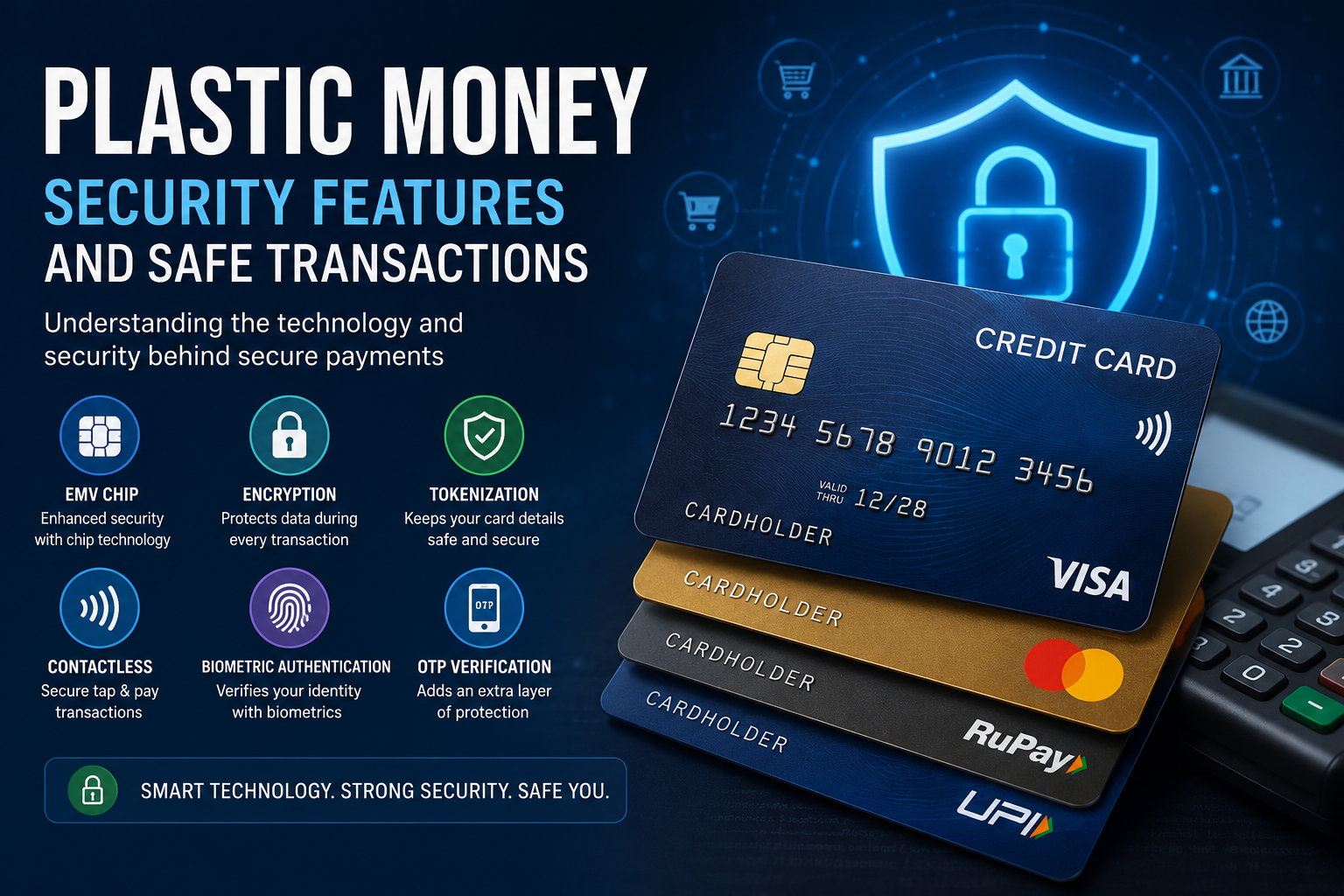
Today, modern payment cards incorporate advanced security technologies such as EMV chips, contactless payment systems, biometric authentication, and tokenization, making transactions safer than ever before.
Types of Plastic Money
Debit Cards
Debit cards are directly linked to a customer’s bank account. When a purchase is made, the amount is deducted immediately from the account balance.
Credit Cards
Credit cards allow users to borrow money up to a predetermined credit limit and repay the amount later, often with interest if not paid within the billing cycle.
Prepaid Cards
These cards are loaded with a specific amount of money in advance. Users can spend only the amount available on the card.
Smart Cards
Smart cards contain embedded microchips capable of storing and processing data securely, making them suitable for financial and identification purposes.
Contactless Cards
These cards use Near Field Communication (NFC) technology, allowing users to make payments by simply tapping the card on a compatible payment terminal.
Importance of Security in Plastic Money
As the use of plastic money has increased, so have attempts at financial fraud and cybercrime. Criminals continuously develop methods such as card cloning, skimming, phishing, and data theft to gain unauthorized access to card information.
To combat these threats, banks, card networks, and payment service providers have implemented numerous security features designed to protect cardholders and maintain trust in electronic payment systems.
Security Features of Plastic Money
EMV Chip Technology
One of the most important security features of modern payment cards is the EMV (Euro-pay, Mastercard, and Visa) chip.
Unlike traditional magnetic stripes, EMV chips generate a unique transaction code for every purchase. Even if transaction data is intercepted, it cannot be reused for fraudulent transactions.
Benefits:
- Prevents card cloning.
- Reduces counterfeit card fraud.
- Enhances transaction security
Magnetic Stripe
Although being gradually replaced by chip technology, many cards still contain a magnetic stripe on the back.
The stripe stores account information required for transaction processing. However, magnetic stripes are more vulnerable to skimming and duplication than chip-based systems.
Card Verification Value (CVV)
The Card Verification Value (CVV) is a three-digit or four-digit security code printed on the card.
This code is commonly required during online transactions to verify that the cardholder physically possesses the card.
Benefits:
- Helps prevent unauthorized online purchases.
- Adds an extra layer of authentication
Holograms
Most payment cards feature holographic images that are difficult to duplicate accurately.
These holograms display three-dimensional effects and change appearance when viewed from different angles.
Benefits:
- Helps identify genuine cards.
- Discourages counterfeiting
Signature Panel
A designated signature strip on the back of the card allows the cardholder to sign the card upon receipt.
Merchants can compare the signature on the receipt with the signature on the card for identity verification.
Contactless Security Features
Contactless cards use encrypted communication through NFC technology.
Each contactless transaction generates dynamic cryptographic data that makes it difficult for criminals to intercept and reuse transaction information.
PIN Authentication
Many debit and credit card transactions require a Personal Identification Number (PIN).
Only the legitimate cardholder should know the PIN, making unauthorized use of a stolen card significantly more difficult.
Benefits:
- Strong user authentication.
- Protection against unauthorized transactions
Biometric Authentication
Some modern payment cards and banking applications support biometric verification methods such as:
- Fingerprint recognition
- Facial recognition
- Iris scanning
Biometric authentication provides a highly secure method of verifying the cardholder’s identity.
One-Time Password (OTP)
For many online transactions, banks send a One-Time Password (OTP) to the registered mobile number or email address.
The transaction can only be completed after entering the correct OTP.
Benefits:
- Two-factor authentication.
- Protection against unauthorized online usage
Common Threats to Plastic Money
Despite advanced security measures, cardholders should remain vigilant against:
- Card skimming
- Phishing attacks
- Data breaches
- Card theft
- Fake payment websites
- Social engineering scams
Understanding these threats helps users adopt safer financial practices.
Tips for Safe Use of Plastic Money
To maximize security, cardholders should:
- Never share PINs, CVVs, or OTPs.
- Use trusted websites for online shopping.
- Enable transaction alerts.
- Regularly monitor account statements.
- Report lost or stolen cards immediately.
- Avoid using public Wi-Fi for financial transactions.
- Keep contact information updated with the bank
Conclusion
Plastic money has transformed the way people make payments by offering convenience, speed, and security. With advanced features such as EMV chips, CVV codes, encryption, and biometric authentication, it provides a safer alternative to traditional cash transactions. As digital payment technologies continue to evolve, plastic money will remain a key component of the modern financial system, enabling secure and efficient cashless transactions.


Post comments (0)