A document may look clean, altered, or partially erased to the naked eye, but that does not necessarily mean the original information is gone. In forensic document examination, even an apparently blank or modified area can contain valuable clues about what was written or printed there before. This is why erased documents can become important pieces of evidence in criminal investigations, fraud cases, financial disputes, and other legal matters.
But how can forensic experts recover information that someone tried to remove? The answer lies in the science of questioned document examination.
What Happens When a Document Is Erased?
Erasing a document does more than simply remove visible writing. When someone uses an eraser, abrasion, scraping, chemical treatment, or another method to eliminate information, the physical characteristics of the paper can change.
For example, an ordinary rubber eraser may remove some of the ink or graphite from the surface. However, the friction can disturb or damage the paper fibres. It may also leave differences in surface texture, thickness, or reflectivity.
Similarly, scraping or cutting away writing can create microscopic changes that may remain visible under specialized examination.
In some cases, the person attempting to erase information may remove the visible evidence but unintentionally leave behind traces that reveal that an alteration occurred.
Why Erased Documents Matter in Forensic Investigations
Erased or altered documents can appear in many types of cases. These may include forged contracts, altered financial records, fraudulent receipts, manipulated certificates, disputed signatures, altered dates, and suspicious handwritten notes.
Imagine a signed agreement in which a numerical amount has been erased and replaced with another figure. To a casual observer, the document might appear legitimate. A forensic document examiner, however, may examine the paper, writing sequence, ink characteristics, and disturbed areas to determine whether the document has been altered.
The objective is not simply to “read the erased text.” The examiner attempts to determine what happened to the document and whether the questioned area contains information that can be scientifically interpreted.
Techniques Used to Examine Erased Documents
Forensic document examination involves several techniques. The method selected depends on the document, the type of alteration, and the condition of the evidence.
Visual Examination
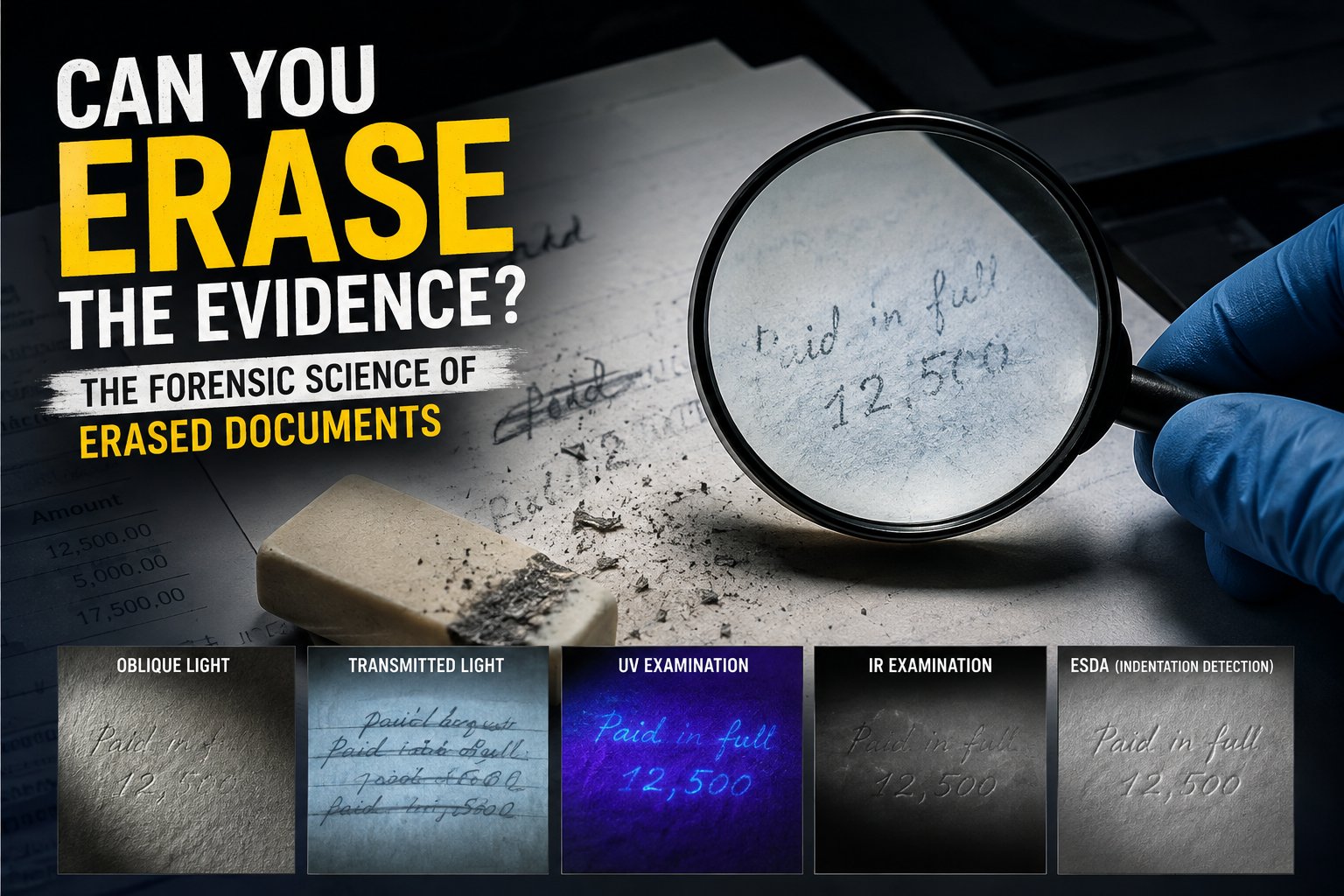
The first step is often careful visual examination under suitable lighting. Experts may look for differences in paper texture, disturbed fibres, irregular writing, discoloration, indentation, or changes in the appearance of the questioned area.
Magnification can reveal details that are difficult to see with the unaided eye.
Oblique Lighting
Oblique or side lighting involves illuminating the document from a low angle. This can help reveal surface disturbances.
If an area has been rubbed, scraped, embossed, or otherwise physically altered, changes in the paper surface may become more noticeable when light strikes it from an angle.
This technique can be particularly useful for detecting physical alterations that are difficult to see under normal lighting.
Transmitted Light
In transmitted-light examination, light is placed behind the document so that it passes through the paper.
Variations in thickness, density, or damage may become visible. An erased portion can sometimes appear different from the surrounding paper because the fibres have been disturbed or the paper has been thinned.
This technique can provide useful information without requiring the document to be physically altered further.
Ultraviolet and Infrared Examination
Different inks, papers, and substances may react differently to ultraviolet (UV) or infrared (IR) radiation.
Under specialized forensic illumination, writing that appears similar under ordinary light may behave differently. Some alterations may become more apparent because the original and added materials have different optical properties.
Infrared examination can sometimes help differentiate writing materials or reveal information obscured by other markings. However, it is important to understand that no single wavelength or technique can recover every erased document.
Electrostatic Detection of Indentations
Sometimes the visible writing is gone, but the pressure used during writing has left indentations in the paper.
Electrostatic detection techniques, commonly associated with an electrostatic detection apparatus (ESDA), can help visualize indented writing on paper.
This can be extremely valuable when someone writes on one sheet while another sheet is underneath. Even if the original writing is later removed from the top page, impressions may remain on subsequent pages.
The recovered impressions can potentially provide information about words, numbers, or other markings.
Ink and Document Analysis
Forensic examiners may also compare the questioned ink with other writing on the document. Differences in ink composition or optical behavior can help establish whether different writing materials were used.
In appropriate laboratory settings, advanced analytical techniques may also be used to examine inks and other document materials.
The purpose is not necessarily to identify a specific pen, but to determine whether different inks or writing processes are consistent with the document’s history.
Can Every Erased Document Be Recovered?
No. This is one of the most important facts about forensic document examination.
There is no universal technique that can restore every erased word or number. The success of an examination depends on several factors, including the type of erasure, the material used, the amount of information removed, the condition of the paper, and whether the original writing left detectable traces.
For example, heavy physical abrasion may destroy both the writing and the paper surface. Chemical treatment may also damage the document or alter the original materials.
Therefore, forensic examiners must avoid making assumptions about what the document originally contained. Their conclusions must be based on observable and scientifically supportable evidence.
Why Preservation of the Original Document Is Critical
One of the biggest mistakes in a document-related investigation is unnecessarily handling, cleaning, folding, writing on, or attempting to restore the evidence.
An original document can contain information that is not visible during routine inspection. Improper handling can destroy fingerprints, trace materials, indentation evidence, or other important features.
For this reason, questioned documents should be preserved carefully and submitted for examination in their original condition whenever possible.
Photocopies and scanned images can be useful for preliminary assessment, but they may not contain all the physical information available from the original document.
The Science Behind “Invisible” Evidence
The forensic examination of erased documents demonstrates an important principle of forensic science: evidence does not always disappear simply because it becomes invisible.
Paper records physical changes. Writing leaves pressure marks. Erasing can disturb fibres. Different inks can react differently to light. Alterations can create inconsistencies that remain detectable through careful examination.
A document therefore has a history, and forensic examination attempts to reconstruct that history scientifically.
Conclusion
Can you erase the evidence? Sometimes you can remove what is visible, but completely eliminating every trace is much more difficult.
Forensic document examination combines observation, specialized lighting, magnification, indentation analysis, and other scientific methods to investigate documents that may have been erased or altered. These techniques can help investigators determine whether a document has been manipulated and, in suitable cases, recover information that would otherwise remain hidden.
The key lesson is simple: an erased document is not necessarily an empty document.
What appears to be a blank space may still contain physical, chemical, or optical clues. In forensic science, even the smallest disturbance can become an important piece of the story.


Post comments (0)