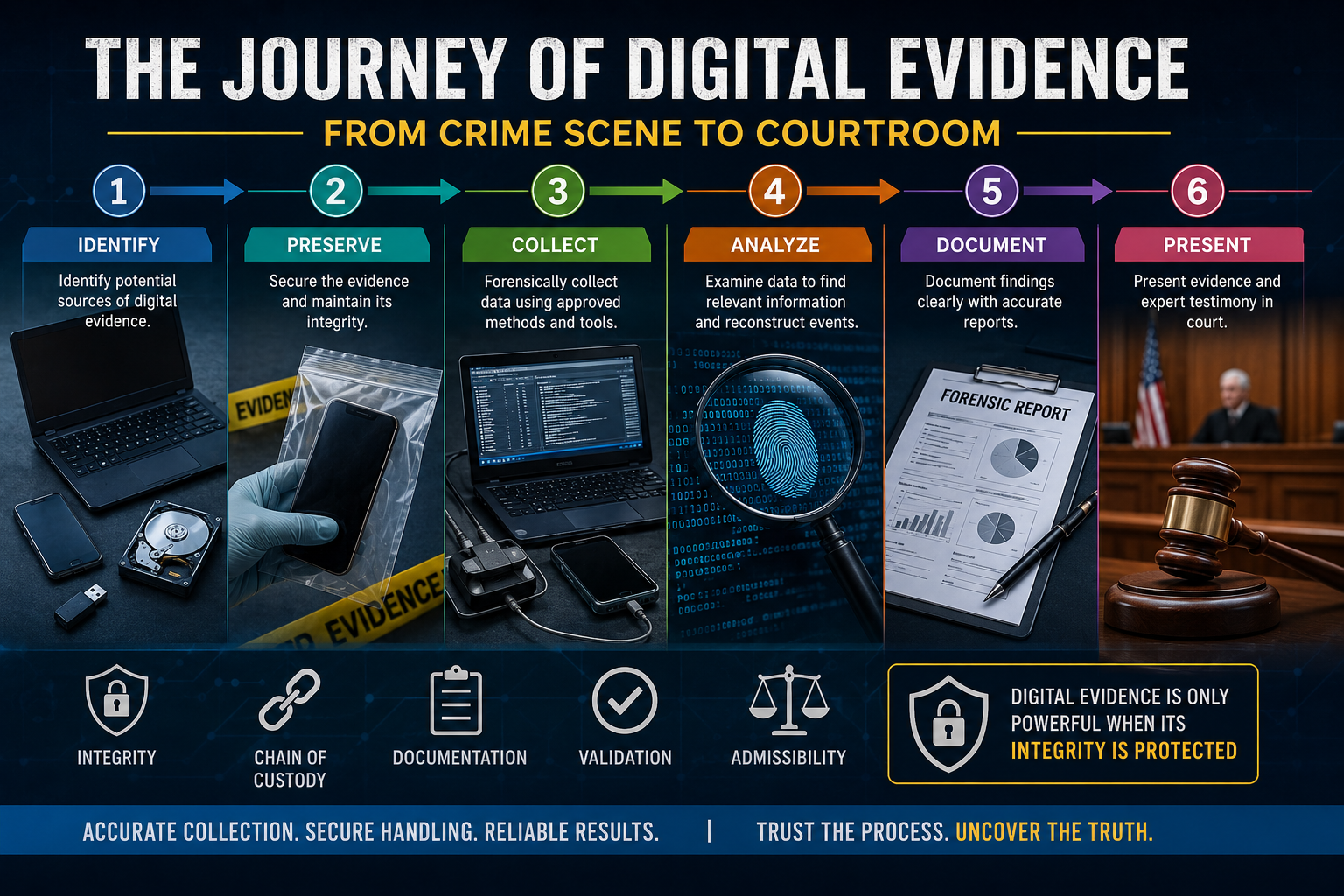
Every cybercrime investigation begins with a single piece of digital evidence. It may be a smartphone recovered from a suspect, a laptop found at a crime scene, a surveillance video, or an email linked to fraudulent activity. However, collecting digital evidence is only the beginning. To ensure that the evidence is reliable and legally admissible, it must follow a carefully documented process from the crime scene to the courtroom.
The journey of digital evidence involves identifying, preserving, collecting, analyzing, documenting, and presenting electronic evidence while maintaining its integrity. Even a small mistake during any stage can compromise the investigation or make the evidence inadmissible in court.
This article explores each stage of the digital evidence lifecycle and explains how digital forensic experts ensure that electronic evidence remains accurate, authentic, and legally defensible.
What Is Digital Evidence?
Digital evidence is any information stored or transmitted in digital form that can support an investigation or legal proceeding.
Examples include:
- Mobile phones
- Computers and laptops
- CCTV footage
- Emails
- WhatsApp chats
- Social media messages
- GPS data
- USB drives
- Hard disks and SSDs
- Cloud storage
- Smartwatches
- IoT devices
Unlike traditional evidence, digital evidence can be easily modified or deleted. Therefore, investigators must handle it with extreme care.
Stage 1: Identifying Digital Evidence
Every investigation starts by locating potential sources of digital evidence.
Investigators identify devices such as:
- Smartphones
- Computers
- External storage devices
- CCTV systems
- Routers
- Cloud accounts
- Smart devices
Additionally, they determine whether the evidence is volatile, encrypted, or remotely accessible.
Proper identification ensures that no valuable evidence is overlooked.
Stage 2: Securing the Crime Scene
Before collecting any device, investigators secure the crime scene to prevent unauthorized access or accidental alteration of evidence.
During this stage, they:
- Restrict access to the area.
- Photograph devices in their original position.
- Record device conditions.
- Note running systems.
- Document connected peripherals.
This documentation preserves the context of the evidence.
Stage 3: Preserving Digital Evidence
Preservation is one of the most critical stages of the investigation.
Digital forensic experts ensure that the original evidence remains unchanged by:
- Isolating devices from networks.
- Using write blockers when appropriate.
- Preventing remote access.
- Maintaining chain of custody.
- Storing evidence securely.
Furthermore, investigators avoid directly examining original devices whenever possible.
Stage 4: Collecting Digital Evidence
Once the evidence is secured, forensic experts collect it using scientifically accepted methods.
Collection may involve:
- Forensic imaging of storage devices
- Mobile device acquisition
- Memory (RAM) capture
- Cloud data acquisition
- Email preservation
- CCTV video extraction
- Network log collection
The objective is to create an exact forensic copy while preserving the original evidence.
Stage 5: Maintaining Chain of Custody
The chain of custody documents every person who handles the evidence from collection to presentation in court.
The record typically includes:
- Evidence identification number
- Date and time of collection
- Collector’s name
- Transfer details
- Storage location
- Examination records
Maintaining a complete chain of custody helps demonstrate that the evidence has not been altered or tampered with.
Stage 6: Digital Forensic Analysis
After acquisition, investigators begin analyzing the forensic copies.
Depending on the case, they may examine:
- Deleted files
- Internet browsing history
- Emails
- Call logs
- WhatsApp chats
- GPS locations
- Documents
- Images and videos
- System logs
- USB activity
- Application databases
By correlating these artifacts, investigators reconstruct the sequence of events.
Stage 7: Timeline Reconstruction
Digital evidence often comes from multiple devices and platforms.
Investigators create a timeline showing:
- User activities
- File creation and deletion
- Login history
- Device connections
- Communication records
- Network activity
This timeline helps explain exactly what happened and when.
Stage 8: Preparing the Forensic Report
Once the analysis is complete, forensic experts prepare a comprehensive report.
The report typically includes:
- Case details
- Evidence examined
- Investigation methodology
- Tools used
- Findings
- Timeline of events
- Screenshots and supporting evidence
- Conclusions
The report must be clear, objective, and technically accurate.
Stage 9: Presenting Evidence in Court
The final stage is presenting the findings before a court or legal authority.
The forensic expert may explain:
- How evidence was collected
- How integrity was maintained
- Which forensic methods were used
- What conclusions were reached
- Whether the findings support the investigation
The expert’s role is to explain the technical evidence in a clear and understandable manner.
Challenges in Handling Digital Evidence
Investigators frequently encounter challenges such as:
- Encrypted devices
- Cloud-based storage
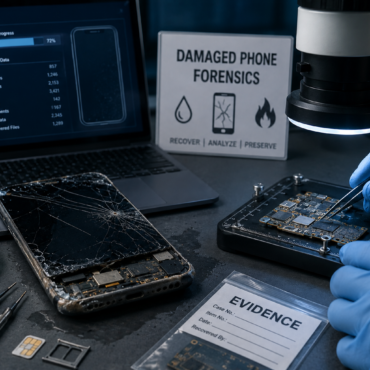
- Damaged devices
- Anti-forensic techniques
- Deleted data
- Large volumes of evidence
- Multiple jurisdictions
Despite these challenges, modern forensic tools and established methodologies help investigators recover and analyze digital evidence effectively.
Best Practices for Digital Evidence Handling
To maintain the integrity of digital evidence, investigators should:
- Preserve original evidence.
- Create forensic copies before analysis.
- Maintain chain of custody documentation.
- Use validated forensic tools.
- Record every investigative action.
- Secure evidence storage.
- Follow internationally accepted forensic procedures.
Following these practices ensures that digital evidence remains reliable and legally defensible.
The Future of Digital Evidence
As technology evolves, the sources of digital evidence continue to expand.
Emerging areas include:
- Artificial Intelligence investigations
- Cloud Forensics
- IoT Forensics
- Vehicle Forensics
- Smartwatch Forensics
- Drone Forensics
- Blockchain investigations
Consequently, digital forensic professionals must continuously adapt to new technologies and investigative techniques.
Conclusion
The journey of digital evidence from the crime scene to the courtroom is a structured and carefully controlled process. Every stage—from identifying and preserving evidence to forensic analysis and courtroom presentation—plays a vital role in ensuring that digital evidence remains authentic, reliable, and legally admissible.
As cybercrime becomes increasingly sophisticated, digital forensics continues to serve as a cornerstone of modern investigations. By following internationally accepted forensic procedures, investigators can uncover the truth while protecting the integrity of electronic evidence.



Post comments (0)