Introduction:
Ultraviolet (UV) light has become an indispensable tool in modern forensic science. It enables investigators to detect and document evidence that may be invisible under normal lighting conditions. From locating biological stains to identifying altered documents and trace evidence, UV lights provide a fast, non-destructive, and highly effective method of crime scene examination.
Understanding the different types of UV lights and their forensic applications helps investigators choose the right equipment for accurate evidence detection.
What is Ultraviolet (UV) Light?
Ultraviolet (UV) light is electromagnetic radiation with wavelengths shorter than visible light but longer than X-rays.
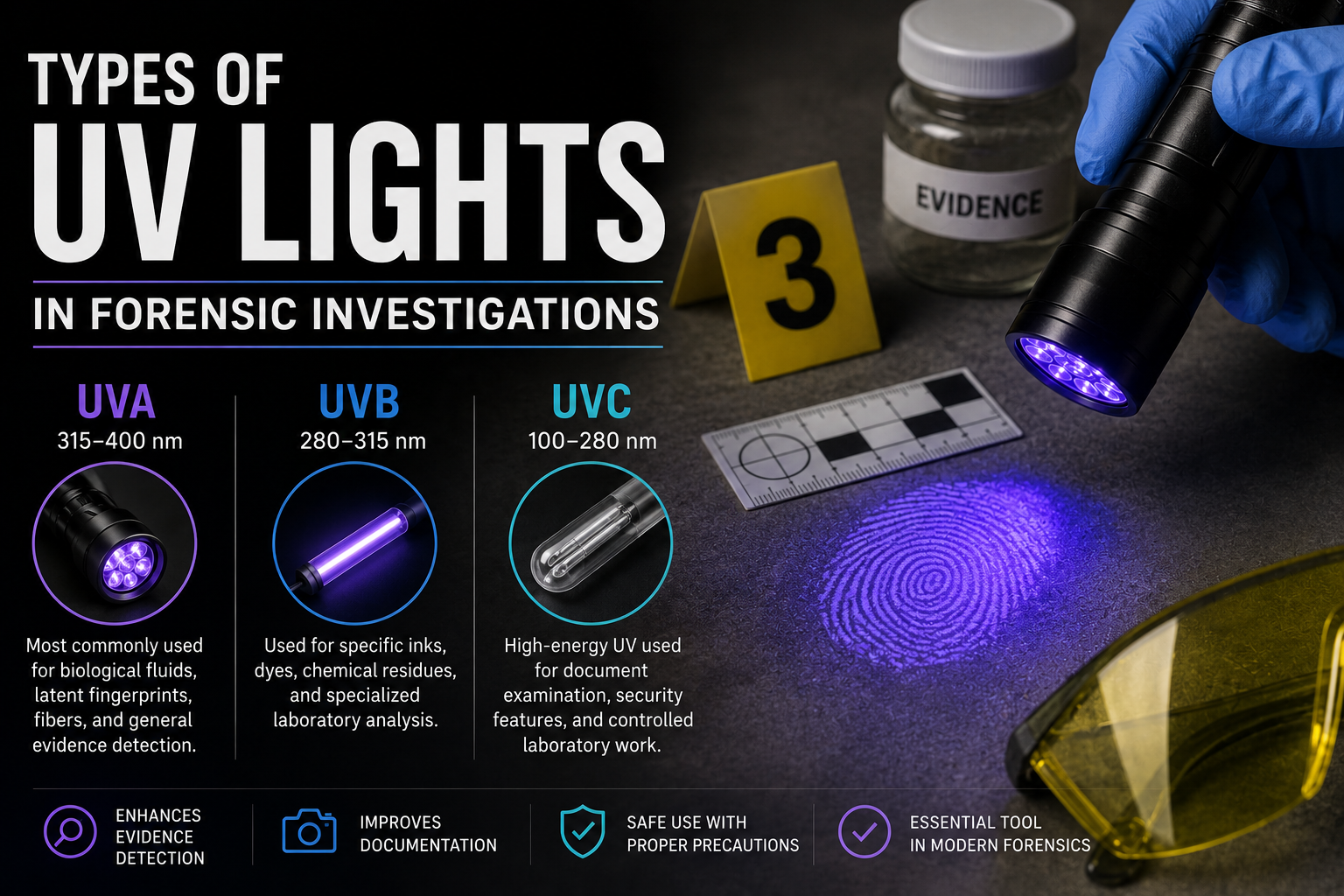
The UV spectrum is divided into three primary categories:
- UVA (315–400 nm) – Long-wave ultraviolet
- UVB (280–315 nm) – Medium-wave ultraviolet
- UVC (100–280 nm) – Short-wave ultraviolet
Among these, UVA is the most widely used in forensic investigations due to its safety and ability to induce fluorescence in various types of evidence.
Long-Wave UV Light (UVA):-
Wavelength:
315–400 nm (Most commonly 365 nm or 395 nm)
Features:
- Safest UV range for forensic examinations.
- Produces fluorescence in many biological and chemical materials.
- Available as handheld flashlights, inspection lamps, and forensic light sources.
Forensic Applications:
- Detection of semen, saliva, and urine stains.
- Examination of latent fingerprints after fluorescent powder processing.
- Detection of fibers and textile evidence.
- Identification of fluorescent inks and security markings.
- Preliminary document examination.
- Crime scene searches in dark environments.
Advantages:
- Safe for routine use with protective eyewear.
- Portable and easy to operate.
- Cost-effective.
- Minimal damage to evidence.
Medium-Wave UV Light (UVB):-
Wavelength:
280–315 nm
Features:
- More energetic than UVA.
- Less commonly used in routine forensic work.
- Requires additional safety precautions.
Forensic Applications:
- Examination of certain inks and dyes.
- Detection of specific chemical residues.
- Specialized laboratory analysis.
- Some counterfeit currency examinations.
Advantages:
- Higher fluorescence for selected materials.
- Useful for specialized forensic laboratories.
Limitations:
- Greater risk of skin and eye exposure.
- Not suitable for prolonged field use.
Short-Wave UV Light (UVC):-
Wavelength:
100–280 nm (Common forensic lamps operate around 254 nm)
Features:
- Highest energy UV radiation.
- Strong germicidal properties.
- Primarily used in laboratory environments.
Forensic Applications:
- Examination of altered or erased documents.
- Detection of security features.
- Specialized trace evidence analysis.
- Laboratory research.
- Controlled document authentication.
Advantages:
- Excellent for certain document examinations.
- Reveals features not visible under longer wavelengths.
Limitations:
- Hazardous to skin and eyes.
- Requires protective equipment.
- Limited field applications.
Common UV Light Sources Used in Forensics
Handheld UV Flashlights:
Portable and battery-operated, these are ideal for quick crime scene searches and evidence screening.
Best for:
- Biological fluids
- Trace evidence
- General crime scene inspection
UV Inspection Lamps:
These provide broader illumination and are commonly used in laboratories for examining larger surfaces or documents.
Best for:
- Document examination
- Laboratory inspections
- Evidence screening
Alternate Light Sources (ALS):
Modern forensic ALS systems combine UV, visible, and near-infrared wavelengths in a single device with interchangeable filters.
Applications:
- Latent fingerprints
- Biological fluids
- Fibers
- Gunshot residue
- Bruise detection
- Trace evidence
- Document analysis
ALS systems are considered one of the most versatile forensic light sources available today.
UV LED Lights:
LED technology has largely replaced traditional mercury lamps due to several advantages:
- Longer lifespan
- Lower power consumption
- Instant operation
- Lightweight design
- Better portability
- Minimal heat generation
UV LED lights are now commonly found in handheld forensic flashlights and professional crime scene lighting systems.
Choosing the Right UV Light:-
| Application |
Recommended UV Type |
| Biological fluids |
UVA (365 nm) |
| Latent fingerprints |
UVA + Fluorescent powders |
| Trace fibers |
UVA |
| Security markings |
UVA or UVC |
| Document examination |
UVC or ALS |
| Counterfeit currency |
UVA/UVB |
| Crime scene searches |
UVA |
| Laboratory research |
UVB/UVC |
Safety Guidelines:-
While UV light is extremely useful, investigators should always follow proper safety procedures:
- Wear UV-blocking protective glasses.
- Avoid direct exposure to skin.
- Never look directly into the UV beam.
- Use gloves when handling evidence.
- Operate high-intensity UV lights only in controlled environments.
- Follow manufacturer safety recommendations.
Future of UV Technology in Forensics:-
Advancements in UV LED technology, multispectral imaging, and portable forensic light systems are improving evidence detection while making equipment lighter, more powerful, and easier to use.
Combined with digital imaging and AI-assisted analysis, UV-based examination continues to enhance the speed and accuracy of forensic investigations.
Conclusion:-
UV lights are among the most valuable non-destructive tools in forensic science. Whether searching for biological evidence at a crime scene, examining questioned documents, or locating trace materials, selecting the appropriate UV wavelength is essential for effective evidence detection. While UVA remains the primary choice for field investigations due to its versatility and safety, UVB and UVC play important roles in specialized laboratory examinations.
By understanding the characteristics and applications of each UV type, forensic professionals can improve evidence recovery, documentation, and ultimately contribute to more accurate criminal investigations.


Post comments (0)