Wireless networks have become an essential part of modern life, connecting laptops, smartphones, IoT devices, and enterprise systems. However, wireless communication travels through the air, making it vulnerable to unauthorized access and interception. To address these risks, several Wi-Fi security standards have been developed over the years, including WEP (Wired Equivalent Privacy), WPA (Wi-Fi Protected Access), and WPA2 (Wi-Fi Protected Access II).
Understanding these security protocols is important for network administrators, cybersecurity professionals, and digital forensic investigators, as each standard leaves unique artifacts and presents different security implications.
Why Wi-Fi Security Matters
Without proper encryption and authentication mechanisms, attackers can:
- Intercept network traffic
- Steal sensitive information
- Gain unauthorized network access
- Launch man-in-the-middle attacks
- Capture credentials and session data
- Exploit vulnerable devices connected to the network
Wi-Fi security protocols are designed to ensure:
- Confidentiality – Protecting data from unauthorized viewing
- Integrity – Preventing unauthorized modification of data
- Authentication – Verifying the identity of users and devices
WEP (Wired Equivalent Privacy)
Introduction
WEP was introduced in 1997 as part of the original IEEE 802.11 wireless networking standard. Its objective was to provide a level of security comparable to wired networks.
How WEP Works
WEP uses:
- RC4 stream cipher for encryption
- 40-bit or 104-bit secret key
- 24-bit Initialization Vector (IV)
The encryption key and IV are combined to generate the encryption stream used to protect transmitted data.
Advantages of WEP
- Simple implementation
- Low computational requirements
- Supported by older hardware
Security Weaknesses
Despite its early adoption, WEP contains serious vulnerabilities:
Weak Initialization Vectors
The 24-bit IV space is too small, causing frequent reuse of encryption values.
RC4 Key Vulnerabilities
Attackers can analyze repeated IV patterns to recover encryption keys.
Easy Key Cracking
Modern tools can crack WEP-protected networks within minutes by capturing enough wireless packets.
No Effective Integrity Protection
WEP’s integrity mechanism can be manipulated, allowing packet modification attacks.
Current Status
WEP is considered obsolete and insecure. Organizations should avoid using WEP under any circumstances.
WPA (Wi-Fi Protected Access)
Introduction
WPA was introduced in 2003 as an interim security solution while a stronger standard was being developed.
It was designed to address the weaknesses found in WEP without requiring significant hardware upgrades.
How WPA Works
WPA introduced several improvements:
- Temporal Key Integrity Protocol (TKIP)
- Dynamic key generation
- Message Integrity Check (MIC)
- Improved authentication mechanisms
Instead of using static encryption keys, WPA generates new keys during communication sessions.
Key Features
TKIP Encryption
TKIP changes encryption keys dynamically, reducing risks associated with key reuse.
Enhanced Integrity Checking
MIC helps detect unauthorized packet modifications.
Better Authentication
Supports both:
- WPA-Personal (Pre-Shared Key)
- WPA-Enterprise (RADIUS authentication)
Security Limitations
Although WPA significantly improved security over WEP, it still has weaknesses:
- TKIP relies on RC4 encryption
- Vulnerable to dictionary attacks against weak passwords
- No longer considered secure for modern environments
Current Status
Most security experts recommend replacing WPA with WPA2 or newer protocols.
WPA2 (Wi-Fi Protected Access II)
Introduction
WPA2 became mandatory for Wi-Fi certification in 2006 and remains one of the most widely deployed wireless security standards.
It was developed to provide stronger encryption and authentication mechanisms than WPA.
How WPA2 Works
WPA2 replaces TKIP with:
AES Encryption
Advanced Encryption Standard (AES) provides significantly stronger protection than RC4.
CCMP Protocol
Counter Mode Cipher Block Chaining Message Authentication Code Protocol (CCMP) ensures:
- Data confidentiality
- Data integrity
- Authentication
Key Features of WPA2
Strong Encryption
AES-128 encryption is highly resistant to cryptographic attacks.
Enterprise Authentication
Supports:
- RADIUS servers
- 802.1X authentication
- Certificate-based access control
Improved Data Integrity
CCMP provides robust protection against packet tampering.
Better Key Management
Dynamic session keys reduce exposure to long-term key compromise.
WPA2 Security Considerations
Although WPA2 remains highly secure, some attacks are still possible.
Weak Password Attacks
Attackers can perform brute-force or dictionary attacks against weak Wi-Fi passwords.
Example Weak Passwords:
- password123
- admin123
- qwerty123
Strong passwords significantly reduce this risk.
KRACK Attack
The Key Reinstallation Attack (KRACK) discovered in 2017 targeted weaknesses in the WPA2 handshake process.
However, software updates and patches have largely mitigated this vulnerability.
Rogue Access Points
Attackers may create fake Wi-Fi networks that imitate legitimate networks to steal credentials.
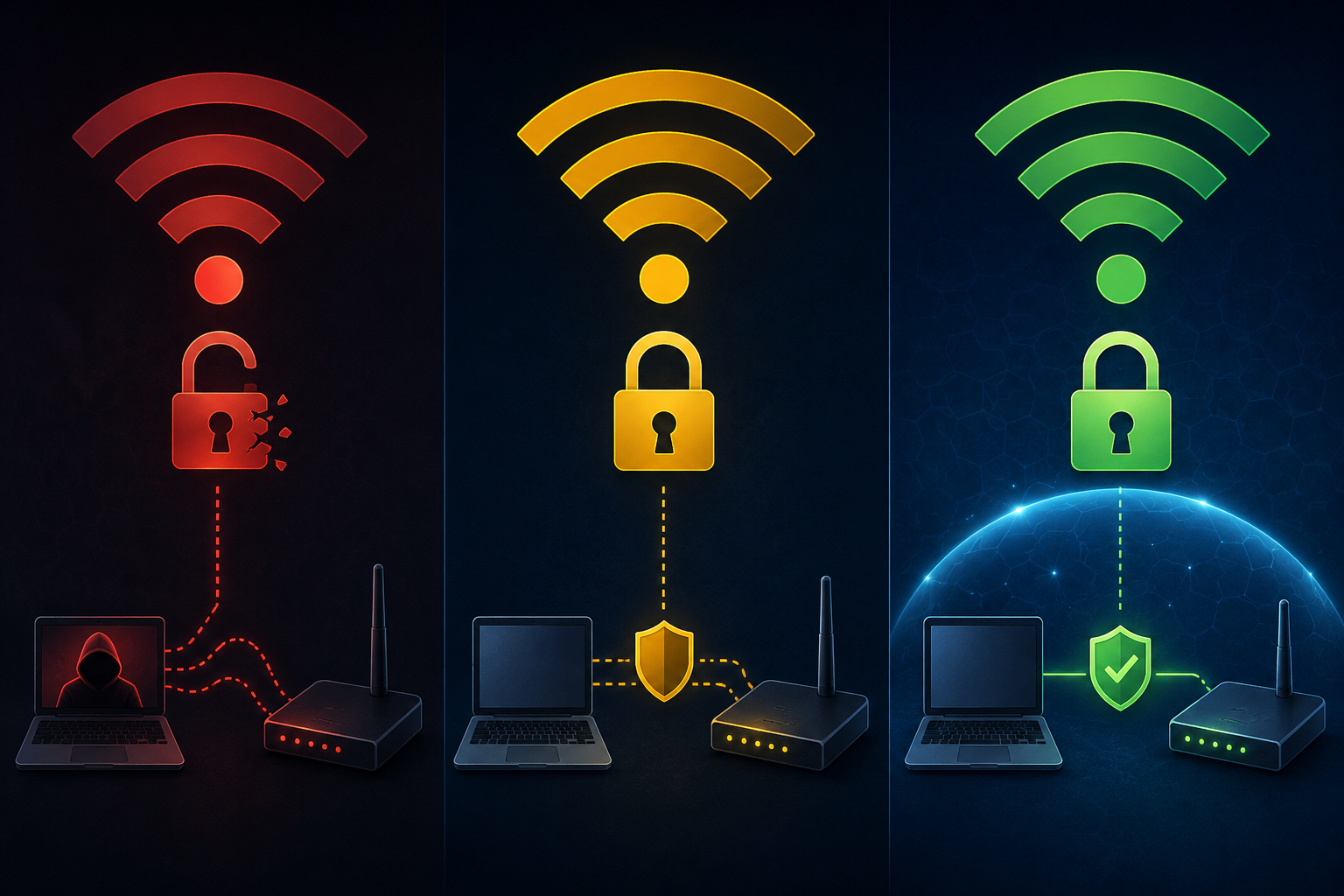
Comparison of WEP, WPA, and WPA2
| Feature |
WEP |
WPA |
WPA2 |
| Introduced |
1997 |
2003 |
2004/2006 |
| Encryption |
RC4 |
TKIP (RC4) |
AES |
| Key Management |
Static |
Dynamic |
Advanced Dynamic |
| Integrity Protection |
Weak |
Improved |
Strong |
| Authentication |
Basic |
Enhanced |
Advanced |
| Security Level |
Poor |
Moderate |
High |
| Recommended Today |
No |
No |
Yes |
Digital Forensics Perspective
Wireless network security plays an important role in digital forensic investigations.
Investigators may encounter:
- Stored Wi-Fi profiles
- Saved SSIDs
- Network authentication records
- Wireless adapter logs
- Router configuration files
- DHCP lease information
- Connection timestamps
These artifacts can help establish:
- Device presence at a location
- User activity timelines
- Network access history
- Potential unauthorized access events
When investigating wireless incidents, understanding whether a network used WEP, WPA, or WPA2 can influence the analysis of captured traffic and attack feasibility.
Best Practices for Wi-Fi Security
To maintain a secure wireless environment:
Use WPA2 or WPA3
Avoid WEP and WPA entirely.
Create Strong Passwords
Use long passphrases containing:
- Uppercase letters
- Lowercase letters
- Numbers
- Special characters
Update Router Firmware
Install security updates regularly.
Disable WPS
Wi-Fi Protected Setup can introduce additional attack vectors.
Monitor Connected Devices
Regularly review devices connected to the network.
Use Enterprise Authentication
Organizations should implement WPA2-Enterprise with RADIUS authentication.
Conclusion
The evolution from WEP to WPA and ultimately WPA2 represents a significant advancement in wireless network security. WEP’s vulnerabilities made it unsuitable for protecting modern networks, while WPA served as a temporary improvement. WPA2 introduced strong AES-based encryption and robust authentication mechanisms that continue to provide effective protection for millions of wireless networks worldwide.
For cybersecurity professionals and digital forensic investigators, understanding these protocols is essential when assessing network security, investigating wireless incidents, and analyzing evidence related to network access. While newer standards such as WPA3 are becoming increasingly common, WPA2 remains a reliable and widely trusted security solution when properly configured.



Post comments (0)