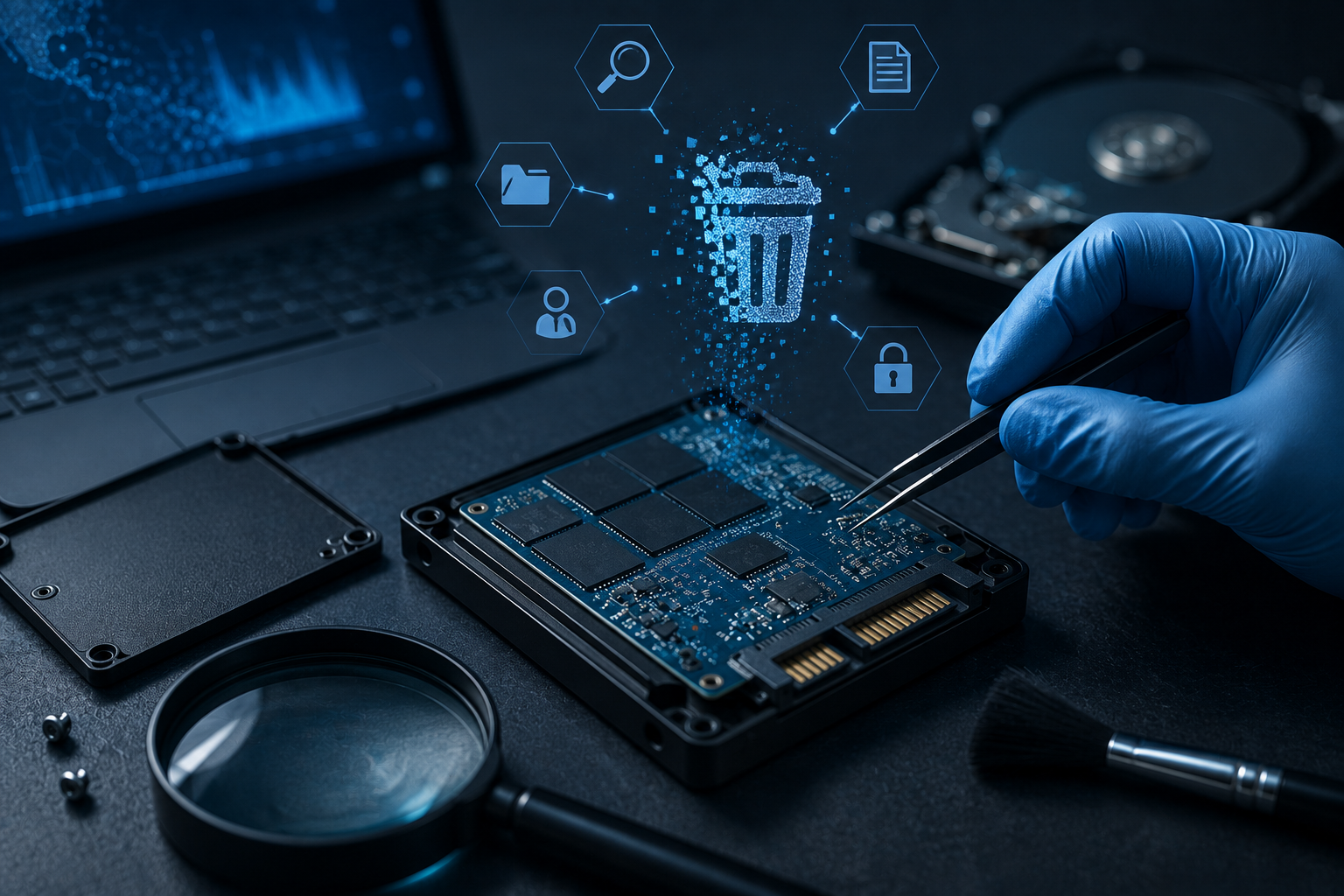
Have you ever wondered why recovering deleted files from modern devices has become increasingly difficult? The answer often lies in the type of storage technology being used. Today, most laptops, desktops, and smartphones rely on Solid-State Drives (SSDs) because they offer faster performance, improved reliability, and lower power consumption. However, these advantages also introduce new challenges for digital forensic investigations.
SSD Forensics has become one of the most important areas of modern digital forensics. Unlike traditional hard disk drives (HDDs), SSDs use advanced technologies that can automatically remove deleted data, making forensic recovery significantly more challenging. As a result, investigators must adopt specialized techniques to preserve and analyze digital evidence stored on SSDs.
In this article, we explore how SSD Forensics works, why deleted data recovery is becoming more difficult, and the challenges investigators face during forensic examinations.
What Is SSD Forensics?
SSD Forensics is the process of identifying, preserving, collecting, and analyzing digital evidence stored on Solid-State Drives. Digital forensic experts examine SSDs during cybercrime investigations, corporate disputes, financial fraud cases, and criminal investigations.
Modern SSDs are widely used in:
- Desktop computers
- Laptops
- Smartphones
- Gaming devices
- Enterprise servers
- Cloud infrastructures
- External storage devices
Because SSDs manage data differently from traditional storage devices, investigators must understand how these technologies affect digital evidence.
Why Is SSD Forensics Different?
Traditional hard drives store data on magnetic platters. Even after files are deleted, investigators can often recover valuable evidence if it has not been overwritten.
However, SSDs work differently. They use flash memory and intelligent controllers to manage data efficiently. Consequently, deleted files may disappear much faster than they would on traditional hard drives.
Several technologies make SSD investigations more challenging, including:
- TRIM commands
- Wear leveling
- Garbage collection
- Hardware encryption
- Over-provisioning mechanisms
These features improve device performance but can significantly impact forensic recovery efforts.
Understanding the TRIM Command
The TRIM command is one of the biggest challenges in SSD Forensics. When users delete files, operating systems may send TRIM commands to the SSD, informing it that specific storage blocks are no longer needed.
Unlike traditional hard drives, SSDs may automatically erase these blocks during their normal maintenance processes.
As a result:
- Deleted files may become permanently inaccessible.
- Recovery attempts become significantly more difficult.
- Valuable digital evidence may disappear within a short period.
Therefore, preserving evidence immediately becomes critical during forensic investigations.
How Wear Leveling Affects Investigations
Wear leveling is another technology that complicates SSD Forensics. SSDs distribute data evenly across memory cells to improve their lifespan.
Although wear leveling improves device reliability, it creates challenges for investigators because:
- Data may not remain in predictable locations.
- Storage blocks are constantly reassigned.
- Deleted information may become fragmented.
- Traditional recovery techniques may be less effective.
Consequently, forensic experts must rely on advanced methodologies when examining SSD-based devices.
What Digital Evidence Can Investigators Recover?
Despite these challenges, SSDs can still contain valuable forensic artifacts.
Investigators may recover:
- Browser history
- System logs
- User account information
- Application records
- Metadata
- Temporary files
- Internet activity records
- Cloud synchronization artifacts
- Connected device information
- Timeline evidence
Furthermore, investigators often combine evidence from multiple sources to reconstruct user activities during an investigation.
Challenges in Recovering Deleted Data
Recovering deleted information from SSDs presents several challenges.
Garbage Collection
SSDs automatically perform garbage collection processes to improve performance. During this process, unnecessary data may be permanently removed.
Hardware Encryption
Many modern SSDs use built-in encryption technologies. Without proper access credentials, investigators may face significant limitations during forensic examinations.
Rapid Data Removal
Deleted information may disappear much faster on SSDs than on traditional hard drives. Consequently, delays in evidence collection can significantly reduce recovery opportunities.
Cloud-Based Synchronization
Modern devices frequently synchronize information with cloud services. Therefore, investigators must examine both local storage and associated cloud artifacts whenever legally permitted.
Best Practices in SSD Forensics
Digital forensic experts follow established best practices when examining SSDs.
These include:
- Preserving digital evidence immediately.
- Maintaining complete chain of custody documentation.
- Creating forensic images whenever possible.
- Documenting every investigative procedure.
- Using validated forensic methodologies.
- Examining associated devices and cloud artifacts.
- Correlating evidence from multiple sources.
Following these practices helps preserve the integrity and reliability of digital evidence.
The Future of SSD Forensics
SSD technology continues to evolve rapidly. Similarly, digital forensic methodologies are becoming more advanced every year.
Emerging developments include:
- Improved forensic acquisition techniques
- Advanced SSD controller analysis
- Enhanced cloud forensic capabilities
- Artificial intelligence-assisted investigations
- Better timeline reconstruction methods
- Specialized forensic tools for flash memory analysis
These advancements will help investigators address the growing challenges associated with modern storage technologies.
Conclusion
SSD Forensics has become an essential discipline within modern digital investigations. Although SSDs provide exceptional performance and reliability, technologies such as TRIM commands, wear leveling, and garbage collection have made deleted data recovery increasingly difficult.
Nevertheless, deleted data is not always beyond recovery. By preserving evidence quickly and applying scientifically accepted forensic methodologies, investigators can still uncover valuable digital artifacts that support cybercrime investigations and legal proceedings.
As storage technologies continue to advance, SSD Forensics will remain a critical component of digital evidence analysis, helping investigators adapt to the challenges of modern digital devices.



Post comments (0)