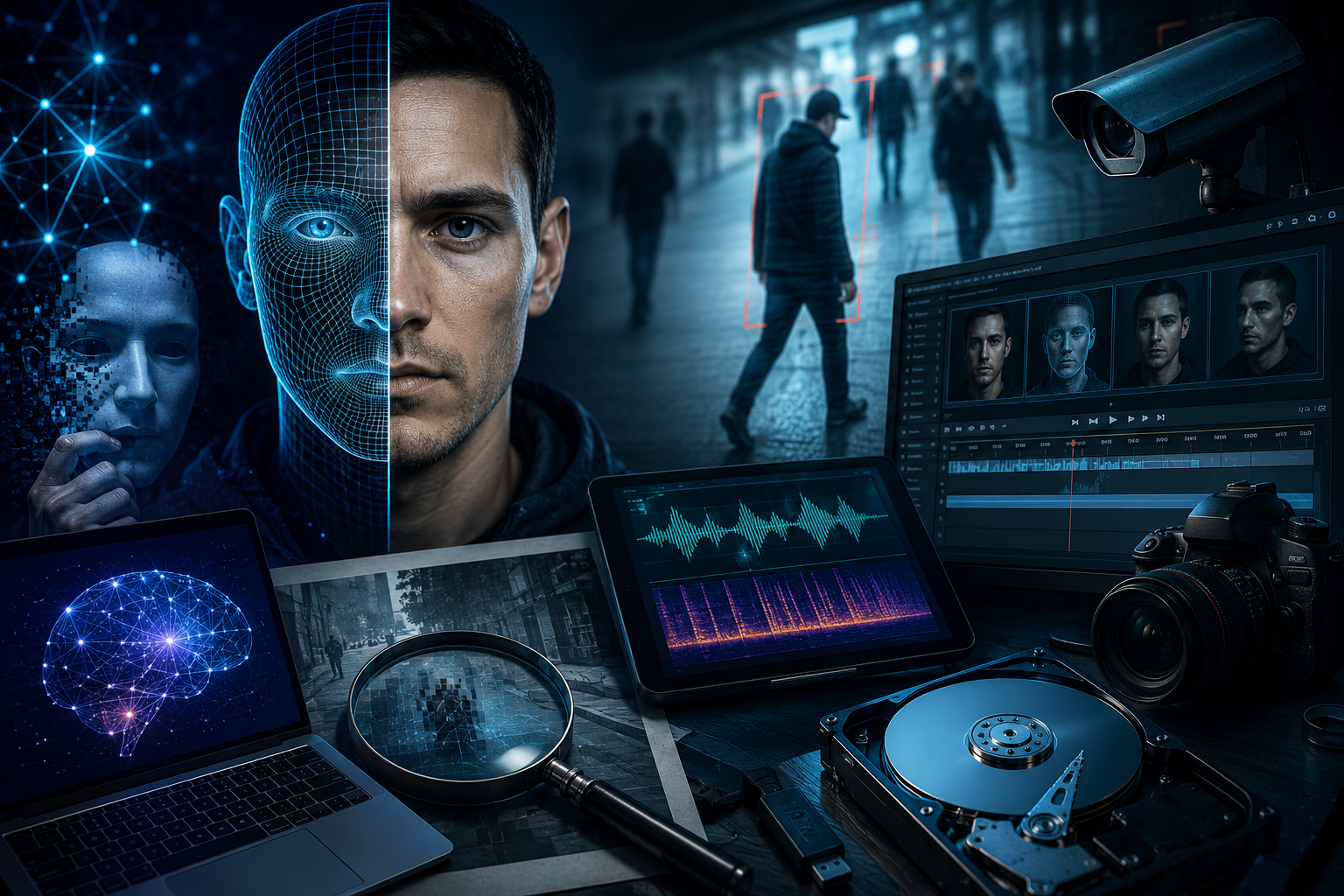
Artificial intelligence is changing how digital content is created, manipulated, and distributed. Today, realistic photographs, videos, voices, documents, and even conversations can be generated or altered using AI within minutes.
For digital forensic investigators, this creates an important question:
How can investigators determine whether digital evidence is genuine, manipulated, or completely AI-generated?
The problem is bigger than traditional photo or video manipulation. Generative AI can create synthetic content that may never have existed in the physical world.
This makes AI-generated evidence an emerging challenge for digital forensics, law enforcement, courts, cybersecurity professionals, and forensic laboratories.
In this article, we explore what AI-generated evidence is, why it is difficult to detect, how forensic investigators can identify synthetic content, and what techniques can be used to authenticate and counter it.
What Is AI-Generated Evidence?
AI-generated evidence refers to digital content that has been completely or partially created, altered, enhanced, or manipulated using artificial intelligence.
AI-generated or AI-manipulated evidence can include:
- AI-generated photographs
- Deepfake videos
- AI-generated audio
- Voice cloning
- Face-swapped videos
- AI-generated documents
- Fake screenshots
- Fabricated conversations
- Synthetic social media posts
- Manipulated CCTV footage
- AI-enhanced images and videos
Not every use of AI automatically makes evidence fraudulent.
For example, an AI-based enhancement may be used to improve the visibility of an object in CCTV footage. The forensic concern arises when AI manipulation changes relevant information and the resulting content is presented as an original recording.
Therefore, forensic examination must establish what was originally captured, what was subsequently modified, and whether those modifications affect the evidentiary value of the material.
Why Is AI-Generated Evidence a Problem for Digital Forensics?
Digital evidence has always been susceptible to manipulation.
Investigators traditionally look for indicators such as:
- inconsistent metadata,
- editing traces,
- compression anomalies,
- pixel-level inconsistencies,
- cloning artifacts,
- unnatural shadows,
- inconsistent lighting,
- file-system anomalies.
However, generative AI introduces a fundamentally different challenge.
An AI-generated image may not have an original photograph behind it.
An AI-generated voice may not originate from a real conversation.
An AI-generated video may depict an event that never happened.
This leads to an important forensic question:
How do you authenticate digital evidence when there may be no genuine original source?
This is why AI-generated evidence detection cannot rely solely on visual inspection or a single detection tool.
AI-Generated Images: Can Forensic Investigators Detect Them?
AI image generators have become capable of producing highly realistic photographs.
Older AI-generated images often contained obvious visual errors such as:
- distorted hands,
- unrealistic facial features,
- abnormal teeth,
- inconsistent objects,
- unnatural shadows.
Modern generative AI has significantly reduced many of these obvious indicators.
As a result, “it looks real” is no longer a reliable authentication method.
Forensic Examination of AI-Generated Images
A digital forensic examiner can examine an image at several levels.
1. Metadata Analysis
Metadata may provide information about:
- camera make and model,
- creation date,
- modification date,
- GPS coordinates,
- editing software,
- image dimensions,
- color profile.
However, metadata should not be considered conclusive proof of authenticity.
Metadata can be removed, altered, or recreated.
Therefore:
Camera metadata ≠ proof that a camera captured the image.
2. Pixel-Level Examination
Forensic image analysis may examine:
- compression patterns,
- image noise,
- sensor noise characteristics,
- resampling,
- texture consistency,
- edge characteristics,
- lighting,
- reflections,
- perspective,
- geometric relationships.
The objective is not necessarily to find one specific “AI artifact.”
Instead, investigators should determine whether the image is consistent with its claimed origin and acquisition history.
Deepfake Videos: A Major Challenge for CCTV Forensics
Video evidence is frequently used to establish:
- identity,
- presence,
- movement,
- sequence of events,
- vehicle identification,
- timing of an incident.
AI-generated video and deepfake technology can potentially manipulate these elements.
For example, a manipulated video could make it appear that an individual entered a location when they were never there.
This creates significant challenges for forensic video authentication.
What Should Investigators Examine in Suspected Deepfake Videos?
A forensic video examination can include:
- frame continuity,
- frame timestamps,
- video encoding,
- GOP structure,
- compression,
- duplicated or missing frames,
- audio-video synchronization,
- facial boundaries,
- lighting consistency,
- reflections,
- background continuity,
- object movement,
- motion consistency.
The source of the video is equally important.
Whenever possible, investigators should obtain CCTV footage directly from the DVR, NVR, camera system, or original storage media rather than relying only on a copy shared through social media or messaging applications.
AI-Generated Audio and Voice Cloning
AI-generated audio is another emerging digital forensic challenge.
Voice cloning technology can generate highly convincing speech based on samples of a person’s voice.
Potential misuse includes fabricated:
- phone conversations,
- ransom demands,
- threatening calls,
- business instructions,
- interviews,
- confessions,
- voice messages.
Human listeners should not be relied upon as the sole method of determining whether an audio recording is genuine.
Forensic Audio Analysis
A forensic examiner may examine:
- waveform characteristics,
- spectrograms,
- frequency patterns,
- background noise,
- room acoustics,
- microphone characteristics,
- codec information,
- compression,
- signal continuity,
- speech characteristics,
- unnatural transitions.
AI-based audio detection tools may also assist the examination.
However, their output should be interpreted carefully because AI detection systems can produce both false positives and false negatives.
AI-Generated Documents and Fake Screenshots
AI can also make the creation of convincing digital documents easier.
Potentially fabricated material includes:
- emails,
- invoices,
- bank statements,
- certificates,
- social media posts,
- chat conversations,
- letters,
- official-looking documents.
Screenshots deserve particular attention.
A screenshot showing a conversation does not necessarily prove that the underlying conversation existed.
For example, a screenshot claiming to show a messaging application conversation may have been:
- edited in an image editor,
- recreated,
- fabricated using HTML,
- generated using AI,
- altered after taking the original screenshot.
Examine the Source, Not Just the Screenshot
Whenever possible, investigators should examine the underlying source.
Depending on the case, this may include:
- the original mobile device,
- application databases,
- system artifacts,
- notification records,
- cloud data,
- associated media,
- account information,
- timestamps.
This leads to a fundamental principle of digital forensics:
The representation of digital evidence should not automatically be treated as the underlying digital evidence.
Can AI Detectors Reliably Identify AI-Generated Evidence?
Several AI detection systems can analyze images, videos, audio, and text for potential signs of synthetic generation.
But investigators should be careful about treating AI detectors as definitive forensic tools.
Detection systems can produce:
- false positives,
- false negatives,
- inconsistent results,
- reduced accuracy after compression,
- different results after resizing or transcoding.
Therefore, a result such as:
“90% AI-generated”
should not automatically be interpreted as conclusive proof of fabrication.
Similarly:
“5% AI-generated”
does not prove that the evidence is genuine.
AI detection should therefore be considered one component of a broader forensic examination.
Digital Provenance: A Possible Solution to AI-Generated Evidence
One of the most promising approaches to the synthetic media problem is digital content provenance.
Instead of attempting to detect manipulation after content has been distributed, provenance technologies attempt to preserve information about the origin and history of digital content.
This may include:
- originating device,
- creation process,
- editing history,
- applications used,
- modifications,
- cryptographic signatures.
Technologies such as C2PA and Content Credentials are examples of efforts to establish verifiable provenance for digital content.
This changes the forensic question from:
“Can we detect whether this image is AI-generated?”
to:
“Can we establish where this content came from and what happened to it?”
For digital evidence authentication, that distinction is extremely important.
Hashing and AI-Generated Evidence
Traditional forensic techniques remain important in the age of generative AI.
Cryptographic hashing can be used to demonstrate the integrity of a file during forensic acquisition and examination.
However, investigators must understand an important distinction:
A hash verifies the integrity of the file being hashed. It does not prove that the contents of that file are authentic.
For example, if an investigator calculates a SHA-256 hash of a deepfake video, the hash can demonstrate that the examined file has not changed since the hash was calculated.
It cannot establish that the event shown in the video actually occurred.
Therefore:
File integrity and content authenticity are two different forensic questions.
Why the Original File Matters in AI Evidence Investigation
The original file can contain forensic information that may disappear during subsequent processing.
Digital evidence shared through:
- WhatsApp,
- Telegram,
- social media,
- email,
- cloud services,
- video-sharing platforms,
may undergo compression, resizing, transcoding, metadata stripping, or format conversion.
These processes can destroy or modify valuable forensic indicators.
Therefore, investigators should obtain the highest-quality original evidence available and document its source.
A proper forensic workflow should establish:
Who provided the evidence → how it was acquired → where it was stored → what processing occurred → who examined it.
Corroborating AI-Generated Evidence With Other Digital Evidence
One of the most effective ways to evaluate suspicious digital evidence is to avoid examining it in isolation.
Consider a video that allegedly shows an individual entering a building at 10:30 PM.
Instead of asking only:
“Is this video real?”
Investigators should ask:
- Does another CCTV camera capture the same event?
- Do access-control records support the entry?
- Does mobile-device evidence place the individual nearby?
- Are vehicle records consistent with the event?
- Do witness statements support the timeline?
- Are timestamps consistent across systems?
- Does the building’s CCTV system contain the same event?
This process of independent corroboration can be extremely valuable.
If multiple independent evidence sources support the same event, the overall evidentiary picture becomes stronger.
A Practical Workflow for Detecting AI-Generated Evidence
A forensic investigation involving suspected AI-generated evidence can follow a structured workflow.
Step 1: Preserve the Evidence
Preserve the original evidence and create forensic working copies where appropriate.
Step 2: Document the Source
Record:
- source,
- acquisition method,
- date and time,
- original location,
- device information,
- file name,
- file format.
Step 3: Calculate Hash Values
Calculate appropriate cryptographic hashes and document them.
Step 4: Examine Metadata
Analyze:
- EXIF metadata,
- file-system timestamps,
- container information,
- codec information,
- software information.
Step 5: Perform Forensic Analysis
Depending on the evidence type:
Images
Examine compression, noise, pixels, lighting, reflections, and geometry.
Videos
Examine frames, encoding, timestamps, continuity, motion, and audio-video synchronization.
Audio
Examine waveform, spectrogram, frequency characteristics, background noise, compression, and continuity.
Mobile Devices
Examine application data, system artifacts, original media, timestamps, and associated files.
Step 6: Use AI Detection Tools
Where appropriate, use validated or relevant AI detection techniques.
Document:
- tool name,
- version,
- configuration,
- output,
- limitations.
Step 7: Corroborate With Independent Evidence
Compare the evidence with other available sources.
Step 8: Formulate the Forensic Opinion
Conclusions should be based on documented findings rather than the output of a single automated detector.
The Biggest Mistake: Treating AI Detection as a Simple “Real or Fake” Test
AI-generated evidence should not always be viewed as a binary problem.
Digital content may exist across a spectrum:
Original → Processed → Enhanced → Edited → AI-Assisted → Manipulated → Fully Synthetic
For example, a photograph may have been captured using a genuine camera but later modified using generative AI.
Therefore, the forensic question should not always be:
“Is this AI-generated?”
Instead, investigators should ask:
“What is the origin of this file, what transformations has it undergone, and do those transformations affect the information relevant to the investigation?”
This approach provides a much more meaningful forensic framework.
How Can Investigators Counter AI-Generated Evidence?
As generative AI becomes more accessible, forensic laboratories and investigative agencies need to adapt.
1. Update Digital Forensic SOPs
Standard operating procedures should include provisions for suspected synthetic and AI-manipulated evidence.
2. Train Forensic Examiners
Examiners should understand:
- generative AI,
- deepfakes,
- synthetic media,
- AI detection,
- multimedia forensics,
- digital provenance,
- limitations of automated detection.
3. Prioritize Original Evidence
Whenever possible, acquire evidence directly from the source device or system.
4. Maintain Chain of Custody
Document every stage of evidence handling, acquisition, storage, transfer, and examination.
5. Use Multiple Examination Techniques
Do not rely on a single AI detector or one visual characteristic.
6. Preserve Provenance Information
Where available, preserve cryptographically verifiable provenance and content credentials.
7. Corroborate Digital Evidence
Compare suspicious content against independent digital and physical evidence.
AI-Generated Evidence and the Future of Digital Forensics
The increasing availability of generative AI does not mean that digital evidence has become useless.
Instead, it changes what forensic investigators need to establish.
A photograph is no longer necessarily proof that a camera captured an event.
A voice recording is no longer necessarily proof that a person spoke the recorded words.
A video is no longer necessarily proof that the recorded event actually occurred.
And a screenshot is certainly not equivalent to the underlying digital record.
The future of digital forensics will therefore require a greater emphasis on:
- forensic acquisition
- metadata analysis
- multimedia forensics
- AI-generated content detection
- cryptographic integrity
- digital provenance
- chain of custody
- independent corroboration
Conclusion
AI-generated evidence is already an emerging challenge for digital forensics.
The problem is not simply that AI can create convincing fake images, videos, voices, or documents.
The bigger concern is that generative AI is reducing the technical expertise, time, and resources required to create convincing synthetic evidence.
The forensic response should therefore not be based on simply asking:
“Does this look real?”
Instead, investigators should ask:
“Can we establish its origin, integrity, history, and consistency with independent evidence?”
This shift—from appearance-based authentication to evidence-based authentication and provenance—will be increasingly important as synthetic media becomes more sophisticated.
AI may make fabricated evidence harder to recognize.
But with proper forensic acquisition, technical examination, provenance analysis, and corroboration, investigators can continue to distinguish what appears authentic from what can actually be supported by evidence.
Frequently Asked Questions (FAQs)
What is AI-generated evidence?
AI-generated evidence is digital content that has been created, altered, enhanced, or manipulated using artificial intelligence. It may include images, videos, audio recordings, documents, screenshots, and synthetic conversations.
How can AI-generated evidence be detected?
Detection can involve metadata analysis, image and video forensics, audio analysis, compression examination, file-system analysis, AI detection tools, provenance information, and comparison with independent evidence.
Can AI detectors prove that evidence is fake?
Not necessarily. AI detection tools can produce false positives and false negatives. Their results should generally be interpreted as one component of a broader forensic examination.
Can metadata prove that an image is genuine?
No. Metadata can provide useful information about a file’s history, but it can also be modified, removed, or recreated. Metadata should therefore be interpreted alongside other forensic findings.
Does hashing prove that digital evidence is authentic?
No. Hashing demonstrates the integrity of the specific file that was hashed. It does not establish that the content itself is genuine or that the event depicted in the file actually occurred.
What is deepfake forensics?
Deepfake forensics involves the examination and authentication of suspected AI-manipulated images, videos, and audio. It can include technical analysis of frames, compression, facial features, audio characteristics, metadata, and other digital artifacts.
What is digital provenance?
Digital provenance refers to information that helps establish where digital content originated and what happened to it during its lifecycle. Cryptographically verifiable provenance can provide stronger evidence about content history.
Final Takeaway
In the age of generative AI, digital evidence must be authenticated—not simply observed.
The question is no longer only:
“Is this real?”
It is:
“Can we scientifically establish where it came from, whether it was altered, and whether independent evidence supports what it shows?”



Post comments (0)