Ultraviolet (UV) light is one of the most valuable tools in modern forensic investigations. From detecting latent fingerprints to revealing biological stains and examining questioned documents, UV light helps investigators uncover evidence that is invisible under normal lighting conditions. However, not all UV lights perform the same way. Two of the most commonly used wavelengths are UV 365 nm and UV 395 nm, and understanding their differences is essential for choosing the right forensic equipment.
Although both wavelengths belong to the UVA spectrum (315–400 nm), they produce significantly different results during forensic examinations. While UV 395 nm is widely available and economical, UV 365 nm is the preferred choice for professional fingerprint detection due to its superior fluorescence and higher image contrast.
Understanding UV Wavelengths
The term “nm” (nanometer) refers to the wavelength of ultraviolet light. A lower wavelength generally produces stronger fluorescence in forensic materials.
- UV 365 nm: Long-wave UVA with minimal visible violet light.
- UV 395 nm: Near-visible UVA that emits a noticeable purple glow.
Both can excite fluorescent materials, but their efficiency differs considerably.
Why Fluorescence Matters in Fingerprint Detection
Latent fingerprints are often invisible because they consist of natural skin secretions such as sweat, oils, and amino acids. Investigators commonly develop these prints using fluorescent fingerprint powders or dyes. When exposed to UV light, these materials emit visible light, making the fingerprint easier to observe and photograph.
The quality of fluorescence directly affects:
- Ridge clarity
- Contrast against the background
- Ease of photography
- Accuracy of fingerprint comparison
This is where the choice between UV 365 nm and UV 395 nm becomes important.
UV 365 nm: The Professional Choice
UV 365 nm is considered the gold standard for forensic fingerprint examination. It produces strong fluorescence while emitting very little visible violet light. Since there is less background illumination, developed fingerprints appear brighter and more distinct.
Advantages of UV 365 nm:
- Produces stronger fluorescence from fingerprint powders and dyes.
- Excellent ridge detail and image contrast.
- Minimal background interference.
- Ideal for crime scene photography.
- Compatible with most fluorescent fingerprint powders.
- Suitable for laboratory and field investigations.
Because of these advantages, forensic laboratories around the world commonly use UV 365 nm as part of their Alternative Light Source (ALS) systems.
UV 395 nm: A Cost-Effective Alternative
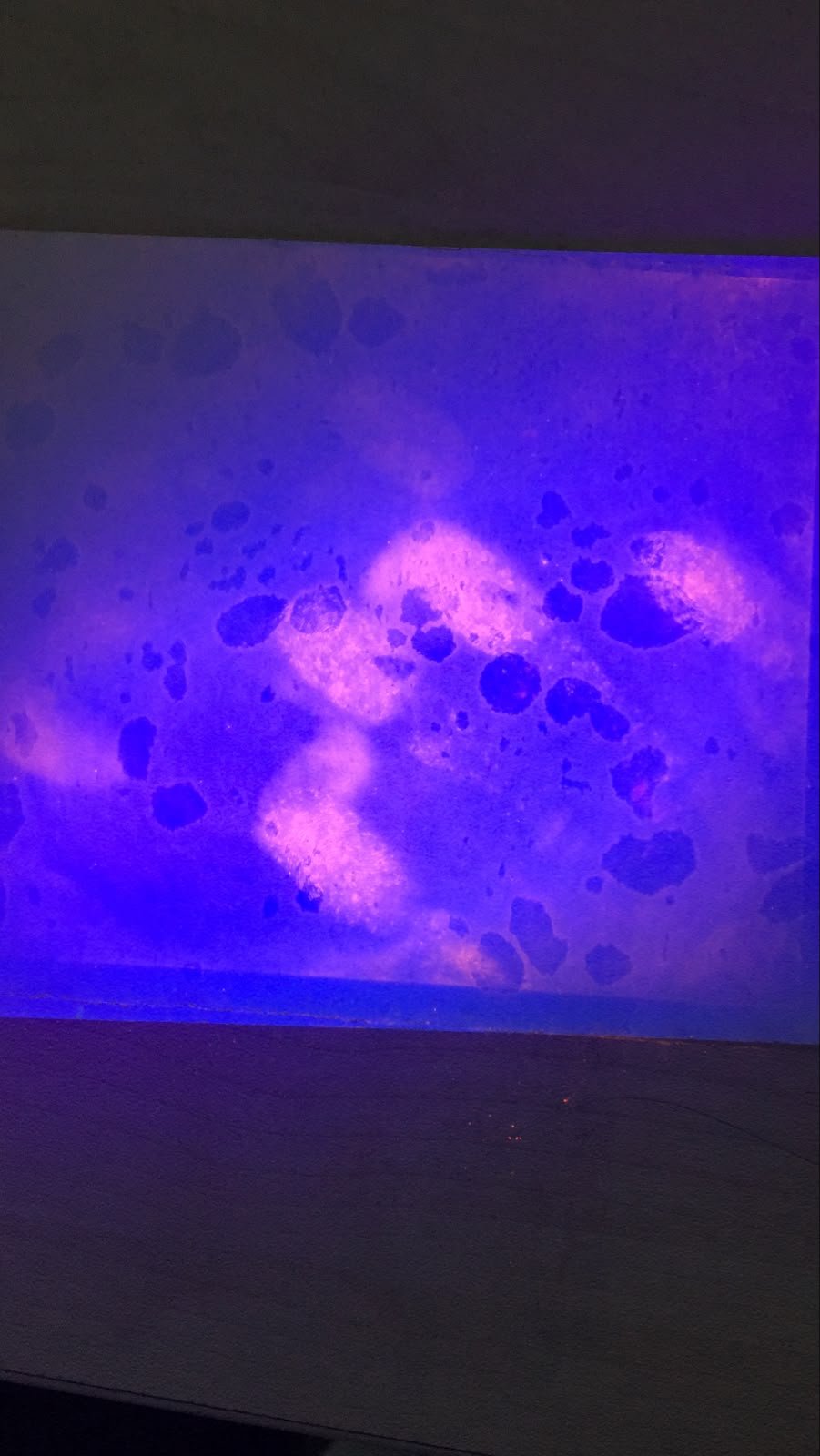
UV 395 nm is popular because it is inexpensive, readily available, and useful for many inspection tasks. However, unlike 365 nm, it emits a significant amount of visible purple light.
This visible light illuminates the entire surface rather than only the fluorescent evidence. As a result, the background becomes brighter, reducing the contrast between the fingerprint and the surface.
Advantages of UV 395 nm
- Lower purchase cost.
- Good for general UV inspection.
- Easy to find in handheld flashlights.
- Suitable for demonstrations and training.
Limitations
- Weaker fluorescence.
- Higher background illumination.
- Reduced fingerprint contrast.
- Less effective for forensic photography.
While UV 395 nm can reveal some fluorescent fingerprints, the quality is generally inferior compared to UV 365 nm.
Comparison Between UV 365 nm and UV 395 nm
| Feature |
UV 365 nm |
UV 395 nm |
| Fluorescence |
Strong |
Moderate |
| Visible Purple Light |
Very Low |
High |
| Fingerprint Contrast |
Excellent |
Lower |
| Background Interference |
Minimal |
Higher |
| Photography Quality |
Excellent |
Average |
| Compatible with Fluorescent Powders |
Most fluorescent powders |
Some fluorescent powders |
| Professional Forensic Use |
Yes (Preferred) |
Limited |
| Cost |
Higher |
Lower |
Performance with Fluorescent Fingerprint Powders
Fluorescent powders are specifically designed to glow under ultraviolet illumination. Common colors include:
- Green
- Yellow
- Orange
- Red
- White fluorescent powders
These powders exhibit their brightest fluorescence under 365 nm UV light. Since UV 365 produces stronger excitation and less visible light, the fluorescent ridges appear sharp and highly contrasted.
Under UV 395 nm, these same powders often appear dimmer because the strong purple light partially masks the emitted fluorescence.
Which Light Produces Better Fingerprint Photographs?
Forensic photography requires maximum contrast between the fingerprint and the background.
UV 365 nm offers several advantages:
- Cleaner background
- Better ridge definition
- Reduced reflections
- Improved camera exposure
- Higher-quality evidence documentation
In contrast, UV 395 nm often creates a purple haze in photographs, making it more difficult to capture fine ridge details.
Other Forensic Applications
Besides fingerprint detection, UV light is also used for:
- Biological fluid detection
- Questioned document examination
- Security feature verification
- Crime scene searches
- Trace evidence examination
Again, UV 365 nm generally performs better because many forensic materials are specifically designed or naturally respond to this wavelength.
When Should You Choose UV 395 nm?
Despite its limitations, UV 395 nm still has useful applications.
It is suitable for:
- Educational demonstrations
- Basic forensic training
- General UV inspections
- Budget-conscious users
- Preliminary evidence searches
For users who occasionally need UV illumination without demanding forensic-grade performance, UV 395 nm offers reasonable value.
When Is UV 365 nm Worth the Investment?
Professional investigators should consider UV 365 nm when:
- Detecting latent fingerprints.
- Working with fluorescent powders or dyes.
- Photographing forensic evidence.
- Performing laboratory examinations.
- Conducting crime scene investigations.
- Seeking reliable, high-contrast results.
Although the initial cost is higher, the improvement in evidence visibility and documentation makes it a worthwhile investment for forensic professionals.
Final Verdict
For latent fingerprint detection using fluorescent powders and forensic dyes, UV 365 nm is the preferred wavelength. It produces stronger fluorescence, generates minimal visible violet light, and delivers higher ridge contrast, making fingerprints easier to detect, photograph, and compare.
In contrast, UV 395 nm emits a stronger visible purple light that can reduce the contrast between the fingerprint and the background. While it is suitable for basic UV inspections, demonstrations, and training purposes, it is generally less effective for forensic fingerprint examinations where fine ridge detail is critical.


Post comments (0)