Introduction
One of the first questions forensic experts try to answer when unidentified skeletal remains are discovered is, “Was the individual male or female?” Determining biological sex is a crucial step in building a biological profile, helping investigators narrow down missing person records and identify unknown individuals.
In forensic anthropology, skeletal analysis plays a significant role because bones preserve valuable biological information even after soft tissues have decomposed. While no single bone can determine sex with absolute certainty in every case, the combination of skeletal features allows experts to estimate biological sex with a high degree of accuracy.
This article explains the major differences between male and female skeletons and how forensic anthropologists use these characteristics during investigations.
Why Sex Estimation Matters in Forensic Science
Biological sex estimation helps investigators by:
- Reducing the pool of potential missing persons.
- Assisting in facial reconstruction.
- Supporting age and ancestry estimation.
- Providing important evidence in criminal investigations and disaster victim identification.
- Assisting archaeological and historical research.
Sex estimation is usually performed before age estimation and stature reconstruction because many skeletal measurements depend on biological sex.
The Pelvis: The Most Reliable Bone
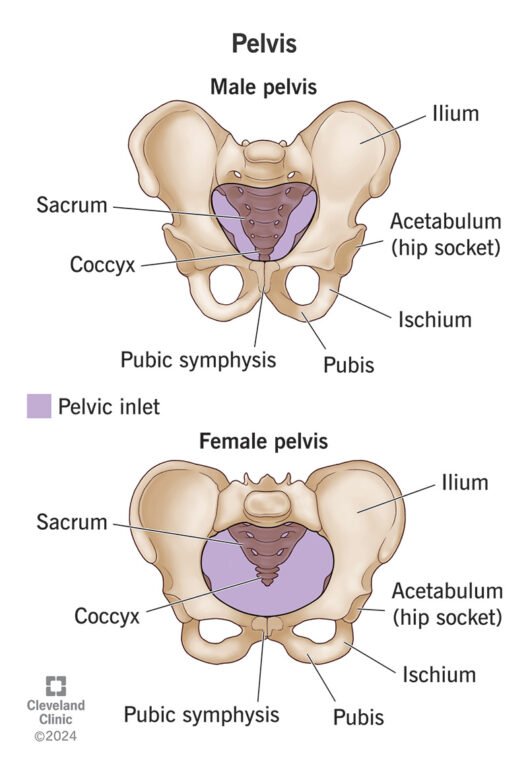
The pelvis is considered the most accurate bone for determining biological sex, with an accuracy often exceeding 90–95% when it is well preserved.
The differences primarily result from female adaptation for childbirth.
Male Pelvis-
Characteristics include:
- Narrow and heavy
- Heart-shaped pelvic inlet
- Deep pelvic cavity
- Acute subpubic angle (less than 70°)
- Narrow greater sciatic notch
- Larger and more robust bones
- Sacrum is long and narrow
These features provide greater structural strength but less space within the pelvic cavity.
Female Pelvis-
Characteristics include:
- Wider and lighter
- Oval or circular pelvic inlet
- Broad pelvic cavity
- Wide subpubic angle (greater than 80–90°)
- Broad greater sciatic notch
- Shorter and wider sacrum
- More flexible pelvic architecture
These adaptations facilitate childbirth.
Skull Differences
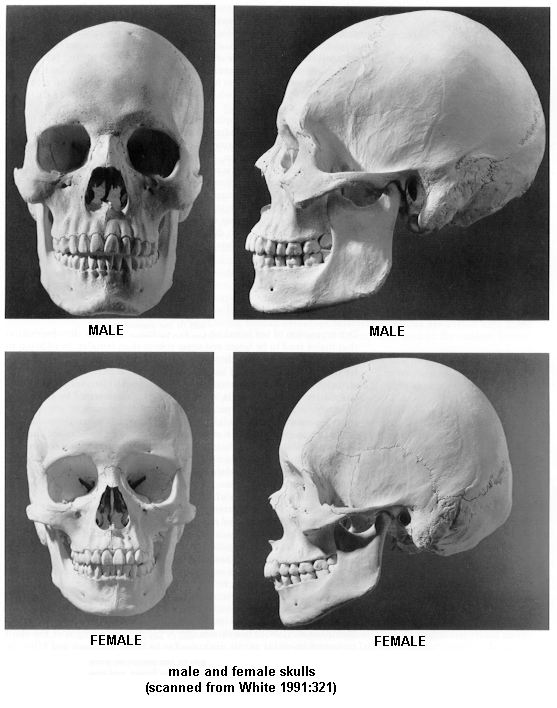
The skull is the second most reliable indicator after the pelvis.
Male Skull
Typically shows:
- Larger overall size
- Prominent brow ridges
- Sloping forehead
- Larger mastoid processes
- Square chin
- Robust jaw
- Pronounced external occipital protuberance
- Larger muscle attachment sites
The male skull generally appears more rugged due to stronger muscle attachments.
Female Skull
Usually has:
- Smaller overall size
- Smooth forehead
- Less pronounced brow ridges
- Rounded chin
- Smaller mastoid processes
- Graceful jawline
- Less prominent muscle attachment areas
The female skull tends to have smoother contours.
Long Bone Differences
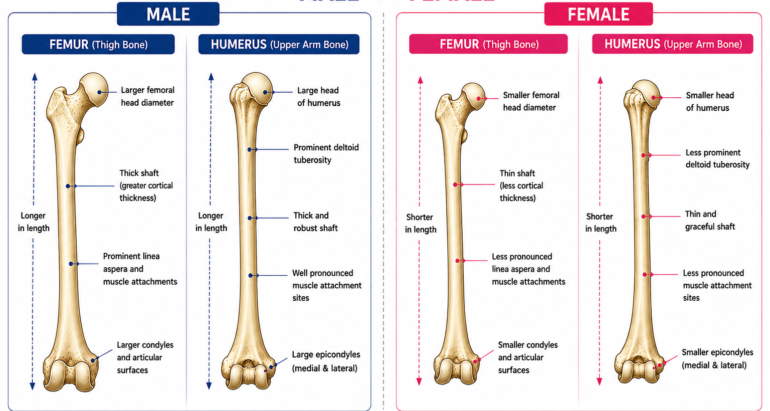
Long bones also exhibit sexual dimorphism.
Common examples include:
Femur-
Male femurs are generally:
- Longer
- Thicker
- Heavier
- Larger femoral head diameter
Female femurs are:
- Slightly shorter
- More slender
- Smaller femoral head
Humerus-
Male humerus shows:
- Larger overall size
- Larger humeral head
- Thicker cortical bone
- Prominent deltoid tuberosity
- Well-developed muscle attachment sites
- Larger medial and lateral epicondyles
- Heavier bone
Female humerus shows:
Scientific Methods Used
Forensic anthropologists rely on multiple methods rather than visual observation alone.
These include:
Morphological Analysis-
Experts evaluate:
- Pelvic traits
- Skull characteristics
- Bone robustness
- Joint morphology
Metric Analysis-
Measurements are taken using:
- Osteometric boards
- Sliding calipers
- Digital calipers
- Statistical population databases
Mathematical models improve objectivity and reduce observer bias.
CT and 3D Imaging—
Modern forensic laboratories increasingly use:
- CT scans
- 3D surface scanners
- Digital skeletal reconstruction
- AI-assisted morphometric analysis
These technologies allow non-destructive examination and precise measurements.
Limitations of Sex Estimation
Although skeletal analysis is highly reliable, several factors can affect accuracy:
- Fragmented or damaged remains
- Juvenile skeletons (before puberty, male and female bones are very similar)
- Population-specific anatomical variation
- Disease or trauma affecting bone shape
- Age-related bone degeneration
For these reasons, experts typically report findings as probable, likely, or consistent with male or female rather than making absolute claims.
Importance in Criminal Investigations
Sex estimation is essential in many forensic contexts, including:
- Homicide investigations
- Mass disaster victim identification
- Archaeological excavations
- Human rights investigations
- Missing person cases
- Cold case investigations
By narrowing the search for an unknown individual, skeletal analysis significantly accelerates the identification process.
Conclusion
Identifying whether skeletal remains belong to a male or female is one of the foundational tasks in forensic anthropology. The pelvis provides the highest accuracy, while the skull, long bones, and overall skeletal robustness offer additional supporting evidence. Rather than relying on a single feature, forensic experts assess multiple anatomical characteristics to reach a scientifically supported conclusion.
As imaging technology and forensic research continue to evolve, sex estimation methods are becoming even more accurate and reliable. Combined with DNA analysis and other forensic techniques, skeletal examination remains an indispensable tool in solving criminal cases, identifying disaster victims, and uncovering historical mysteries.




Post comments (0)