A signature can play a crucial role in legal agreements, property transactions, wills, bank documents, and other important records. But what happens when someone questions the date on which a signature was written? Can forensic science determine whether a signature was made yesterday, a few months ago, or several years ago?
The answer is yes, certain scientific examinations can provide clues about the age of a signature, but determining its exact date is extremely difficult and is not always possible. Forensic document examination involves studying handwriting, ink, paper, and other physical characteristics to investigate the authenticity and history of a questioned document.
Understanding the difference between identifying a signature’s writer and determining when it was written is essential in forensic investigations.
1. What Is Signature Age Determination?
Signature age determination is the scientific examination of a handwritten signature to assess when it may have been placed on a document.
For example, imagine a property agreement that supposedly contains a signature from 2019. Years later, one party claims that the signature was added in 2024. A forensic document examiner may be asked to investigate whether the available physical and chemical evidence supports the claimed date.
This examination is different from signature verification. Signature verification focuses on whether a particular person wrote the signature, whereas signature age determination focuses on the possible time when the signature was created.
Both examinations may be important in cases involving suspected document alteration, disputed wills, financial fraud, and legal disputes.
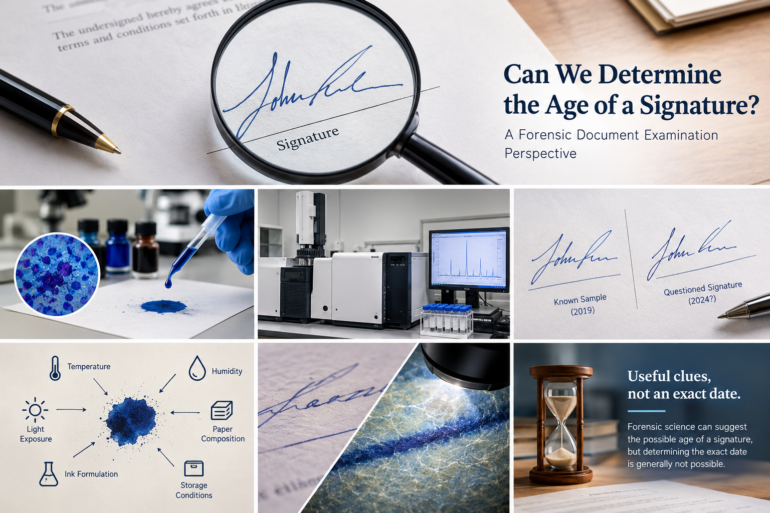
2. How Can Forensic Experts Examine the Age of a Signature?
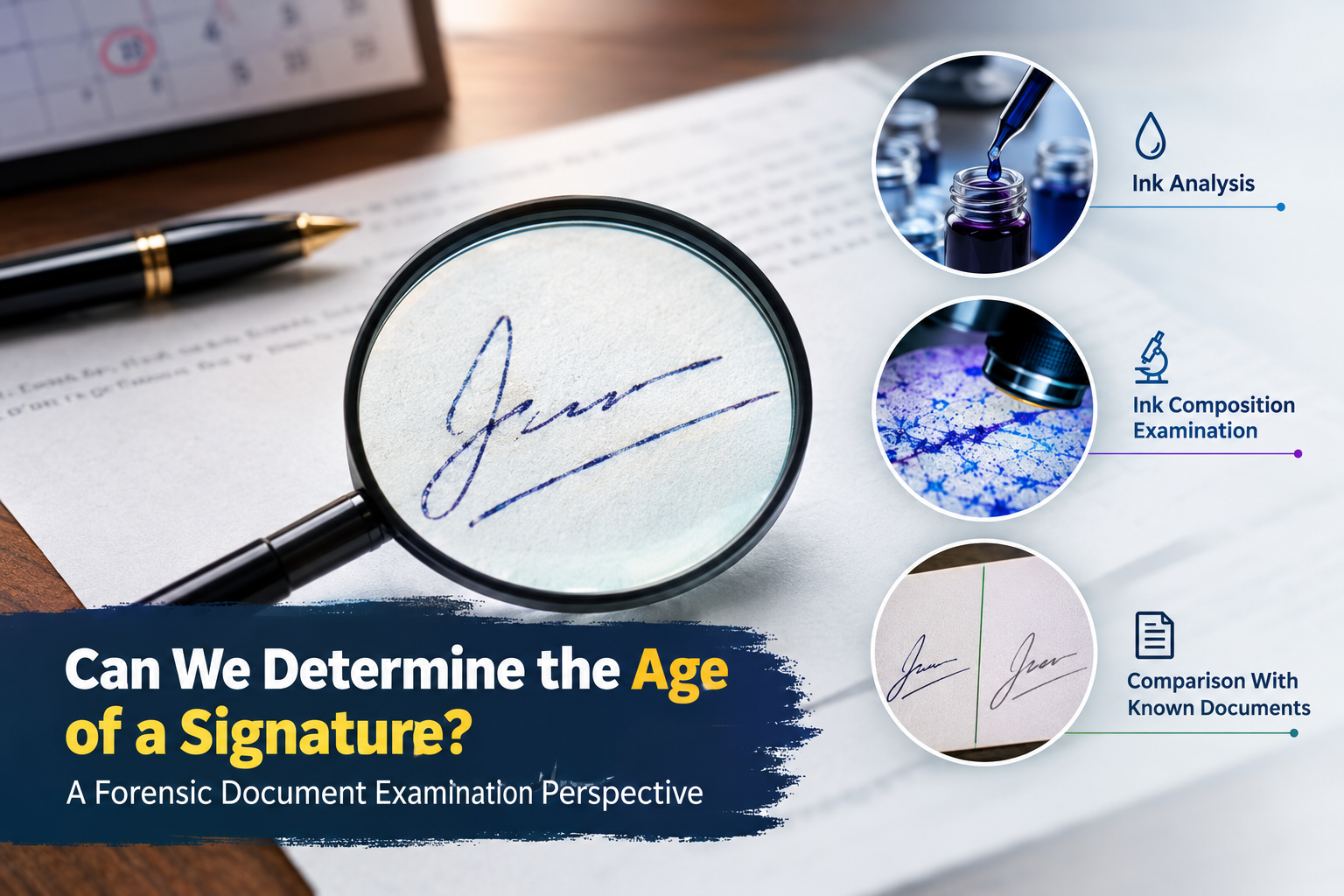
A forensic document examiner may use several approaches, depending on the document, the ink, the available comparison samples, and the question being investigated.
A. Ink Analysis
Ink analysis is one of the important methods used in investigating the possible age of a signature. Different pens contain different ink formulations, including dyes, pigments, and solvents.
After ink is deposited on paper, certain chemical components may gradually change or evaporate. Scientists can examine these changes using suitable analytical techniques to obtain information about the ink.
Methods such as gas chromatography–mass spectrometry (GC-MS) may be used to study selected ink components, including volatile or semi-volatile substances.
However, these changes do not work like a simple clock. The rate of ink ageing can depend on the ink formulation, paper composition, temperature, humidity, exposure to light, and storage conditions. Consequently, ink analysis may provide useful information in suitable cases, but it cannot automatically establish the exact date of a signature.
B. Examination of Ink Composition
Experts may compare the ink used in a questioned signature with other inks or reference samples.
The purpose may be to determine whether the inks share similar characteristics or whether the questioned ink contains components that help establish a limitation on when it could have been used.
For instance, if an ink formulation became commercially available after the date written on a document, that finding may raise questions about the document’s claimed history.
Nevertheless, identifying similar ink does not necessarily prove that two signatures were written on the same day. Likewise, finding differences between inks does not automatically establish that a document was altered, because different pens may have been used during the same signing event.
C. Comparison With Known Documents
If documents containing signatures of known dates are available, an examiner may compare them with the questioned signature.
The comparison can help investigate whether the questioned writing is consistent with the document’s claimed history. Experts may also examine the sequence of writing, printing, stamps, or other features when relevant.
This approach is particularly useful when the investigation involves several documents from different periods. However, the dates of the comparison documents must themselves be reliable, and similarities alone cannot establish an exact writing date.
3. Can We Determine the Exact Date of a Signature?
In most cases, forensic science cannot reliably determine the exact day, month, or year when a signature was written solely by examining the signature.
Some specialised ink-ageing methods may estimate the age of certain inks within a limited period under appropriate conditions. However, their reliability depends on the method used, the type of ink, the available reference data, and the environmental history of the document.
For example, a method developed for recently deposited ballpoint ink may not be suitable for estimating the age of ink that has been on paper for several years. Applying a method outside its validated range can lead to unreliable conclusions.
Research published in forensic science literature highlights the challenges of interpreting ink-ageing results and accounting for the uncertainties involved.
Therefore, a responsible forensic report should explain the findings, limitations, and degree of support for the conclusions rather than claim an exact date without sufficient scientific evidence.
4. What Factors Affect the Age of a Signature?
Several factors can influence the results of a signature age examination:
-
Type of ink: Different formulations undergo different chemical changes over time.
-
Paper composition: The paper can influence the behaviour and ageing of ink.
-
Storage conditions: Temperature, humidity, and exposure to light can affect ink ageing.
-
Environmental exposure: Heat, sunlight, and other conditions may accelerate certain chemical changes.
-
Available reference samples: Reliable samples of known dates may help with comparative analysis.
-
Examination techniques: Different analytical methods have different capabilities and limitations.
These factors explain why a single test may not be sufficient to establish the age of a questioned signature.
5. When Is Signature Age Examination Useful?
Signature age examination may be considered in several types of forensic investigations:
-
Property disputes: Investigating claims that a signature was added to an agreement at a different time.
-
Will and inheritance disputes: Examining questioned signatures on wills and related documents.
-
Financial fraud: Investigating disputed signatures on cheques, loan documents, and banking records.
-
Contract disputes: Assessing allegations that a document was signed or modified after the claimed date.
-
Document alteration cases: Examining whether signatures, entries, or other elements may have been added at different times.
In these situations, the examiner may need to consider the entire document rather than focus exclusively on the signature. Examination of ink, paper, printing, alterations, and writing sequence may provide a more complete picture.
6. Why Is a Professional Forensic Document Examination Important?
Signature examination requires specialised knowledge, appropriate instruments, and a systematic approach. Visual inspection alone is rarely sufficient to establish when a signature was written.
A forensic document examiner may use microscopy, specialised lighting, ink examination, and other suitable techniques based on the circumstances of the case. The examiner must also consider alternative explanations for the observed findings.
For further reading, consult these resources:
-
-
These resources discuss the scientific principles and limitations relevant to handwriting and ink examination.
Conclusion
Can we determine the age of a signature? In certain circumstances, forensic examination can provide useful evidence about the possible age of the ink or help assess whether a document’s claimed history is consistent with the findings. However, determining the exact date of a signature is generally not possible through signature examination alone.
The most appropriate approach depends on the case, the type of ink, the condition of the document, and the availability of reliable comparison material. A qualified forensic document examiner can assess which methods are suitable and explain what conclusions the evidence can genuinely support.
At Hawk Eye Forensic Lab, questioned document examination can help investigate disputed signatures, handwriting authenticity, and suspected document alterations through a systematic forensic approach.


Post comments (0)