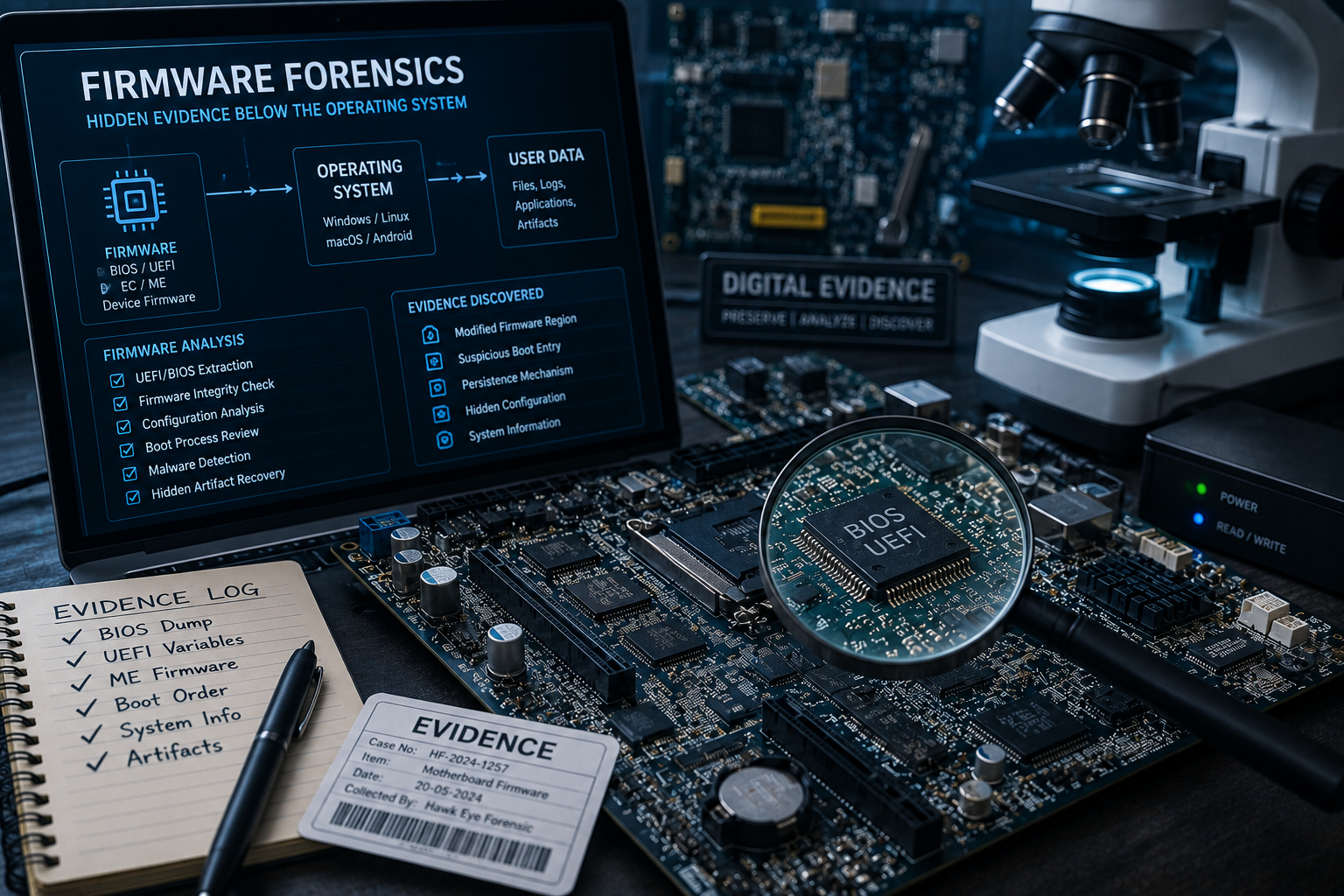
When people think about digital forensic investigations, they often focus on files, emails, browser history, or deleted data stored on a device. However, valuable digital evidence can exist much deeper within a system. Hidden beneath the operating system lies firmware—a critical component that controls how hardware communicates with software.
Firmware Forensics is an emerging field of digital forensics that helps investigators identify and analyze evidence stored below the operating system level. Furthermore, it plays an important role in investigating advanced cyberattacks, malware persistence techniques, and system compromises that traditional forensic methods may overlook.
As cybercriminals adopt increasingly sophisticated attack techniques, understanding firmware-level evidence has become more important than ever.
What Is Firmware Forensics?
Firmware Forensics is the process of identifying, preserving, collecting, and analyzing digital evidence stored within firmware components. Unlike files stored on a hard drive or SSD, firmware operates at a lower level and controls the basic functionality of hardware devices.
Modern devices contain firmware in several components, including:
- Motherboards
- Storage devices
- Network adapters
- Graphics cards
- Smartphones
- USB devices
- Routers
- Internet of Things (IoT) devices
Because firmware operates independently of the operating system, it can remain active even when software is removed or reinstalled.
Why Is Firmware Forensics Important?
Many people assume that reinstalling Windows or formatting a storage device removes every trace of malicious activity. However, that is not always true. Certain advanced threats can hide within firmware and survive traditional remediation techniques.
Firmware Forensics is particularly important because it can help investigators:
- Identify hidden malware.
- Investigate advanced persistent threats (APTs).
- Recover valuable forensic artifacts.
- Detect unauthorized firmware modifications.
- Analyze sophisticated cyberattacks.
- Support incident response investigations.
- Preserve digital evidence for legal proceedings.
Consequently, firmware-level investigations have become increasingly valuable in both corporate and criminal investigations.
Understanding Firmware in Modern Devices
Firmware acts as a bridge between hardware and software. It provides the instructions necessary for hardware components to function properly.
Examples of firmware include:
- BIOS firmware
- UEFI firmware
- SSD controller firmware
- Smartphone firmware
- Router firmware
- Embedded system firmware
- Network device firmware
Although firmware is designed to improve system functionality, attackers may exploit vulnerabilities to establish long-term persistence on compromised devices.
How Can Attackers Hide Within Firmware?
Modern cyberattacks are becoming increasingly sophisticated. Rather than targeting files alone, attackers may attempt to compromise firmware components.
Common techniques include:
- Firmware modification
- Rootkit deployment
- Persistent malware installation
- Unauthorized firmware updates
- Boot process manipulation
- Hardware-level persistence attacks
As a result, malicious code may remain active even after:
- Formatting storage devices
- Reinstalling operating systems
- Removing applications
- Performing factory resets
Therefore, traditional forensic examinations may not always reveal the complete picture during an investigation.
What Digital Evidence Can Firmware Forensics Reveal?
Firmware Forensics can provide valuable insights during cybercrime investigations. Investigators examine multiple sources of digital evidence to identify suspicious activities and unauthorized modifications.
Digital evidence may include:
- Firmware configuration records
- System boot information
- Device identifiers
- Update histories
- Hardware communication records
- Security logs
- Metadata artifacts
- Timeline information
Furthermore, investigators often correlate firmware-level evidence with operating system artifacts to establish investigative findings more accurately.
The Role of BIOS and UEFI Forensics
The BIOS and UEFI firmware control how systems initialize during the boot process. Consequently, they play a significant role during advanced forensic investigations.
Investigators may examine:
- Boot configurations
- Firmware integrity
- Unauthorized modifications
- System initialization records
- Secure Boot settings
- Firmware update histories
Because malicious firmware can persist for extended periods, examining these artifacts may reveal evidence that traditional forensic methods might miss.
Firmware Malware and Persistent Threats
Firmware-based malware represents one of the most challenging threats in modern cybersecurity. Unlike conventional malware, it can survive operating system reinstallation and evade traditional security mechanisms.
Some characteristics of firmware-level attacks include:
- Long-term persistence
- Reduced visibility
- Hardware-level execution
- Advanced evasion techniques
- Increased forensic complexity
Moreover, these attacks may affect multiple system components simultaneously, making forensic investigations significantly more challenging.
Challenges in Firmware Forensics
Firmware investigations present several unique challenges for digital forensic experts.
These challenges include:
- Proprietary firmware architectures
- Limited forensic tools
- Encrypted firmware components
- Hardware-specific configurations
- Advanced malware persistence techniques
- Rapid technological changes
Additionally, investigators must preserve evidence carefully to avoid unintentionally modifying critical forensic artifacts.
Despite these challenges, advances in digital forensic methodologies continue to improve firmware investigations.
Best Practices in Firmware Forensics
Digital forensic experts follow established best practices when conducting firmware examinations.
These include:
- Preserving digital evidence immediately.
- Maintaining complete chain of custody documentation.
- Using validated forensic methodologies.
- Documenting every investigative step.
- Examining associated hardware components.
- Correlating firmware and operating system artifacts.
- Preserving forensic integrity throughout the investigation.
Following these practices helps strengthen both investigative findings and legal admissibility.
The Future of Firmware Forensics
As technology continues to evolve, Firmware Forensics will become increasingly important in cybercrime investigations. Modern devices are becoming more interconnected, and firmware components are growing more complex every year.
Emerging developments include:
- Advanced firmware analysis techniques
- Artificial intelligence-assisted investigations
- Enhanced malware detection capabilities
- Improved hardware forensic methodologies
- Better incident response procedures
- Specialized firmware forensic tools
Consequently, investigators must continuously adapt their methodologies to address evolving cyber threats.
Conclusion
Firmware Forensics provides investigators with a deeper understanding of digital evidence that exists below the operating system. Although traditional forensic examinations remain essential, they may not always reveal sophisticated firmware-level compromises.
Furthermore, advanced cyber threats increasingly rely on persistence techniques designed to evade conventional security measures. By preserving and analyzing firmware-related evidence, digital forensic experts can identify hidden threats, reconstruct investigative timelines, and support cybercrime investigations more effectively.
As digital technologies continue to advance, Firmware Forensics will remain a critical discipline within modern digital forensic investigations, helping uncover hidden evidence that would otherwise remain invisible.



Post comments (0)