Fingerprint evidence has long been regarded as one of the most trusted forms of forensic identification in criminal investigations. For more than a century, courts worldwide have accepted fingerprints as a powerful tool for linking suspects to crime scenes. The uniqueness and permanence of fingerprint ridge patterns make them a valuable source of identification.
However, despite its strong scientific foundation, fingerprint evidence is not without challenges. Questions regarding reliability, interpretation, examiner bias, and courtroom scrutiny continue to shape how fingerprint evidence is presented and evaluated in legal proceedings.
Why Fingerprint Evidence Is Considered Reliable
The reliability of fingerprint evidence rests on two widely accepted principles:
1. Uniqueness
No two individuals, including identical twins, have ever been found to share identical fingerprint ridge characteristics. Minute ridge details known as minutiae points—such as ridge endings, bifurcations, dots, and enclosures—make each fingerprint distinct.
2. Permanence
Fingerprint patterns are formed before birth and generally remain unchanged throughout a person’s lifetime unless affected by significant injury or scarring.
These characteristics allow forensic experts to compare latent prints recovered from crime scenes with known prints from suspects or databases to establish identity.
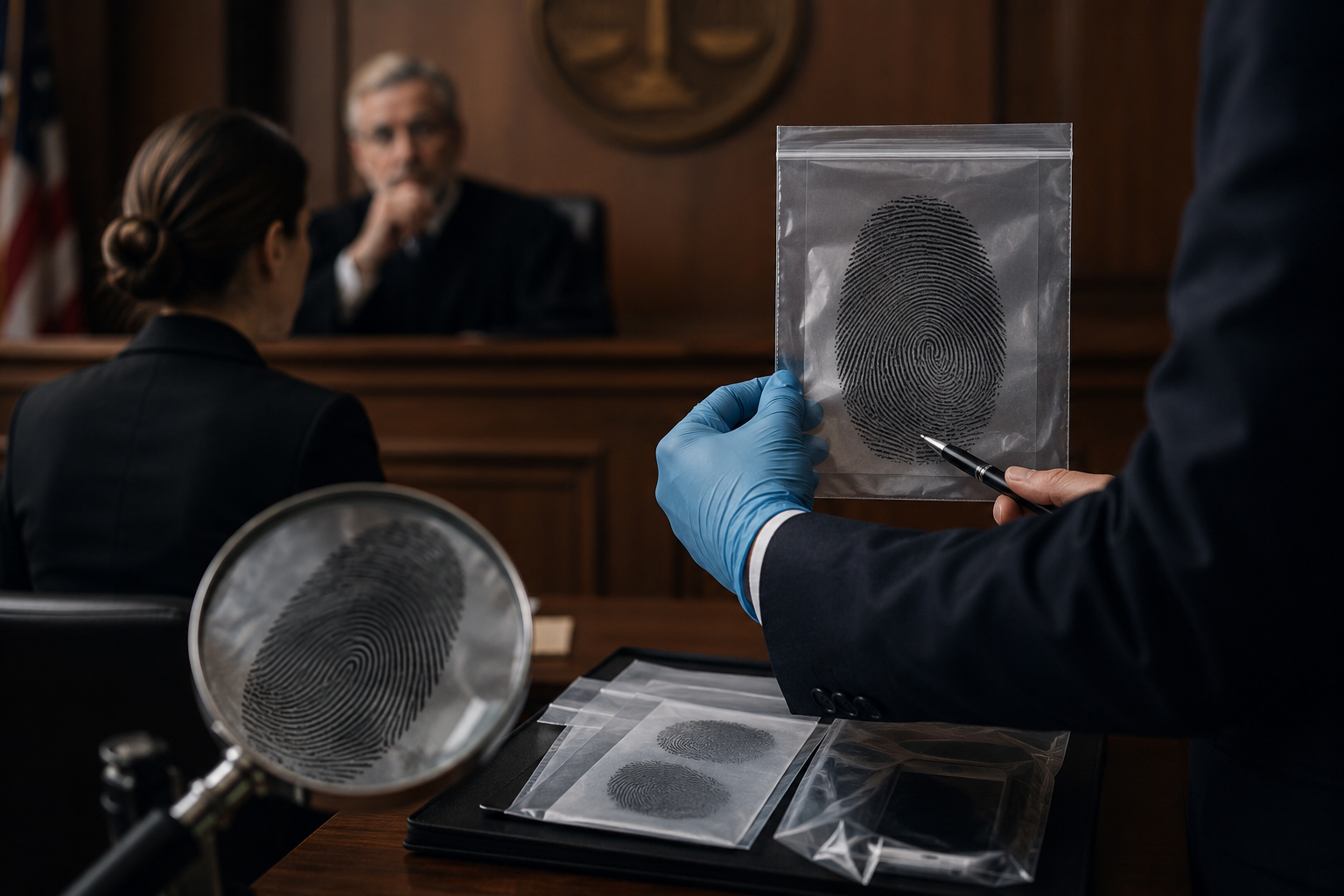
How Fingerprint Evidence Is Presented in Court
Fingerprint evidence enters the courtroom through expert testimony. A certified fingerprint examiner typically explains:
- How the latent print was recovered
- Enhancement techniques used
- Comparison methodology followed
- Matching characteristics identified
- Degree of certainty in identification
Most forensic laboratories follow the ACE-V method:
- Analysis – Examining print quality and suitability
- Comparison – Comparing latent and known prints
- Evaluation – Determining similarity or exclusion
- Verification – Independent review by another examiner
This structured approach strengthens reliability and supports admissibility in court.
Challenges to Fingerprint Evidence
Although fingerprint evidence is powerful, several challenges can affect its reliability.
1. Poor Quality Latent Prints
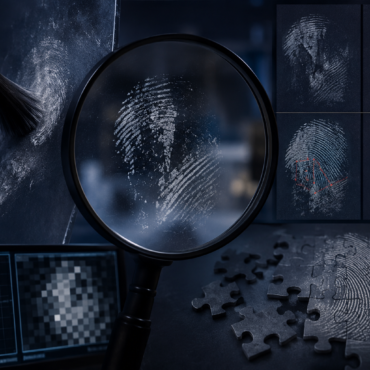
Crime scene fingerprints are often partial, smudged, distorted, or incomplete. Environmental conditions such as heat, moisture, or surface texture can degrade print quality, making comparison difficult.
Low-quality prints increase the risk of misinterpretation.
2. Subjective Interpretation
Fingerprint comparison involves expert judgment. Unlike automated matching systems, final identification often depends on human interpretation.
Different examiners may occasionally disagree on borderline cases, especially when prints lack sufficient detail.
3. Confirmation Bias
If an examiner knows case details or suspect information before analysis, unconscious bias may influence conclusions.
Modern forensic labs reduce this risk through blind verification procedures, where secondary examiners review evidence independently.
4. Lack of Universal Match Standards
Some countries require a fixed number of matching points for identification, while others rely on overall ridge pattern sufficiency.
This lack of global consistency can lead to legal debate over admissibility and certainty.
5. Historical Misidentifications
Though rare, documented fingerprint misidentifications have raised concerns about overconfidence in forensic testimony.
One notable example is the Brandon Mayfield Fingerprint Misidentification Case, where a mistaken fingerprint match highlighted the risks of examiner error and procedural bias.
Such cases have encouraged stricter laboratory protocols and better examiner training.
Courtroom Scrutiny and Legal Standards
Courts often evaluate fingerprint evidence under admissibility standards such as:
- Daubert Standard – Focuses on scientific validity and testing
- Frye Standard – Requires broad scientific acceptance
Fingerprint evidence generally satisfies these standards, but courts increasingly demand transparency regarding limitations and uncertainty.
The Future of Fingerprint Evidence
Advancements in forensic science continue to improve reliability through:
- AI-assisted fingerprint matching
- High-resolution digital enhancement
- Statistical probability modeling
- Improved blind verification systems
- Standardized international protocols
These developments aim to reduce subjectivity while strengthening scientific confidence.
Final Thoughts
Fingerprint evidence remains one of forensic science’s most valuable identification tools. Its long-standing courtroom acceptance is supported by the uniqueness and permanence of ridge patterns.
However, reliability depends heavily on proper collection, careful examination, and unbiased interpretation. Recognizing the challenges associated with fingerprint analysis ensures that justice systems use this evidence responsibly and accurately.
As forensic technology advances, fingerprint evidence will likely become even more precise, transparent, and scientifically defensible in court.


Post comments (0)