In the world of forensic science, where the smallest detail can determine the authenticity of a document, microscopy plays an indispensable role. From identifying forged signatures to examining ink strokes and paper fibers, microscopy allows forensic document examiners to uncover evidence invisible to the naked eye.
Document analysis is not simply about comparing handwriting styles or spotting visible alterations—it often requires an in-depth examination of microscopic characteristics that reveal how a document was created, modified, or manipulated. This is where microscopy becomes one of the most powerful tools in questioned document examination.
What is Microscopy in Document Analysis?
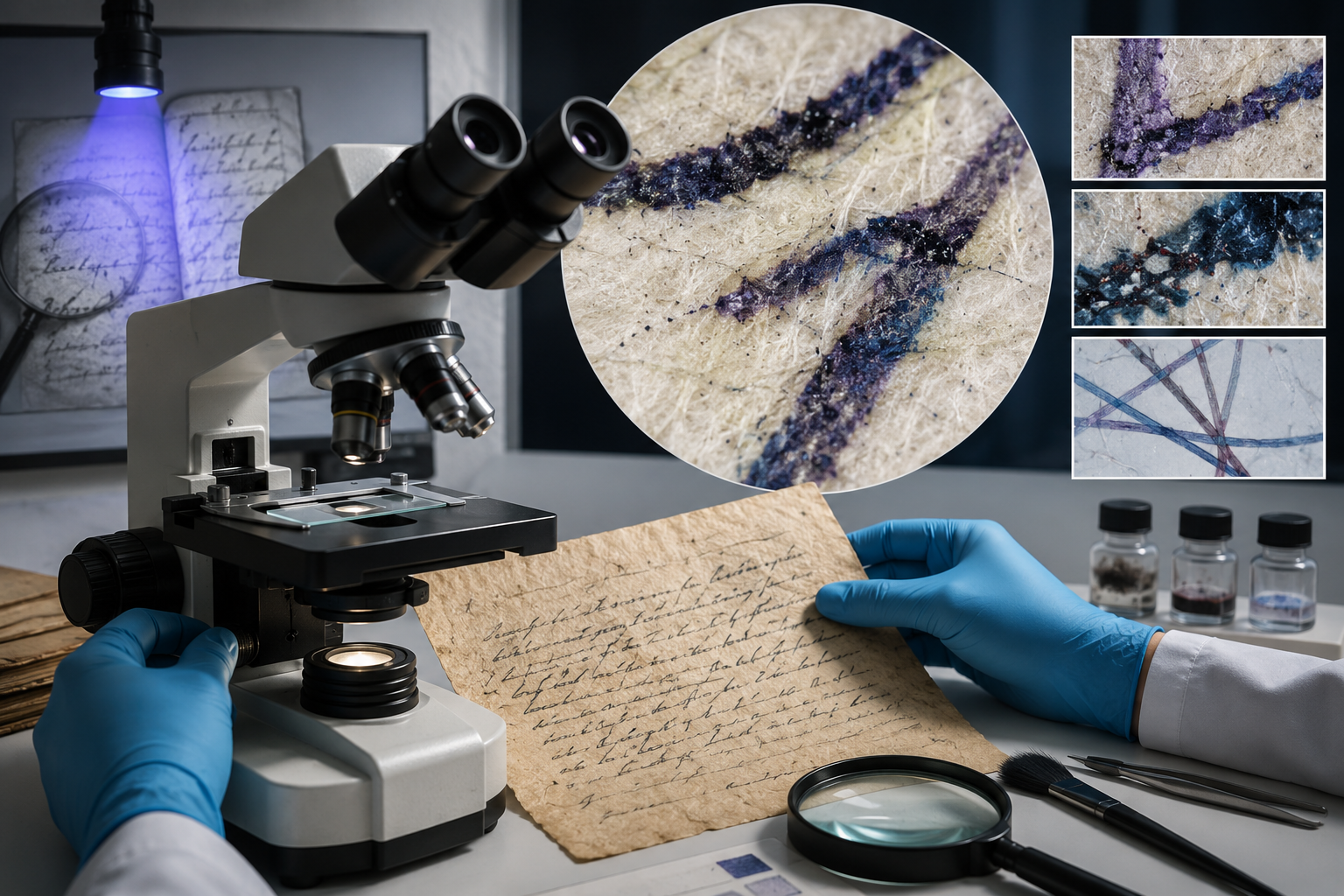
Microscopy involves the use of specialized optical instruments to magnify and inspect the fine details of documents. These instruments allow forensic experts to analyze:
- Ink distribution and layering
- Pen pressure and stroke quality
- Paper surface texture
- Erasures and alterations
- Printing patterns
- Toner characteristics
- Security fibers and embedded features
By enlarging these details, examiners can detect inconsistencies that may indicate forgery, tampering, or document substitution.
Types of Microscopes Used in Forensic Document Examination
Stereomicroscope
The stereomicroscope is one of the most commonly used instruments in forensic laboratories. It provides a three-dimensional view of a document’s surface.
It is especially useful for:
- Examining pen lifts and hesitation marks
- Detecting line crossings
- Identifying indented writing
- Observing paper damage from erasures
For example, when analyzing a suspicious signature, a stereomicroscope can reveal unnatural tremors or pauses that suggest simulation or tracing.
Comparison Microscope
A comparison microscope combines two microscopes with a shared viewing system, allowing side-by-side comparison of two samples.
This is essential for:
- Comparing handwriting samples
- Matching printed text characteristics
- Examining paper fibers from questioned and known documents
It helps forensic experts identify subtle differences or similarities that support authenticity assessments.
Polarized Light Microscope
This microscope is used to analyze the optical properties of paper fibers and inks.
Applications include:
- Identifying fiber composition
- Distinguishing different paper sources
- Examining ink crystal structures
It can reveal whether two documents originated from the same source or if pages were substituted.
Digital Microscopes
Modern forensic laboratories increasingly use digital microscopy for high-resolution imaging and documentation.
Benefits include:
- Real-time magnification on-screen
- Easy image capture for reports
- Enhanced image processing
- Efficient courtroom presentation of evidence
Digital microscopy improves both analysis accuracy and evidence communication.
Detecting Document Alterations
Microscopy is particularly valuable in identifying alterations that are intentionally concealed.
Erasures
Mechanical erasures disturb paper fibers. Under magnification, examiners can detect disrupted surface patterns and abrasions.
Ink Additions
Microscopic examination can reveal whether additional writing was added later by studying stroke overlap and ink layering.
Line Crossings
Determining which line was written first can help establish sequence, especially in disputed signatures or altered dates.
For instance, if a signature crosses printed text, microscopy may show whether the signature was placed before or after printing—critical evidence in fraud investigations.
Ink Examination Under Magnification
Ink analysis is one of microscopy’s most valuable applications.
Under magnification, examiners study:
- Stroke edges
- Ink absorption patterns
- Flow irregularities
- Pen pressure variation
- Deposits caused by pauses or hesitation
These characteristics can reveal whether writing was naturally executed or slowly simulated by a forger.
A genuine signature typically shows smooth, fluid ink flow, while forged signatures often display tremors, blunt starts, and inconsistent pressure.
Paper Fiber Analysis
Microscopy also helps analyze the physical structure of paper.
By examining fiber arrangement, density, and additives, forensic experts can:
- Compare questioned paper with known samples
- Identify page substitutions
- Detect counterfeit certificates or legal documents
Even subtle differences in paper manufacturing can become decisive evidence.
Courtroom Significance of Microscopic Findings
Microscopic evidence often strengthens expert testimony in legal proceedings.
Captured microscopic images allow courts to visually understand:
- Why a signature is suspicious
- How an alteration occurred
- Whether two documents share common origins
This visual clarity makes technical findings easier for judges and juries to interpret, increasing the credibility of forensic conclusions.
Challenges and Limitations
While microscopy is highly effective, it is not infallible.
Its limitations include:
- Dependence on examiner expertise
- Potential interpretation subjectivity
- Need for complementary techniques such as spectroscopy or chemical analysis
Microscopy works best when combined with broader forensic methodologies rather than as a standalone tool.
The Future of Microscopy in Document Examination
Technological advancements are transforming forensic microscopy.
Emerging innovations include:
- AI-assisted image analysis
- 3D surface profiling
- Automated stroke comparison systems
- Enhanced multispectral microscopic imaging
These developments are increasing precision and reducing examiner bias, making document authentication even more reliable.
Conclusion
Microscopy is the silent detective of forensic document analysis. It uncovers hidden evidence, exposes forgery attempts, and reveals the microscopic truth behind disputed documents.
From analyzing ink flow to detecting altered fibers, microscopy provides forensic experts with the precision needed to establish authenticity and support justice.
In questioned document examination, sometimes the smallest details tell the biggest story.


Post comments (0)