Introduction
Signatures have long been used as a symbol of identity, consent, and authorisation. From banking transactions and legal agreements to passports and business contracts, signatures continue to play a vital role in everyday life. However, with the increasing cases of forgery and document fraud, verifying the authenticity of signatures has become an important aspect of forensic science.
Signature verification is not simply about comparing two signatures visually. It is a scientific process that involves detailed examination of handwriting characteristics, writing habits, pressure patterns, movement, rhythm, and several microscopic features. Forensic document examiners use specialised techniques and tools to determine whether a signature is genuine, forged, disguised, or traced.
Understanding the science behind signature verification helps explain how forensic experts uncover document fraud and support criminal and civil investigations.
What is Signature Verification?
Signature verification is the process of analysing and comparing signatures to determine authenticity. In forensic document examination, experts compare a questioned signature with known genuine samples of the same individual.
The primary objective is to answer questions such as:
- Was the signature written by the claimed person?
- Has the signature been forged or altered?
- Was the signature copied, traced, or simulated?
- Does the signature show signs of disguise?
Every individual develops unique writing habits over time. These habits become deeply ingrained through repeated writing movements and are difficult to imitate perfectly. Even when a person intentionally changes their signature, certain natural characteristics remain present.
This individuality forms the scientific basis of signature verification.
Why Signatures Are Unique
No two individuals write exactly alike. A person’s signature develops through years of practice and muscle memory. Factors such as hand coordination, writing speed, pressure, pen grip, education, and neurological patterns influence signature formation.
Even though genuine signatures may show natural variations, they still maintain consistent individual characteristics. These recurring features help forensic experts identify authenticity.
Some common signature characteristics include:
- Letter formation
- Slant and alignment
- Writing speed
- Pen pressure
- Spacing between letters
- Connecting strokes
- Size and proportions
- Beginning and ending strokes
- Rhythm and fluency
A forged signature may imitate the overall appearance but often fails to reproduce these natural writing features accurately.
Types of Signature Forgery
Forensic experts encounter different types of forged signatures during investigations. Understanding these forgery methods helps in detecting fraud effectively.
Simple Forgery
In simple forgery, the forger writes a name without attempting to imitate the genuine signature. These forgeries are usually easy to identify because they lack the writing habits of the original writer.
Simulated Forgery
This involves careful imitation of a genuine signature by observing an original sample. Simulated forgeries attempt to copy the shape and style of the signature, making them more difficult to detect.
However, simulated signatures often show:
- Hesitation marks
- Tremors
- Slow writing movements
- Poor rhythm
- Unnatural pen lifts
Traced Forgery
In traced forgery, the original signature is copied by manually tracing it or by using light sources. These signatures may appear visually accurate, but usually lack natural writing speed and pressure variation.
Disguised Signature
Sometimes individuals intentionally alter their own signatures to deny authenticity later. This is called disguised writing. Experts examine underlying writing habits to determine whether the signature belongs to the individual despite intentional modifications.
The Process of Signature Verification
Forensic signature verification follows a systematic scientific approach. Experts carefully analyse both questioned and admitted signatures before concluding.
Collection of Samples
The first step involves collecting the following:
- Questioned signatures
- Admitted or specimen signatures
Admitted signatures are known genuine signatures collected from official documents, records, or writing samples provided voluntarily.
For accurate comparison, experts require multiple genuine samples because natural variation exists in every individual’s handwriting.
Preliminary Examination
The examiner first studies the signatures visually to identify obvious similarities or differences. Factors such as size, style, slant, and alignment are observed initially.
This helps determine whether detailed microscopic examination is necessary.
Detailed Comparative Analysis
The questioned and genuine signatures are compared feature by feature. Examiners analyse:
- Stroke quality
- Pen pressure patterns
- Speed and fluency
- Connecting strokes
- Line quality
- Letter formations
- Spacing and proportions
Natural writing usually appears smooth and fluent, whereas forged writing often shows hesitation and unnatural movement.
Microscopic Examination
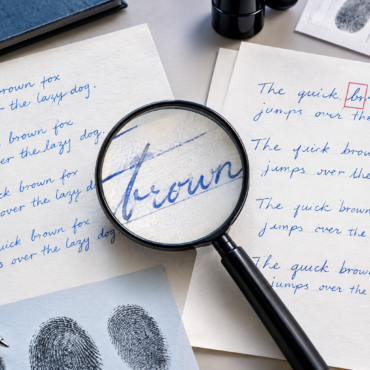
Advanced forensic laboratories use microscopes and digital imaging tools to examine signatures closely.
Microscopic analysis can reveal:
- Pen lifts
- Retouching
- Tremors
- Ink deposits
- Tracing impressions
These details are often invisible to the naked eye.
Evaluation and Conclusion
After examining all characteristics, the forensic document examiner forms an expert opinion regarding authenticity.
The conclusion may state:
- The signature is genuine
- The signature is forged
- Evidence is inconclusive
The writer probably wrote or did not write the signature
Tools Used in Signature Verification
Modern forensic laboratories use advanced instruments and technologies to assist document examination.
Some commonly used tools include:
- Comparison microscopes
- Video spectral comparators (VSC)
- Magnifying lenses
- Digital imaging systems
- Electrostatic detection apparatus (ESDA)
- Infrared and ultraviolet light sources
These tools help experts detect erased writing, alterations, tracing marks, and ink differences.
Importance of Signature Verification
Signature verification plays an essential role in:
- Banking fraud investigations
- Property disputes
- Insurance claims
- Legal document authentication
- Financial fraud cases
- Passport and identity verification
A forged signature can lead to severe financial losses and legal complications. Forensic examination helps establish authenticity and supports fair legal proceedings.
In courts, forensic document examiners may provide expert testimony explaining their findings and scientific analysis.
Challenges in Signature Verification
Despite scientific methods, signature verification can sometimes be challenging.
Certain factors complicate examination, including:
- Limited genuine samples
- Poor-quality photocopies
- Intentional disguise
- Health conditions affecting handwriting
- Age-related writing changes
- Digital signatures and scanned documents
Modern technology has also increased sophisticated forgery methods, requiring forensic experts to continuously adapt and improve examination techniques.
Conclusion
Signature verification is a fascinating blend of science, observation, and forensic expertise. While signatures may appear simple, they contain complex individual characteristics shaped by years of writing habits and muscle memory.
Forensic document examiners use scientific methods to analyse handwriting patterns, identify forgery indicators, and determine authenticity with precision. Through detailed examination of stroke quality, pressure, rhythm, and writing movement, experts can uncover fraudulent signatures that might otherwise go unnoticed.
As document fraud continues to evolve in the digital age, the importance of forensic signature verification remains stronger than ever. Whether in criminal investigations, banking disputes, or legal proceedings, signature verification continues to protect identities, prevent fraud, and support the pursuit of justice.




Post comments (0)