We’ve all seen the classic crime show trope: a detective walks into a dark room, looks at a dented bumper, and suddenly knows exactly where the suspect went. Today, that scene looks very different. The detective wouldn’t just look at the scratches on the outside; they would plug a specialized computer into the vehicle’s dashboard.
Welcome to the era of automotive forensics—the digital autopsy of the modern smart car.
Modern vehicles are no longer just mechanical machines powered by internal combustion or batteries. They are, quite literally, rolling data centers. As you drive, your car is constantly talking to itself, to cell towers, to your phone, and even to the road infrastructure. When a vehicle is involved in an incident, it leaves behind a massive, invisible breadcrumb trail of telemetry data.
Here is what happens when forensic investigators perform a digital autopsy on a smart car, and what your vehicle’s telemetry leaves behind.
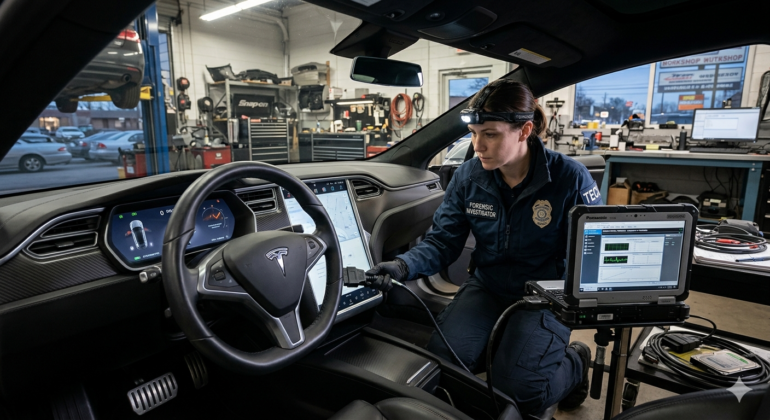
The Rolling Black Box: Where Data Hides
In a traditional computer forensic investigation, an expert looks at a hard drive or a phone. In a car, data isn’t stored in one neat little box. Instead, a vehicle relies on dozens—sometimes hundreds—of mini-computers called Electronic Control Units (ECUs) communicating via internal networks like the CAN bus (Controller Area Network).
When conducting an automotive autopsy, investigators focus on three primary data goldmines:
1. The Event Data Recorder (EDR)
Think of the EDR as the car’s version of an airplane’s black box. It is usually housed within the airbag control module. The EDR doesn’t record your entire road trip, but it is constantly monitoring the car’s vitals in a loop. When a “trigger event” occurs—like a sudden deceleration, a crash, or an airbag deployment—the EDR locks down the data from the 5 to 10 seconds before, during, and after the event under strict regulatory standards like Code of Federal Regulations Title 49 Part 563 in the United States.
2. The Telematics Control Unit (TCU)
The TCU is the car’s bridge to the outside world. It handles the built-in GPS, cellular connectivity, and automatic emergency calls. Because the TCU is constantly communicating with external networks, it keeps logs of location data, system updates, and remote commands (like unlocking the doors via a smartphone app). In regions like Europe, this system is heavily tied to the mandatory eCall emergency framework.
3. The Infotainment System (IVI)
The In-Vehicle Infotainment system is the screen you use for maps, music, and hands-free calling. For forensic investigators, the IVI is often the most rewarding piece of hardware to analyze because it acts as a mirror to the driver’s personal life. Investigators frequently use specialized vehicle forensics hardware and software, such as the Berla iVe ecosystem, to acquire this deeply buried data.
What the Telemetry Leaves Behind
When a car undergoes a digital autopsy, the sheer volume of recovered telemetry can paint a terrifyingly accurate picture of human behavior. Here is a breakdown of what investigators can pull from a car’s memory:
The Physical Dynamics (How you drove)
From the EDR and powertrain modules, forensics can extract granular physical data points sampled multiple times per second:
-
Exact speed and acceleration rates.
-
Braking status: Did the driver slam on the brakes, or did they never even touch the pedal before impact?
-
Steering wheel angle: Was the driver trying to swerve to avoid an obstacle?
-
Seatbelt status: Were the occupants buckled in, and did the pretensioners deploy?
-
Gear position: Was the car in Drive, Reverse, or Park at a critical moment?
The Digital Footprint (Where you went)
Using the GPS cache stored within the TCU and infotainment systems, investigators can reconstruct routes even if the driver didn’t have an active navigation route set. This includes:
-
Geographic coordinates and timestamps of where the car was parked.
-
Frequent destinations and breadcrumb logs of recent drives.
-
Waypoints indicating exactly when a vehicle entered or exited a specific zone.
The Personal Connectivity (Who you talked to)
The moment you plug your smartphone into a car via USB or connect via Bluetooth to use Apple CarPlay or Android Auto, a massive data sync occurs. Most drivers don’t realize that the car often stores this information locally:
-
Call Logs and Text Messages: Complete lists of incoming, outgoing, and missed calls, sometimes alongside the actual text content of SMS messages.
-
Contact Lists: The vehicle imports your address book to make voice dialing easier.
-
Connected Device History: The unique MAC addresses and names of every phone that has ever connected to the car.
The Behavioral Ambient Data (What you were doing)
Modern smart cars track the states of almost every internal switch. Forensic tools can pull logs showing:
-
Exactly when a specific door was opened or closed.
-
Whether the headlights were set to automatic, high-beam, or off.
-
If a passenger was sitting in the front seat (based on weight sensors).
-
Even the volume level of the radio at the exact moment of a crash.
-
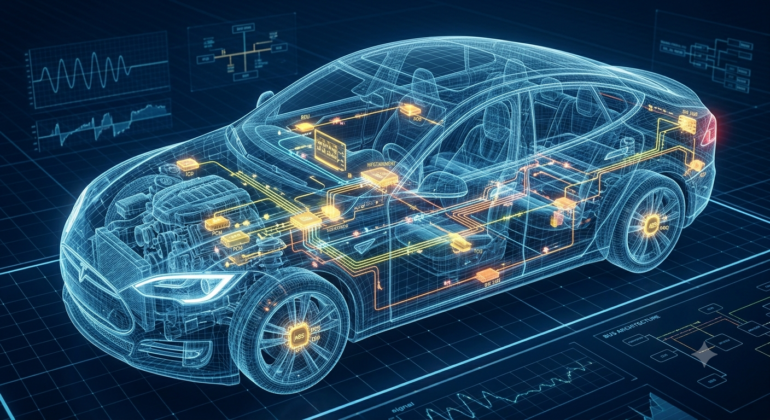
Real-World Case Studies: When the Car Rats on the Driver
Automotive forensics has completely changed how crimes and accidents are solved. Take, for instance, a hit-and-run investigation. A driver might claim their vehicle was stolen or parked at home during the time of an accident.
By performing a digital autopsy, investigators can pull the infotainment logs. If the telemetry shows that the suspect’s specific iPhone connected to the car via Bluetooth exactly two minutes before the crash, and the driver’s side door opened thirty seconds after the crash, the “stolen car” alibi completely collapses.
In another landmark case, vehicle telemetry disproved a driver’s claim that a fatal crash was caused by a mechanical failure. The car’s EDR revealed that in the five seconds leading up to the impact, the throttle was pressed 100% flat to the floor, and the brakes were never applied. The telemetry proved human error—or intent—rather than a mechanical defect.
The Dark Side: Privacy and Security Challenges
While this data is a miracle for law enforcement and insurance investigators, it raises serious privacy concerns for everyday drivers.
When you sell your car or return a rental, do you completely wipe the infotainment system? If not, the next owner might have access to your home address, your contact list, and a history of everywhere you drove. Privacy advocates, such as the Privacy Not Included project by the Mozilla Foundation, have heavily criticized car manufacturers for how aggressively they collect and store personal consumer data.
Furthermore, as cars become more reliant on cloud servers, the risk of data breaches increases. Hackers aren’t just looking to steal cars anymore; they are looking to steal the rich telemetry data associated with them.




Post comments (0)