Apple’s iPhone has earned a reputation for providing strong security and protecting users’ personal information. With every new generation, including the latest iPhone models and Pro series, Apple continues to strengthen its hardware and software security mechanisms. These improvements have made iPhone lock bypassing, passcode recovery, and digital forensic data extraction increasingly challenging.
For digital forensic investigators, law enforcement agencies, and data recovery professionals, accessing a locked iPhone is not simply a matter of connecting it to a computer or running forensic software. The process involves understanding the device’s hardware, iOS version, encryption architecture, and security configuration.
But just how difficult is it to bypass the lock on a modern iPhone? Let’s explore the technical challenges.
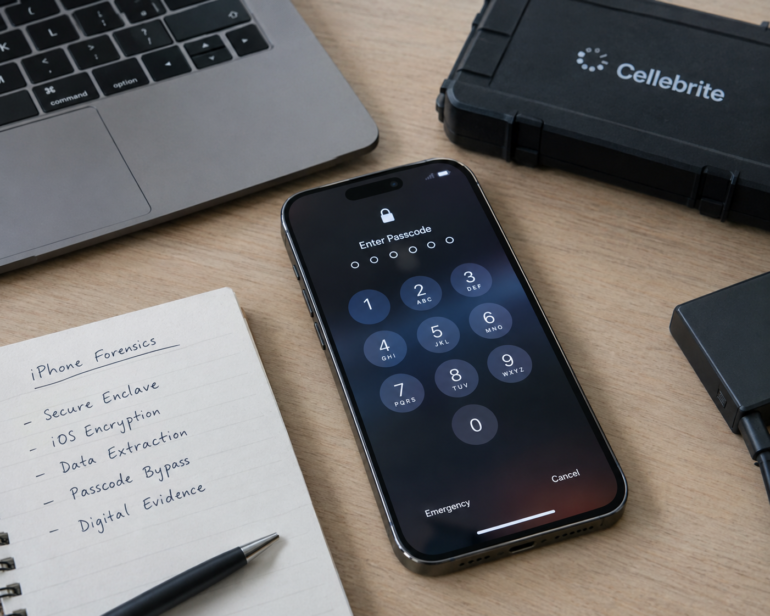
1. Understanding iPhone Security Architecture
One of the primary reasons modern iPhones are difficult to access is Apple’s hardware-based security architecture.
Apple incorporates a dedicated security subsystem known as the Secure Enclave. It is designed to protect sensitive information, including cryptographic keys and biometric authentication data.
The Secure Enclave works alongside the device’s processor and encryption mechanisms to ensure that sensitive information remains protected, even if certain parts of the operating system are compromised.
Apple’s official documentation on the Secure Enclave explains how this security subsystem protects passcode-related information and helps prevent unauthorized access.
This architecture makes traditional password-cracking approaches significantly less effective against modern iPhones.
2. Why the Latest iPhone Pro Models Are More Difficult to Unlock
The latest iPhone Pro models benefit from advanced processors, improved security hardware, and updated iOS security mechanisms.
Several factors contribute to the difficulty of iPhone lock bypassing:
Hardware-Based Encryption
Modern iPhones use hardware-backed encryption to protect stored information. Access to encrypted data depends on cryptographic keys that are protected by the device’s security architecture.
Even if the storage chip is physically removed, the extracted data may remain encrypted and inaccessible without the necessary cryptographic material.
Secure Enclave Protection
The Secure Enclave helps enforce passcode verification and protects sensitive cryptographic operations.
This means that attempting to guess a passcode through repeated external commands is not equivalent to testing passwords against an ordinary computer file.
Passcode Attempt Restrictions
Apple incorporates mechanisms that discourage repeated incorrect passcode attempts. Depending on the device configuration, incorrect attempts can trigger increasing delays or other restrictions.
These protections make brute-force attacks impractical in many situations.
Regular iOS Security Updates
Apple regularly releases iOS updates that address security vulnerabilities. A forensic technique that works on one device or software version may not work on another.
This is particularly important when examining newer iPhone Pro models, where the combination of hardware generation and software version can significantly influence forensic accessibility.
3. Is iPhone Lock Bypassing Still Possible?
The answer is: It depends on the device and its condition.
There is no universal method that can reliably bypass every iPhone lock screen.
In digital forensics, the term “lock bypass” is often used broadly. However, several different situations must be distinguished:
-
Passcode bypass: Attempting to access a device without knowing its screen-lock passcode.
-
Forensic extraction: Acquiring available digital evidence using specialized forensic tools.
-
Logical acquisition: Collecting data that the device makes accessible through supported interfaces.
-
File-system acquisition: Obtaining a more detailed representation of the device’s accessible file system.
-
Data recovery: Attempting to retrieve information that may have become inaccessible because of deletion, damage, or software failure.
These processes are not interchangeable.
A device may be successfully accessed for a limited extraction without providing complete access to all stored information. Similarly, a forensic tool may identify a supported acquisition method but still be unable to retrieve particular categories of data.
The availability of a technique depends on multiple variables, including the iPhone model, iOS version, passcode configuration, device state, and the nature of the investigation.
4. Why Device State Matters in Digital Forensics
An important consideration in iPhone digital forensics is the device’s state when it is received by the laboratory.
For example, an iPhone that has recently restarted may behave differently from one that has remained powered on and unlocked.
After a restart, certain cryptographic keys remain unavailable until the user enters the correct passcode. This can significantly restrict access to protected information.
Other factors that may affect forensic accessibility include:
-
Whether the device has been restarted.
-
Whether the correct passcode is available.
-
Whether the device has been disabled after incorrect attempts.
-
Whether the device is running the latest iOS version.
-
Whether a previous forensic acquisition or backup exists.
-
Whether the device has physical or software-related damage.
Apple’s Encryption and Data Protection documentation provides further information about how hardware-based encryption and key management protect iPhone data.
Understanding these factors is essential before determining whether a forensic examination is technically feasible.
5. The Role of Digital Forensic Tools
Professional digital forensic laboratories use specialized tools to examine mobile devices and acquire available evidence.
Tools such as Cellebrite UFED, MSAB XRY, and Magnet AXIOM support different types of mobile forensic examinations.
However, having access to these tools does not guarantee that every locked iPhone can be bypassed.
Tool compatibility depends on the specific device, software version, available acquisition methods, and the condition of the device.
For this reason, a professional laboratory should conduct a preliminary assessment before making any commitment regarding data extraction or recovery.
It is also important to distinguish between a tool’s advertised capabilities and the results achievable on a particular device.
6. Can Data Be Recovered Without the Passcode?
This is one of the most common questions received by digital forensic laboratories.
The possibility of recovery depends on the circumstances.
If an existing backup is available, some information may be recoverable without accessing the locked device itself. However, encrypted backups may require their original passwords or encryption credentials.
If no backup exists and the device remains locked, the prospects of recovering protected information can be significantly limited.
Furthermore, if the device has been factory-reset, the recovery situation becomes substantially more complicated because the cryptographic keys protecting the previous data may have been destroyed.
A laboratory must therefore evaluate the device’s condition, available backups, and technical limitations before providing a realistic assessment.
Conclusion
Lock bypassing on the latest iPhone models, particularly the Pro series, is a highly specialized and technically challenging process.
Apple’s Secure Enclave, hardware-based encryption, passcode restrictions, and frequent iOS security updates create multiple layers of protection against unauthorized access.
Although specialized digital forensic tools can provide valuable examination capabilities, there is no guaranteed method for unlocking every modern iPhone.
At Hawk Eye Forensic Lab, we believe that every mobile forensic case should begin with a careful technical assessment. The objective is to determine what can realistically be accessed, what limitations exist, and which forensic approach is appropriate for the specific device.
For authorized investigations involving locked iPhones, professional assessment is essential before attempting any procedure that could affect the device or its stored evidence.

Post comments (0)