Natural disasters, transportation accidents, industrial explosions, terrorist attacks, and other mass fatality incidents often leave behind victims who cannot be identified through visual recognition alone. In such situations, Disaster Victim Identification (DVI) becomes one of the most critical responsibilities of forensic science.
DVI is a systematic scientific process used to establish the identity of deceased individuals accurately and respectfully. Correct identification provides legal certainty, assists criminal investigations, enables families to receive closure, and ensures that the deceased are returned to their loved ones with dignity.
What is Disaster Victim Identification (DVI)?
Disaster Victim Identification (DVI) refers to the organized forensic process of identifying individuals who have died during a mass casualty event.
These incidents may include:
- Earthquakes
- Floods
- Tsunamis
- Air crashes
- Train accidents
- Building collapses
- Industrial disasters
- Terrorist attacks
- Fire incidents
- Armed conflicts
Since many victims suffer severe injuries, decomposition, or fragmentation, visual identification is often unreliable. Scientific forensic techniques provide the most accurate means of establishing identity.
Importance of DVI
Accurate victim identification is important for several reasons:
- Provides closure to grieving families.
- Prevents mistaken identity.
- Supports legal documentation such as death certificates.
- Assists insurance and inheritance claims.
- Helps criminal and disaster investigations.
- Maintains human dignity.
- Facilitates international cooperation during multinational disasters.
Incorrect identification can lead to emotional trauma, legal complications, and significant investigative errors.
Role of Forensic Science in DVI
Forensic science combines multiple scientific disciplines to identify victims using reliable evidence.
Major forensic specialties involved include:
- DNA Analysis
- Fingerprint Examination
- Forensic Odontology
- Forensic Anthropology
- Forensic Pathology
- Medical Imaging
- Personal Property Examination
Each discipline contributes valuable information that is combined to establish a positive identification.
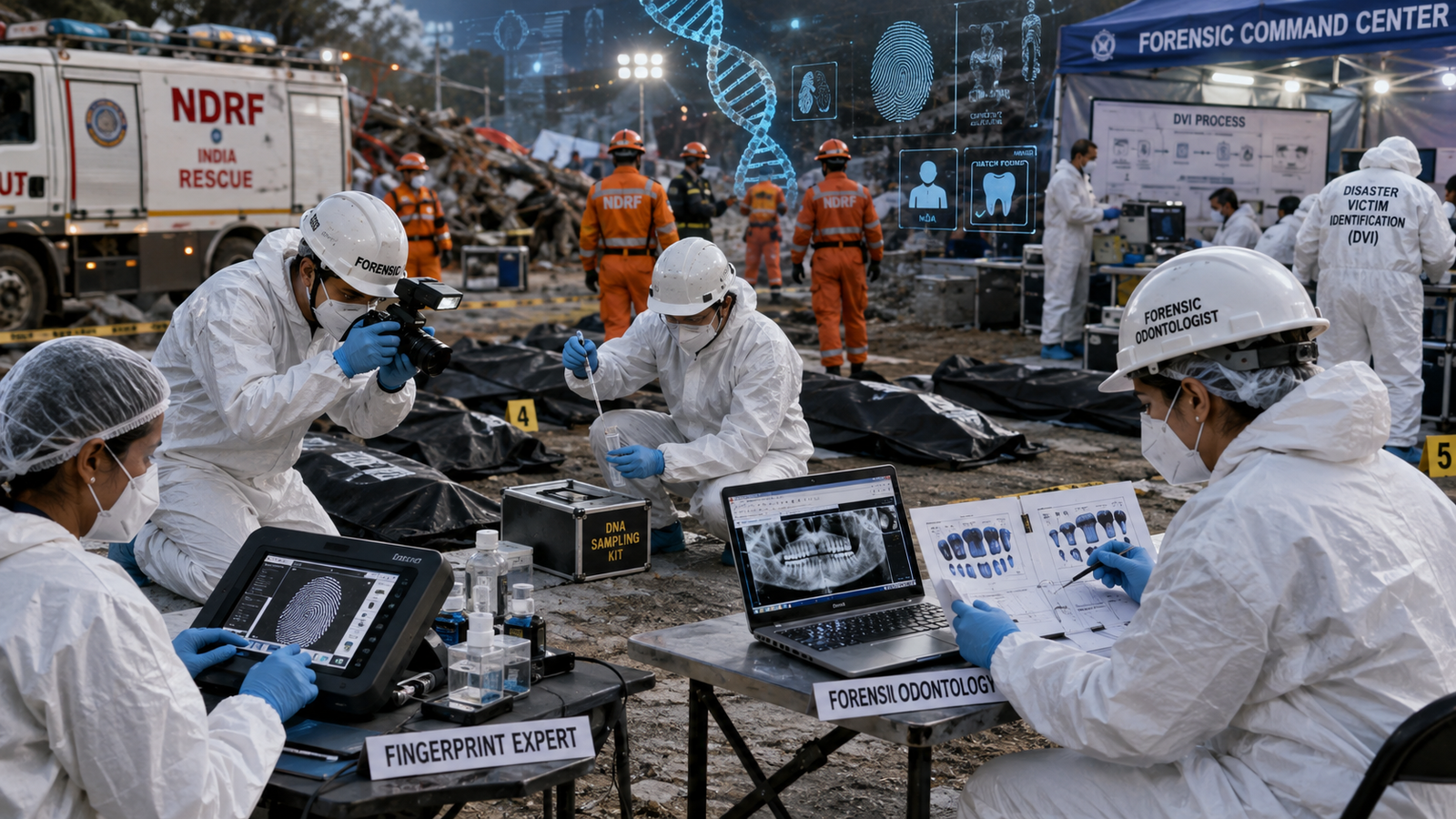
Disaster Victim Identification (DVI) Process
The DVI process typically includes the following stages:
Scene Examination-
The disaster site is carefully documented before recovery begins.
Activities include:
- Mapping the disaster scene
- Photographing remains
- Assigning unique identification numbers
- Recording GPS locations
- Collecting personal belongings
- Preserving biological evidence
- Maintaining chain of custody
Proper documentation prevents loss of crucial identification evidence.
Postmortem Data Collection-
After recovery, forensic experts examine the remains.
They collect:
- Fingerprints
- DNA samples
- Dental examination records
- X-rays
- Medical implants
- Tattoos
- Surgical scars
- Clothing and jewelry
- Biological characteristics
Every observation is documented using standardized forms.
Antemortem Data Collection—
Information about missing persons is gathered from relatives, hospitals, employers, and government records.
This includes:
- Dental records
- Medical history
- Fingerprints
- DNA reference samples from family members
- Photographs
- Surgical records
- Blood group
- Tattoos
- Previous fractures
- Personal descriptions
Accurate antemortem information greatly improves identification success.
Reconciliation-
- Forensic specialists compare postmortem findings with antemortem records.
- Multiple experts independently verify the results before confirming identity.
- Only after scientific agreement is a victim officially identified.
Primary Identification Methods
DNA Analysis
DNA profiling is often considered the most reliable identification technique.
It can be extracted from:
- Teeth
- Bones
- Blood
- Muscle tissue
- Hair roots
The DNA profiles are compared with:
- Family reference samples
- Personal biological items
- Existing DNA databases
Moreover, DNA remains useful even when fingerprints cannot be recovered.
Fingerprint Examination
Fingerprints remain one of the fastest identification methods when ridge details are preserved.
Experts compare recovered fingerprints with:
- National databases
- Employment records
- Immigration records
- Criminal records
- Civil identification systems
Modern fingerprint enhancement techniques can recover prints even from decomposed remains.
Forensic Odontology
Teeth are among the most durable structures in the human body.
Forensic odontologists compare:
- Dental restorations
- Fillings
- Crowns
- Root canal treatments
- Tooth alignment
- Missing teeth
- Dental X-rays
Dental comparison is especially valuable in fire disasters where soft tissues are destroyed.
Secondary Identification Methods
Secondary identifiers support the primary methods.
These include:
- Tattoos
- Birthmarks
- Surgical scars
- Clothing
- Jewelry
- Personal belongings
- Medical implants
- Prosthetic devices
Although useful, these features alone are generally insufficient for positive identification.
Role of Forensic Anthropology
Forensic anthropologists assist when remains are skeletal or fragmented.
They help determine:
- Biological sex
- Approximate age
- Stature
- Ancestry
- Previous fractures
- Bone diseases
- Trauma patterns
Anthropological findings help narrow the list of possible victims.
Role of Forensic Pathology
Forensic pathologists determine:
- Cause of death
- Manner of death
- Injury patterns
- Time since death
- Disease conditions
These findings may also assist disaster investigations and criminal inquiries.
Advanced Technologies in DVI
Modern forensic laboratories increasingly use advanced technologies, including:
- Rapid DNA testing
- 3D facial reconstruction
- Postmortem CT scanning
- Digital dental comparison
- Automated fingerprint identification systems
- Geographic Information Systems (GIS)
- Artificial Intelligence-assisted image analysis
- Digital evidence management systems
These technologies improve both speed and accuracy during large-scale disasters.
Challenges in Disaster Victim Identification
Despite technological advances, DVI teams face several challenges:
- Severely decomposed remains
- Burned or fragmented bodies
- Lack of medical or dental records
- Mixed human remains
- Environmental damage
- Large number of victims
- Cross-border identification issues
- Emotional stress on investigators
- Time-sensitive recovery operations
Effective coordination among forensic experts, police, medical authorities, and disaster management agencies is essential to overcome these challenges.
Importance of Teamwork
A successful DVI operation requires collaboration between multiple professionals, including:
- Crime scene investigators
- Forensic pathologists
- DNA analysts
- Fingerprint experts
- Forensic odontologists
- Forensic anthropologists
- Police officers
- Disaster management authorities
- Medical professionals
- Laboratory scientists
Standardized procedures, accurate documentation, and proper communication ensure reliable identification results.
Future of Disaster Victim Identification
Emerging technologies continue to improve DVI capabilities. Artificial intelligence, advanced DNA sequencing, portable forensic laboratories, drone-assisted disaster mapping, and digital data integration are making victim identification faster and more accurate.
As climate-related disasters and mass casualty incidents become more frequent worldwide, investment in forensic infrastructure, specialized training, and international collaboration will play an increasingly important role in humanitarian response.
Conclusion
Disaster Victim Identification is one of the most vital applications of forensic science. Through DNA profiling, fingerprint examination, dental comparison, forensic anthropology, pathology, and advanced imaging technologies, forensic experts provide scientifically accurate identification even under the most challenging conditions.
Beyond its scientific value, DVI serves a deeply humanitarian purpose—returning names to the deceased, providing certainty to families, supporting legal processes, and preserving dignity after tragedy. As forensic technologies continue to evolve, disaster victim identification will remain an essential component of effective disaster response and public safety.


Post comments (0)