Fingerprints can provide valuable evidence during a forensic investigation. A single latent fingerprint recovered from a surface may help investigators associate a person with an object or location. However, fingerprint evidence can easily be damaged, contaminated, or lost if it is not handled correctly.
Whether the evidence is collected from a crime scene, document, mobile phone, glass, weapon, or another object, proper handling is essential for reliable fingerprint examination.
Here are 10 things you should never do when handling suspected fingerprint evidence.
1. Never Touch the Evidence With Bare Hands
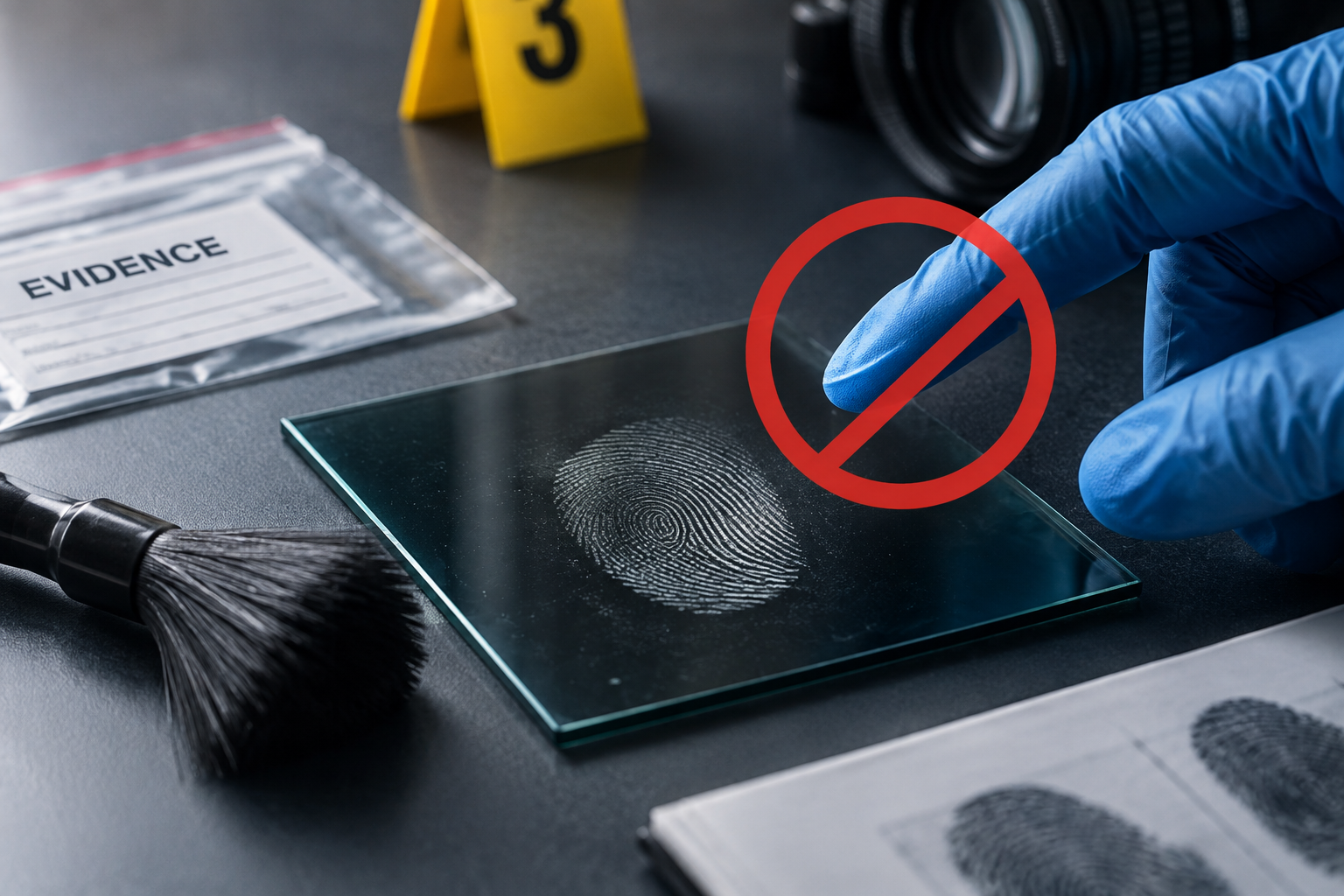
One of the most common mistakes is touching an object that may contain fingerprints. Your own fingerprints can be deposited on the evidence and may contaminate the original latent fingerprints.
Investigators should handle evidence using appropriate protective equipment and avoid touching surfaces where fingerprints may be present.
2. Never Rub or Wipe the Surface
Do not wipe, clean, polish, or rub an object suspected of containing fingerprints. Even apparently harmless cleaning can destroy fingerprint ridge details.
For example, wiping a glass, phone screen, metal surface, or plastic object may remove or smear the fingerprint evidence, making subsequent examination difficult or impossible.
3. Never Apply Fingerprint Powder Without Proper Assessment
Fingerprint powder is commonly used for developing latent fingerprints, but it should not automatically be applied to every surface.
The surface material, condition, background, and nature of the suspected print should be considered before selecting a development technique. Incorrect application can obscure ridge details or interfere with subsequent forensic examination.
4. Never Place Evidence Directly on Unprotected Surfaces
Evidence should not be casually placed on desks, floors, vehicles, or other uncontrolled surfaces.
Contact with another surface can introduce new fingerprints, dust, fibers, moisture, or other contaminants. Proper packaging helps preserve the original condition of the evidence and supports the chain of custody.
5. Never Stack Items Together
Different pieces of evidence should generally be packaged separately when there is a possibility that their surfaces may contain fingerprints.
Placing objects together can cause unwanted contact between surfaces and may transfer fingerprints from one item to another. Separate packaging can help preserve the evidentiary condition of each item.
6. Never Attempt to “Improve” a Fingerprint
A partially visible fingerprint should never be manually enhanced by rubbing, pressing, wetting, or otherwise manipulating the surface.
A forensic examiner uses controlled methods to develop and document latent fingerprint evidence. Trying to improve a suspected print manually may permanently alter the evidence.
7. Never Photograph Fingerprints Without Proper Documentation
Photography is an important part of forensic fingerprint examination, but simply taking a quick photograph is not enough.
The evidence and fingerprint should be properly documented, including appropriate scale, orientation, lighting, and identification information where applicable. Proper documentation allows the examination process to be reviewed later.
8. Never Assume That a Fingerprint Is Automatically an Identification
Finding a fingerprint does not automatically mean that the person responsible for an incident has been identified.
A fingerprint examiner evaluates the quality and characteristics of the impression before conducting a comparison. Factors such as distortion, smearing, insufficient ridge detail, and surface conditions can affect the examination.
The National Institute of Standards and Technology (NIST) provides scientific and technical resources related to biometrics and fingerprint technology.
9. Never Ignore the Original Evidence After Finding a Print
A developed fingerprint should not be considered separately from the object on which it was found.
The location of the print, condition of the surface, surrounding marks, and other associated evidence may be important during the investigation. Proper documentation of the original evidence can provide valuable context for fingerprint identification.
10. Never Break the Chain of Custody
One of the most important principles of evidence handling is maintaining a clear record of who collected, handled, transferred, stored, and examined the evidence.
If the handling history is incomplete, questions may arise about whether the evidence was properly preserved. Maintaining documentation throughout the process supports the integrity and traceability of forensic evidence.
The International Association for Identification (IAI) provides professional resources and information relating to forensic identification disciplines, including friction ridge examination.
Why Proper Fingerprint Evidence Handling Matters
Fingerprint evidence can contain extremely fine ridge details. Once those details are damaged or contaminated, recovering the original information may become difficult.
Proper handling therefore begins before the evidence reaches the forensic laboratory. Investigators and evidence-handling personnel should minimize unnecessary contact, use appropriate packaging, document the evidence carefully, and follow established forensic procedures.
At the laboratory stage, trained professionals can determine the appropriate fingerprint development technique based on the surface and condition of the evidence. Depending on the circumstances, techniques may include powder development, chemical processing, cyanoacrylate fuming, specialized lighting, or other laboratory methods.



Post comments (0)