Introduction
Handwriting is one of the most unique forms of human expression. Long before digital communication became dominant, handwritten notes, letters, and signatures were used as primary means of communication and personal identification. Even today, handwriting continues to play a significant role in forensic investigations, legal disputes, and document verification. A common question often arises: Can handwriting reveal a person’s personality or identity?
The answer is both yes and no. While handwriting can be highly useful in establishing identity through forensic examination, claims about determining personality traits solely from handwriting remain scientifically controversial. Understanding the distinction between handwriting identification and personality analysis is essential.
Understanding Handwriting as an Individual Trait
Handwriting develops through a combination of learned writing systems, motor skills, education, and personal habits. During childhood, individuals are taught a standard writing style. However, as writing becomes more natural over time, people unconsciously introduce unique variations.
These variations may include:
- Letter formations
- Slant and alignment
- Pen pressure
- Spacing between letters and words
- Writing speed
- Connecting strokes
- Size and proportions of characters
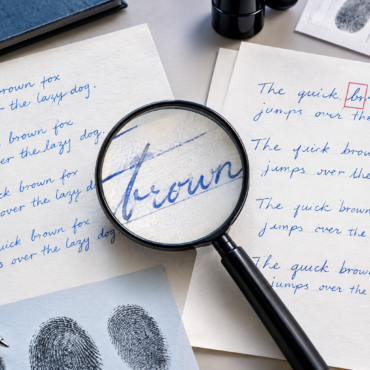
The combination of these characteristics creates a writing style that is often unique to an individual, much like a fingerprint. Although two people may have similar handwriting, no two writers are likely to exhibit the same combination of writing features consistently.
Handwriting and Identity: A Forensic Perspective
From a forensic view, handwriting can be an important tool for identifying or eliminating a writer. The discipline responsible for this process is known as Questioned Document Examination.
Forensic document examiners compare known handwriting samples with questioned documents to determine whether they were written by the same individual. The examination focuses on identifying similarities and differences in writing characteristics.
Common features examined include:
Letter Formation:
Every writer develops distinctive ways of forming letters. Examiners study the shape, structure, and construction of individual characters.
Slant:
The direction in which letters lean can vary from person to person. Some writers have a consistent right slant, while others write vertically or with a left slant.
Spacing:
The distance between letters, words, and lines often remains relatively consistent for an individual writer.
Pen Pressure:
Writers apply varying amounts of pressure when writing. This affects ink distribution and stroke appearance.
Connecting Strokes:
The way letters connect in cursive or semi-cursive writing provides valuable identifying information.
Rhythm and Movement:
Natural handwriting exhibits smooth and spontaneous movement. Forged writing often appears slow, hesitant, or unnatural.
By analyzing these features collectively, forensic experts can determine whether a particular person wrote a document or not. Courts around the world frequently accept handwriting examination as supporting evidence when performed using established forensic methodologies.
The Concept of Graphology
When discussing handwriting and personality, the term “graphology” often emerges.
Graphology is the practice of interpreting handwriting to assess personality traits, emotional states, intelligence, or behavioral tendencies. Graphologists believe that certain handwriting characteristics reflect aspects of an individual’s psychological makeup.
For example, graphology may associate:
- Large handwriting with confidence
- Small handwriting with concentration
- Heavy pressure with determination
- Wide spacing with independence
- Narrow spacing with sociability
Many organizations and individuals have historically used graphology for personality assessment, career guidance, and employee screening.
However, the scientific community generally does not recognize graphology as a reliable method for accurately determining personality traits.
Scientific View on Personality Analysis Through Handwriting
Numerous scientific studies have attempted to evaluate whether handwriting reliably reflects personality characteristics.
The findings have largely shown that:
- Handwriting can vary due to physical and environmental factors.
- Writing style may change depending on mood, health, writing surface, or writing instrument.
- Personality predictions based solely on handwriting are often inconsistent.
- Different graphologists may reach different conclusions when analyzing the same sample.
- As a result, graphology is generally considered a pseudoscience rather than a scientifically validated personality assessment tool.
This does not mean handwriting reveals nothing about a person. Temporary emotional states such as stress, fatigue, nervousness, or illness may influence handwriting appearance.
However, drawing detailed personality conclusions from handwriting alone lacks strong scientific support.
Factors That Influence Handwriting
Several factors can affect how a person writes, making personality-based interpretations difficult.
Age
Children’s handwriting evolves significantly as they develop motor skills. Aged individuals may experience changes due to aging-related conditions.
Health Conditions
Neurological disorders such as Parkinson’s disease, stroke, or tremors can alter handwriting characteristics.
Emotional State
Stress, anxiety, excitement, or fatigue can temporarily influence writing speed, pressure, and consistency.
Writing Conditions
The writing surface, pen type, posture, and available writing space can all affect handwriting appearance.
Intentional Disguise
A writer may deliberately modify their handwriting to conceal identity, although complete disguise is often difficult to maintain consistently.
These variables demonstrate why handwriting should be evaluated carefully and within context.
Can Handwriting Be Used to Confirm Identity?
Handwriting examination can provide strong evidence regarding authorship, but it is generally not considered an absolute method of identification, such as DNA analysis.
Forensic examiners typically express conclusions in terms of probability and confidence levels rather than absolute certainty.
Handwriting evidence is especially useful in cases involving:
- Anonymous letters
- Threatening communications
- Fraudulent documents
- Forged signatures
- Altered contracts
- Wills and testament disputes
When combined with other forms of evidence, handwriting examination can significantly strengthen an investigation.
Handwriting Versus Signature Analysis
Many people assume signatures are reliable indicators of identity. While signatures are highly personal, they are also more vulnerable to imitation than ordinary handwriting.
Forensic experts examine both:
Handwriting:
- Usually contains numerous letters and writing habits.
- Provides a larger quantity of comparison material.
- Offers more identifying characteristics.
Signatures:
- Are highly individualized.
- Often contain stylized elements.
- May vary more due to speed and repetition.
- Are frequently targeted for forgery.
A comprehensive examination often includes both handwriting and signature analysis to achieve the most reliable conclusions.
Modern Technology and Handwriting Examination
Advancements in forensic science have enhanced traditional handwriting analysis.
Modern examiners may use:
- High-resolution digital imaging
- Video spectral comparators
- Microscopic examination
- Computer-assisted handwriting analysis
- Digital measurement software
These tools help identify subtle characteristics that may not be visible to the naked eye. Technology improves accuracy but does not replace the expertise of trained forensic document examiners.
Conclusion
Handwriting can reveal valuable information about a person’s identity, particularly when examined through scientifically accepted forensic document examination techniques. Unique writing habits, letter formations, spacing patterns, and movement characteristics allow experts to compare handwriting samples and evaluate authorship.
However, the idea that handwriting can reliably reveal detailed personality traits remains controversial. While temporary emotional states and certain behavioral tendencies may influence writing, scientific evidence does not strongly support graphology as a dependable personality assessment method.
In essence, handwriting is far more reliable as a tool for identification than for personality analysis. Forensic document examination continues to be an important discipline in legal and investigative settings, helping uncover the truth behind questioned documents and disputed signatures.




Post comments (0)