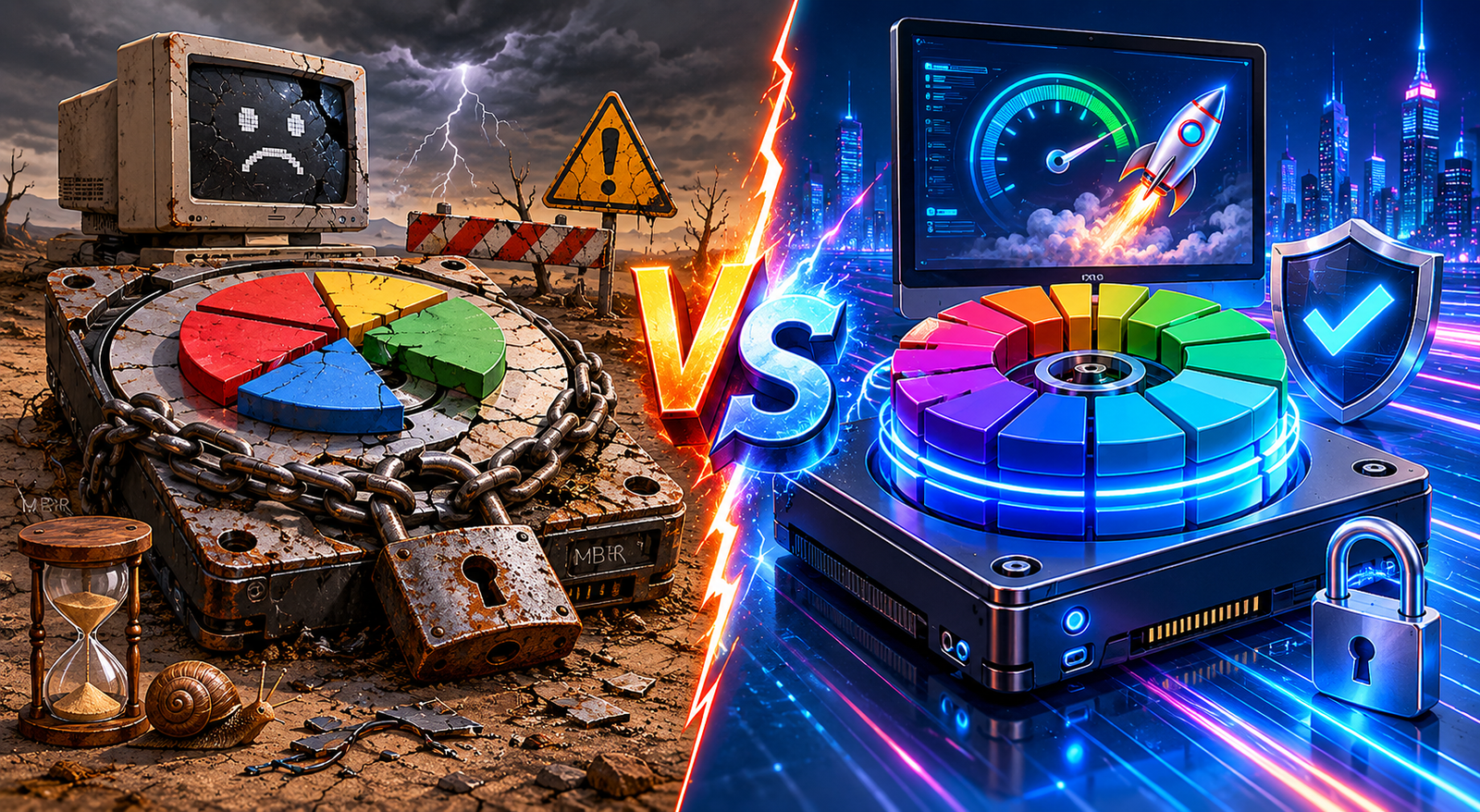
In digital forensics, understanding disk partitioning schemes is essential for accurate evidence acquisition, analysis, and recovery. Two of the most common partitioning standards encountered during forensic investigations are MBR (Master Boot Record) and GPT (GUID Partition Table).
Although both define how data is organized on storage devices, they differ significantly in structure, capabilities, and forensic relevance. Knowing these differences helps forensic investigators recover lost evidence, identify tampering, and analyze storage artifacts more effectively.
What is MBR?
Master Boot Record (MBR) is the traditional disk partitioning scheme introduced in 1983 with IBM-compatible PCs.
It is stored in the first sector of a storage device (Sector 0) and contains:
- Bootloader Code – Starts the operating system
- Partition Table – Defines partitions on the disk
- Disk Signature – Unique identifier
- Boot Signature (55AA) – Indicates a valid boot sector
Key Features of MBR
- Supports disks up to 2 TB
- Allows 4 primary partitions
- Uses 32-bit addressing
- Compatible with legacy BIOS systems
- Simpler structure, easier manual examination
What is GPT?
GUID Partition Table (GPT) is the modern partitioning standard introduced as part of UEFI (Unified Extensible Firmware Interface).
It stores partition information using globally unique identifiers (GUIDs) and includes redundancy for improved reliability.
GPT contains:
- Protective MBR (for backward compatibility)
- Primary GPT Header
- Partition Entry Array
- Backup GPT Header at the disk’s end
Key Features of GPT
- Supports disks larger than 2 TB
- Allows up to 128 partitions (Windows default)
- Uses 64-bit addressing
- Includes CRC32 integrity checks
- Stores backup partition tables
Structural Comparison: MBR vs GPT
| Feature |
MBR |
GPT |
| Introduced |
1983 |
Modern UEFI Standard |
| Max Disk Size |
2 TB |
9.4 ZB |
| Max Partitions |
4 Primary |
128+ |
| Redundancy |
No |
Yes |
| Integrity Check |
No |
CRC32 |
| Boot Compatibility |
BIOS |
UEFI |
| Recovery Reliability |
Lower |
Higher |
Why This Matters in Digital Forensics
Disk partitioning affects how evidence is stored, recovered, and interpreted.
1. Evidence Recovery
With MBR, corruption in sector 0 can make partitions inaccessible, often requiring manual reconstruction.
With GPT, backup headers allow recovery even if the primary header is damaged.
This makes GPT often more resilient during forensic recovery.
2. Detection of Tampering
GPT uses CRC validation.
If a malicious actor modifies partition structures, checksum mismatches can indicate tampering.
MBR lacks integrity verification, making subtle manipulation harder to detect.
3. Deleted Partition Analysis
Investigators often recover deleted partitions.
- MBR: Deleted entries may leave recoverable traces in sector 0
- GPT: Deleted entries may persist in primary or backup tables
GPT often provides multiple forensic recovery points.
4. Hidden Data Possibilities
Attackers may exploit partition structures to conceal evidence.
Examples include:
- Hidden partitions
- Slack space storage
- Manipulated boot sectors
- Overwritten partition tables
Understanding whether a disk uses MBR or GPT determines where investigators should search.
Forensic Artifacts Investigators Examine
In MBR:
- Boot code anomalies
- Partition entry edits
- Invalid boot signatures
- Timestamp inconsistencies
In GPT:
- Header corruption
- CRC mismatches
- Backup header differences
- Altered GUID entries
Common Forensic Tools for Analysis
Investigators use specialized tools to inspect partition structures:
- Autopsy
- FTK Imager
- EnCase
- X-Ways Forensics
- TestDisk
- Hex Editors (WinHex / HxD)
These tools help detect partition manipulation, recover deleted partitions, and validate disk integrity.
Which is Better for Forensics?
There is no universal “better” format.
MBR is simpler and easier for manual hex-level interpretation.
GPT is more robust and provides better recovery opportunities through redundancy and integrity checks.
Modern investigations increasingly encounter GPT because newer systems use UEFI by default.
Final Thoughts
Understanding MBR vs GPT is fundamental for digital forensic professionals.
A forensic investigator who can identify partition structures, interpret their metadata, and detect inconsistencies gains a critical advantage in uncovering hidden evidence and reconstructing digital events.
As storage technologies evolve, mastering both legacy MBR analysis and modern GPT forensic examination remains an essential skill in digital investigations.


Post comments (0)