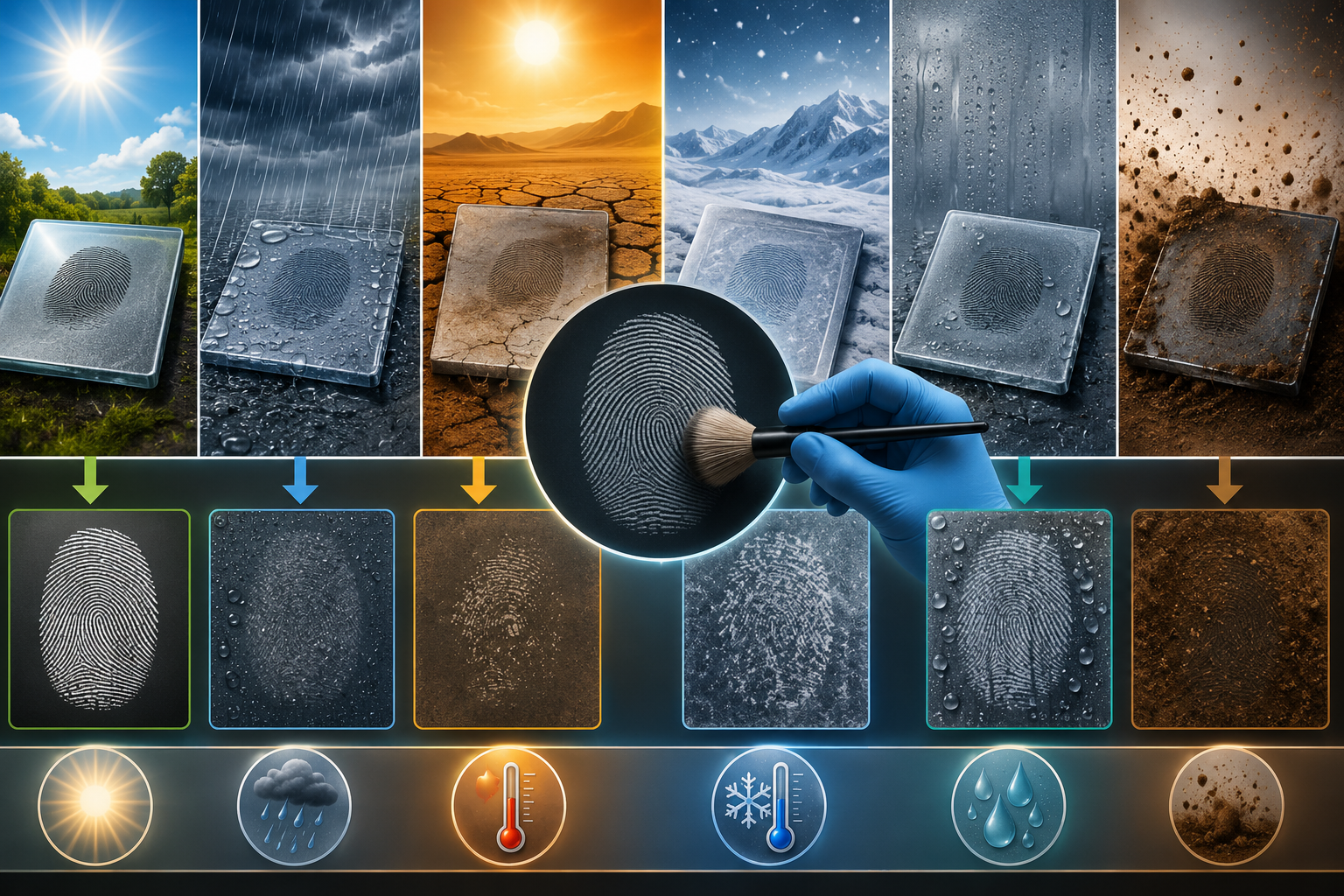
Fingerprints are among the most reliable forms of forensic evidence, often serving as silent witnesses at crime scenes. However, recovering usable fingerprints is not always straightforward. Environmental conditions can significantly affect the visibility, preservation, and recovery of latent fingerprints. Factors such as temperature, humidity, surface exposure, and contamination can either preserve these valuable impressions or degrade them beyond recognition.
Understanding how environmental factors influence fingerprint recovery is essential for forensic investigators, law enforcement professionals, and students of forensic science.
What Are Latent Fingerprints?
Latent fingerprints are invisible impressions left behind when natural oils, sweat, amino acids, and other residues from the skin transfer onto a surface. Unlike patent prints (visible due to blood, ink, or dirt) or plastic prints (impressed into soft material), latent prints usually require enhancement techniques for visualization and analysis.
Their successful recovery depends heavily on the surrounding environmental conditions.
Temperature and Its Impact
Temperature plays a major role in fingerprint preservation.
High Temperatures
Excessive heat can cause fingerprint residues to evaporate or chemically degrade. This is especially true for volatile components such as water and certain organic compounds present in sweat.
Examples:
- Prints left on metal surfaces exposed to direct sunlight may fade rapidly.
- Heat can alter the chemical composition of residues, making traditional powder methods less effective.
Low Temperatures
Cooler environments generally slow degradation and can preserve fingerprints for longer periods.
Examples:
- Refrigerated environments often help maintain fingerprint residue stability.
- Prints on glass or plastic stored in cold conditions may remain recoverable for extended durations.
Investigators often adapt recovery techniques depending on temperature exposure history.
Humidity and Moisture Exposure
Humidity is one of the most challenging environmental variables in fingerprint recovery.
High Humidity
Excess moisture can:
- Cause fingerprint residue to spread or blur
- Encourage bacterial growth that breaks down organic compounds
- Reduce ridge clarity
For porous surfaces like paper, humidity can cause absorption of residues deeper into the material, complicating recovery.
Low Humidity
Dry conditions may preserve fingerprint shape but can also cause residue cracking or fragmentation over time.
In many cases, chemical enhancement methods such as ninhydrin perform differently depending on humidity levels, requiring controlled processing environments.
Rain and Water Exposure
A common forensic myth is that fingerprints disappear immediately when wet.
In reality, fingerprints can sometimes survive water exposure depending on:
- Surface type
- Duration of exposure
- Water temperature
- Whether the print had time to bond to the surface before contact
For example:
- Fingerprints on non-porous surfaces may survive brief immersion.
- Prints on porous materials often degrade faster.
Specialized techniques like Small Particle Reagent (SPR) are designed specifically for recovering prints from wet non-porous surfaces.
Surface Contamination
Environmental contaminants can mask or destroy fingerprints.
Common contaminants include:
- Dust and dirt
- Grease
- Cleaning chemicals
- Oils from handling
- Biological materials
These contaminants may:
- Distort ridge detail
- Interfere with powder adhesion
- Chemically react with print residue
Proper scene handling is essential to minimize contamination and maximize successful recovery.
Sunlight and UV Exposure
Prolonged exposure to sunlight can accelerate fingerprint degradation through:
- Heat generation
- Ultraviolet radiation breakdown of organic compounds
- Surface oxidation
Outdoor crime scenes often present significant challenges because UV exposure can weaken fingerprint residue quickly, particularly on exposed metal, plastic, and glass surfaces.
Investigators may use alternate light sources to detect weakened impressions before applying enhancement methods.
Surface Type and Environmental Interaction
The effect of environmental factors often depends on the surface itself.
Non-Porous Surfaces
Examples:
These surfaces retain prints on the exterior, making them vulnerable to environmental damage but often easier to recover if protected.
Porous Surfaces
Examples:
Residue absorbs into the material, which may protect prints from some external factors but complicates recovery.
Semi-Porous Surfaces
Examples:
- Glossy paper
- Painted wood
- Leather
These present unique challenges because residue behavior varies depending on exposure conditions.
Time: The Silent Environmental Factor
Even under ideal conditions, fingerprint quality degrades over time.
Aging affects:
- Moisture evaporation
- Chemical breakdown
- Interaction with environmental contaminants
Older fingerprints may require advanced recovery methods such as:
- Vacuum metal deposition
- Cyanoacrylate fuming
- Chemical staining
- Fluorescent dye enhancement
The sooner evidence is processed, the better the chance of successful recovery.
Modern Forensic Solutions
Advancements in forensic science continue to improve fingerprint recovery under harsh environmental conditions.
Some modern techniques include:
- Alternate light source imaging
- Nanoparticle-based enhancement
- Advanced chemical reagents
- Digital image reconstruction software
- Vacuum metal deposition systems
These technologies allow investigators to recover prints once considered lost.
Final Thoughts
Environmental conditions can make the difference between a clear, court-admissible fingerprint and an unusable smudge. Temperature, humidity, water exposure, sunlight, contamination, and time all influence fingerprint preservation and recovery.
Forensic investigators must carefully assess environmental conditions before selecting recovery methods. As forensic technology evolves, even fingerprints exposed to challenging environments can often reveal crucial evidence.
Fingerprint recovery is not just about finding a print — it is about understanding the environment that shaped it.


Post comments (0)