Location Data Forensics: How GPS, Wi-Fi, and Cell Towers Expose Movement
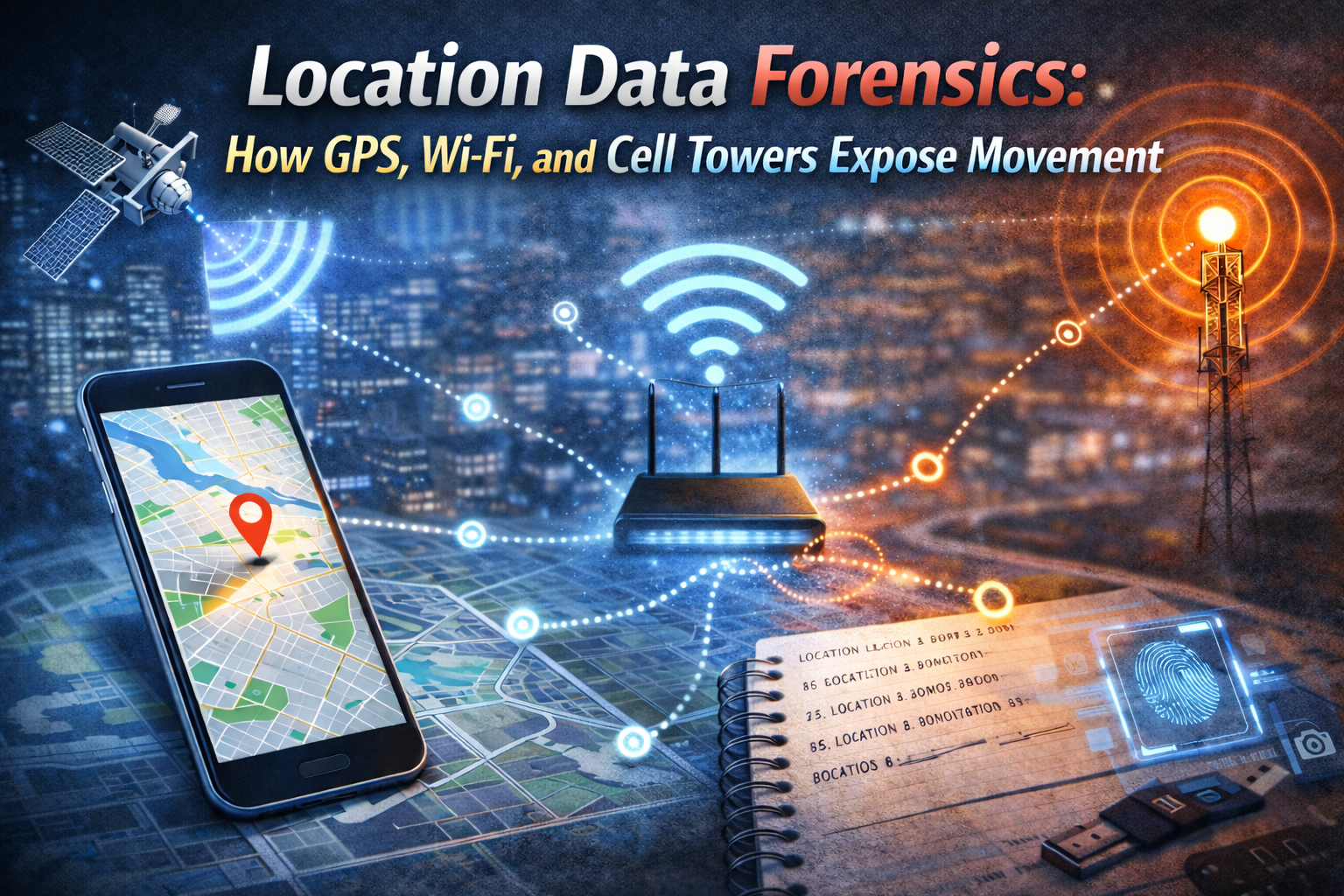
In the digital age, movement leaves a trail. Every step taken with a smartphone, vehicle navigation system, or connected device generates location data that can later become powerful forensic evidence. From criminal investigations to civil disputes, location data forensics plays a crucial role in reconstructing where a person was, when they were there, and how they moved.
Unlike eyewitness testimony, location data is automatically recorded, time-stamped, and often difficult to falsify. This blog explains how GPS, Wi-Fi, and cell tower data expose movement patterns and how digital forensic experts analyze this information scientifically and legally.
Understanding Location Data in Digital Forensics
Location data refers to information generated by digital devices that indicates geographic position. This data may be precise, approximate, continuous, or event-based, depending on the technology used.
In forensic investigations, location data helps answer critical questions such as:
-
Was the suspect present at the crime scene?
-
Did two individuals move together?
-
Does the timeline support or contradict an alibi?
-
What route was taken before or after an incident?
Importantly, no single source of location data is considered perfect. Instead, forensic experts correlate multiple sources to establish reliable conclusions.
GPS Data: The Most Precise Location Evidence
Global Positioning System (GPS) data is one of the most accurate forms of location evidence. It works through satellite signals that calculate a device’s position using triangulation.
Forensic value of GPS data:
-
Provides precise latitude and longitude
-
Includes timestamps and movement speed
-
Records routes, stops, and travel duration
GPS data is commonly recovered from smartphones, vehicle navigation systems, fitness trackers, and mobile applications. However, GPS accuracy can be affected by environmental factors such as tall buildings, tunnels, or disabled location settings.
From a forensic perspective, GPS data is highly valuable but must be validated against system logs and device settings to confirm authenticity and reliability.
Wi-Fi Location Data: The Indoor Tracker
While GPS performs well outdoors, Wi-Fi location data becomes critical indoors. Devices continuously scan for nearby Wi-Fi networks, even when not actively connected.
Each Wi-Fi router has a unique identifier. When a device detects these networks, it creates a record that can later be used to estimate location.
Why Wi-Fi data matters in forensics:
-
Tracks presence inside buildings
-
Helps place a device in specific rooms or floors
-
Supports movement reconstruction in malls, offices, or apartments
Wi-Fi location evidence is particularly useful in cases involving stalking, workplace crimes, or disputes where GPS signals are weak or unavailable.
Cell Tower Data: Mapping Movement Over Distance
Cell tower data, also known as Call Detail Records (CDRs), provides location information based on which cell towers a device connects to during calls, messages, or data usage.
Although less precise than GPS, cell tower data is extremely useful for long-distance movement analysis.
Key forensic applications:
-
Establishes general location over time
-
Confirms presence within a coverage area
-
Helps track movement between cities or regions
Cell tower data is often used to support or refute alibis. For example, if a suspect claims to be in one city while their phone consistently connects to towers in another, the discrepancy becomes significant evidence.
Correlating Multiple Location Sources
One of the most important principles in location data forensics is correlation. Relying on a single source can be misleading. Therefore, forensic experts compare GPS logs, Wi-Fi artifacts, cell tower records, app data, timestamps, and system logs.
When multiple independent sources point to the same movement pattern, the evidentiary value becomes much stronger. Conversely, inconsistencies may indicate data gaps, technical limitations, or intentional manipulation.
Challenges in Location Data Analysis
Despite its power, location data is not without limitations. Common challenges include:
-
Location services turned off by the user
-
Inaccurate timestamps due to system clock changes
-
Shared devices or multiple users
-
Signal interference or data gaps
-
Privacy and legal restrictions on data access
A forensic examiner must acknowledge these limitations clearly in their report. Overstating accuracy can weaken credibility in court.
Legal Significance of Location Data Evidence
Courts increasingly rely on location data to establish timelines and movement patterns. However, admissibility depends on proper collection, preservation, and interpretation.
A reliable forensic report explains:
-
Source of the location data
-
Method of extraction
-
Accuracy range and limitations
-
Correlation with other digital evidence
When presented scientifically, location data often becomes one of the strongest forms of circumstantial evidence.
Conclusion
Location data forensics transforms invisible digital traces into meaningful movement narratives. GPS reveals precise routes, Wi-Fi uncovers indoor presence, and cell towers map broader travel patterns. Together, these technologies allow forensic experts to reconstruct events with remarkable clarity.
However, accuracy lies not in technology alone, but in scientific interpretation. When analyzed responsibly, location data does more than show where someone was—it reveals the truth behind digital movement.


Post comments (0)