India’s digital payment ecosystem has transformed the way people transfer money. Unified Payments Interface (UPI), developed by the National Payments Corporation of India (NPCI) (Outbound: https://www.npci.org.in/what-we-do/upi/product-overview), has made financial transactions faster, simpler, and more accessible than ever before. However, the rapid growth of digital payments has also led to a significant increase in cyber-enabled financial fraud.
From fake payment requests and phishing scams to remote access applications and identity theft, cybercriminals continue to develop sophisticated methods to exploit unsuspecting users. When such incidents occur, digital forensics plays a crucial role in investigating UPI fraud and identifying the individuals responsible. (Internal Link: Digital Forensics Services)
In this article, we explore how UPI fraud investigation is conducted, the digital evidence involved, and how forensic experts assist law enforcement agencies in tracing cybercriminals.
What is UPI Fraud?
UPI fraud refers to any unauthorized or deceptive activity involving Unified Payments Interface transactions that results in financial loss.
Common examples include:
- Fake UPI payment screenshots
- Phishing links requesting PIN verification
- QR code scams
- SIM swapping
- Remote access application fraud
- Social engineering attacks
- Fake customer care numbers
- Identity theft using stolen banking credentials
Most UPI fraud cases rely more on manipulating victims than on breaking banking security systems. Victims are encouraged to report such incidents through the National Cyber Crime Reporting Portal (Outbound: https://cybercrime.gov.in/) as soon as possible.
Why Digital Forensics is Essential in UPI Fraud Investigation
Unlike conventional crimes, cyber fraud leaves behind digital traces across multiple devices and online services.
Digital forensic experts collect, preserve, examine, and interpret electronic evidence while maintaining its admissibility in court. Learn more about digital evidence collection (Internal Link: How Digital Evidence is Collected at a Crime Scene).
A forensic investigation helps answer questions such as:
- Who initiated the fraudulent transaction?
- Which device was used?
- Which IP address was involved?
- Was malware installed?
- Were deleted messages or applications used?
- Can the money trail be reconstructed?
- Can multiple fraud cases be linked to the same suspect?
Cyber incident response in India is also supported by CERT-In (Indian Computer Emergency Response Team) (Outbound: https://www.cert-in.org.in/).
Types of Digital Evidence in UPI Fraud Cases
A successful investigation depends on collecting digital evidence from multiple sources.
1. Mobile Phone Examination
Most UPI transactions occur through smartphones.
Investigators analyze:
- Installed UPI applications
- Transaction history
- SMS alerts
- Device logs
- Contact lists
- Browser history
- Screenshots
- Downloaded files
- Deleted chats
- Authentication records
Advanced forensic tools can often recover deleted artifacts that remain in device storage. Learn more about Mobile Phone Forensics (Internal Link: Mobile Phone Forensics: Process, Tools and Challenges).
2. Banking Records
Banks provide valuable transaction information including:
- UPI transaction IDs
- Beneficiary details
- Account numbers
- Time stamps
- Merchant IDs
- Linked mobile numbers
- Device information
These records help reconstruct the sequence of financial events. Banking institutions follow digital payment regulations issued by the Reserve Bank of India (RBI) (Outbound: https://www.rbi.org.in/).
3. IP Address Analysis
Every online transaction generates network information.
Investigators examine:
- IP addresses
- Internet Service Provider (ISP)
- Device location
- VPN usage
- Login history
- Multiple account access patterns
Although VPNs may conceal locations, additional forensic evidence often helps establish user attribution.
4. Call Detail Records (CDRs)
Call records help establish communication between suspects and victims.
Investigators examine:
- Incoming calls
- Outgoing calls
- SMS activity
- Cell tower locations
- Device movement
- SIM ownership
CDRs frequently support timeline reconstruction.
5. CCTV and ATM Footage
If fraud proceeds are withdrawn in cash, CCTV footage becomes important evidence.
Investigators correlate:
- Withdrawal time
- ATM location
- Vehicle movement
- Suspect appearance
- Bank entry logs
Digital Forensic Process in UPI Fraud Investigation
A structured forensic methodology ensures evidence integrity throughout the investigation.
Step 1: Evidence Preservation
Digital devices are secured to prevent data alteration.
Investigators maintain:
- Chain of custody
- Device isolation
- Write-blocking procedures
- Evidence documentation
Proper evidence handling ensures compliance with the Information Technology Act, 2000 (Outbound: https://www.indiacode.nic.in/). You can also read about the Chain of Custody in Digital Evidence (Internal Link: Chain of Custody in Digital Forensics).
Step 2: Forensic Acquisition
Experts create forensic images rather than examining original devices.
This ensures:
- No alteration of evidence
- Repeatable analysis
- Court admissibility
Hash values such as SHA-256 or MD5 are generated to verify data integrity.
Step 3: Evidence Analysis
Investigators examine:
- Payment applications
- Deleted files
- Browser artifacts
- Login sessions
- GPS history
- Device metadata
- Cloud synchronization
- Social media communication
The objective is to reconstruct the complete sequence of events. Deleted conversations may sometimes be recoverable depending on the device and available data. Read Can Deleted WhatsApp Messages Really Be Recovered? (Internal Link).
Step 4: Timeline Reconstruction
One of the most important aspects of digital forensics is creating an accurate timeline.
A timeline may include:
- Login attempts
- OTP generation
- SMS delivery
- Application installation
- UPI transfers
- Account changes
- Cash withdrawals
Timeline reconstruction often reveals inconsistencies in suspect statements.
Step 5: Reporting
The forensic examiner prepares a detailed report documenting:
- Evidence collected
- Examination methodology
- Findings
- Screenshots
- Hash verification
- Timeline analysis
- Expert conclusions
These reports may be presented in court as expert evidence.
Common Challenges in UPI Fraud Investigation
Digital investigations are becoming increasingly complex.
Challenges include:
- Encrypted messaging applications
- Disposable mobile numbers
- VPN services
- Cryptocurrency laundering
- Cross-border fraud
- Fake KYC documents
- Rapid deletion of evidence
- Cloud-based applications
Despite these challenges, forensic tools and investigative techniques continue to evolve. The Ministry of Electronics and Information Technology (MeitY) (Outbound: https://www.meity.gov.in/) continues to strengthen India’s cybersecurity framework through various digital initiatives.
How Victims Can Help the Investigation
Victims should act quickly after discovering fraud.
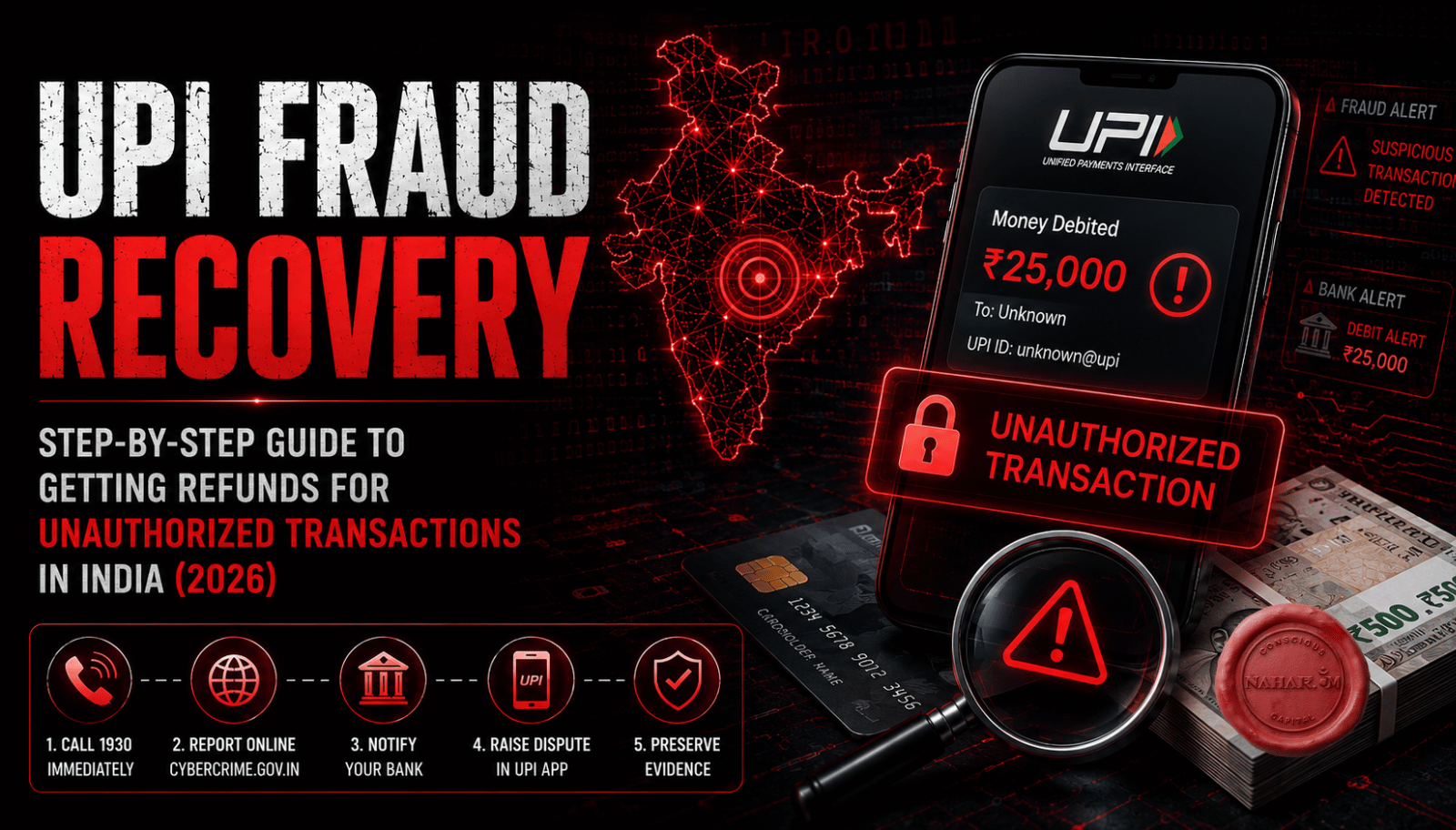
Recommended steps include:
- Inform the bank immediately.
- Report the incident through the National Cyber Crime Reporting Portal (Outbound: https://cybercrime.gov.in/).
- Preserve screenshots and SMS alerts.
- Avoid formatting or resetting the mobile phone.
- Record transaction IDs.
- Save call recordings if available.
- Report the incident to the nearest cyber police station.
Early reporting significantly improves the chances of tracing fraudulent transactions.
The Role of Digital Forensic Experts
Digital forensic professionals assist by:
- Examining mobile devices
- Recovering deleted evidence
- Analyzing transaction artifacts
- Preparing forensic reports
- Providing expert testimony
- Assisting law enforcement agencies
- Supporting financial institutions
Their expertise helps convert technical evidence into legally admissible findings. Organizations seeking professional assistance can learn more about Cyber Crime Investigation Services (Internal Link) or explore Digital Forensics Training Programs (Internal Link) to better understand forensic investigation techniques.




Post comments (0)