Mobile Number Tracking in Digital Forensics
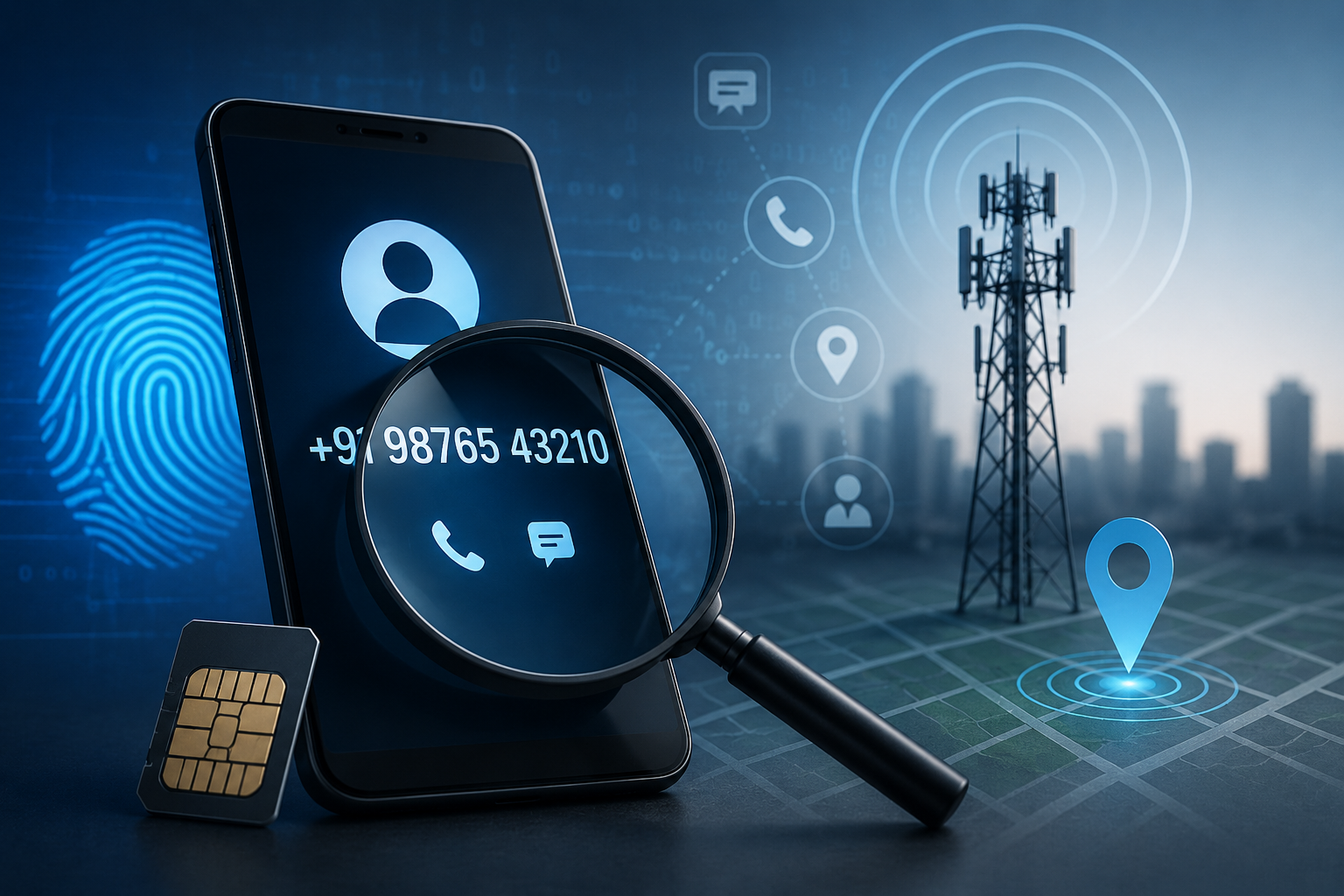
A mobile number can provide useful leads during a digital forensic investigation. However, a forensic expert cannot simply enter a phone number into software and see everything about its owner.
Information is collected from different sources. These may include the mobile device, SIM card, telecom records, call records, and cell tower data.
Focus Keyphrase: mobile number tracking in digital forensics
What Can a Forensic Expert Find From a Mobile Number?
The amount of information available depends on the investigation and legal authorization.
A mobile number can help investigators connect different pieces of digital evidence. For example, it may be linked with subscriber records, communication records, devices, and network activity.
1. Subscriber Information
Telecom companies maintain information about their subscribers. With appropriate legal authorization, investigators may obtain details associated with a mobile connection.
However, subscriber information alone does not prove who was physically using the phone at a particular time.
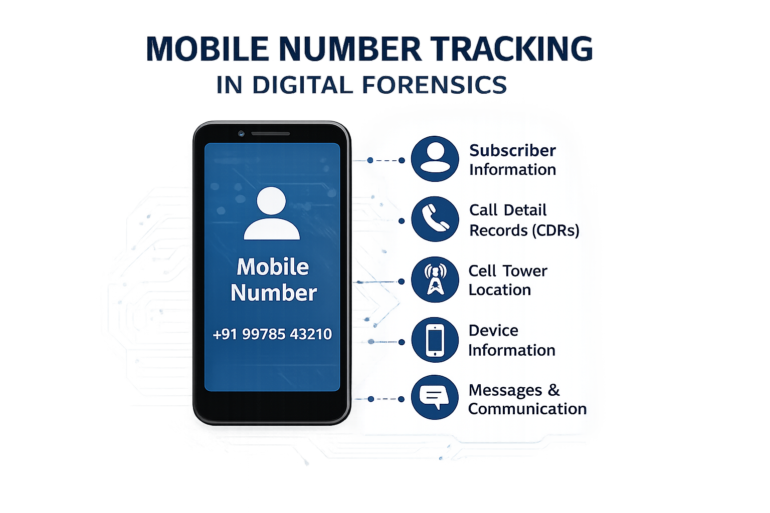
2. Call Detail Records (CDRs)
CDR analysis is widely used in mobile-related investigations.
Call Detail Records may contain:
- Incoming and outgoing numbers
- Date and time of calls
- Call duration
- SMS-related records
- Cell ID or tower information
- Other network-related details
Investigators can use these records to create a communication timeline. They may also identify frequently contacted numbers and communication patterns.
3. IMEI and IMSI
Two important identifiers in mobile investigations are IMEI and IMSI.
IMEI (International Mobile Equipment Identity) identifies mobile equipment.
IMSI (International Mobile Subscriber Identity) identifies a subscriber identity associated with the SIM or eSIM subscription.
Investigators can correlate these identifiers with telecom records. For example, this may help determine whether a SIM was used in different mobile devices.
What Can Be Recovered From the Mobile Phone?
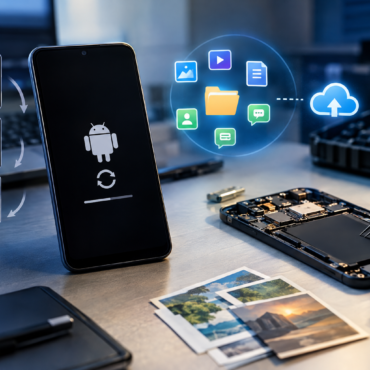
If investigators have lawful access to the physical phone, much more information may be available.
Depending on the device and extraction method, a mobile forensic examination may recover:
Contacts, call logs, messages, photographs, videos, documents, browser data, application data, location artifacts and device information.
In some circumstances, deleted information may also be recoverable.
Professional forensic tools such as Cellebrite UFED and Magnet AXIOM are commonly used for mobile data acquisition and analysis.
How Does Cell Tower Tracking Work?
A mobile phone communicates with cellular network infrastructure.
During normal network activity, technical records may associate the device with particular cells or sectors. These records can become useful during an investigation.
For example, investigators may examine which cell served a phone around a particular time. This can help estimate the general area associated with the device’s network activity.
However, cell tower information should not automatically be treated as an exact GPS location.
Accuracy can depend on several factors, including tower coverage, antenna direction, buildings, terrain, network conditions, and radio propagation.
Therefore, investigators must interpret cell-site information carefully.
Can a Mobile Number Be Tracked Through a Server?
The phrase “server tracking” is often misunderstood.
A digital forensic expert normally cannot access a public server, enter someone’s mobile number, and instantly obtain their live location.
Telecommunications information is controlled by telecom service providers and other authorized entities.
During a lawful investigation, authorized agencies may obtain relevant records from the service provider. Investigators can then compare these records with other evidence.
For example:
Mobile Number → CDR → Cell-Site Data → IMEI/IMSI → Mobile Extraction → Timeline
This process can provide a much clearer picture than relying on one source alone.
For information about telecommunications in India, visit the Department of Telecommunications and Telecom Regulatory Authority of India.
Can Websites Track a Mobile Number?
Many websites claim that they can provide the exact live location of any mobile number.
Such claims should be treated carefully.
Publicly available services may provide basic information, such as the country or numbering information. However, this is different from obtaining a person’s exact location or private telecom records.
Access to sensitive telecom and location information is normally restricted.
Why Is Evidence Correlation Important?
Digital forensic experts rarely depend on a single piece of evidence.
Instead, they compare information from several sources. For example, CDRs may be compared with mobile extraction data, timestamps, CCTV footage, network records, and other digital evidence.
When multiple independent sources support the same event or timeline, the forensic interpretation becomes stronger.
Therefore, mobile number tracking in digital forensics is not simply about locating a phone. It involves collecting, preserving, analyzing, and correlating digital evidence using proper forensic and legal procedures.



Post comments (0)