Can Rain Wash Away Fingerprints?
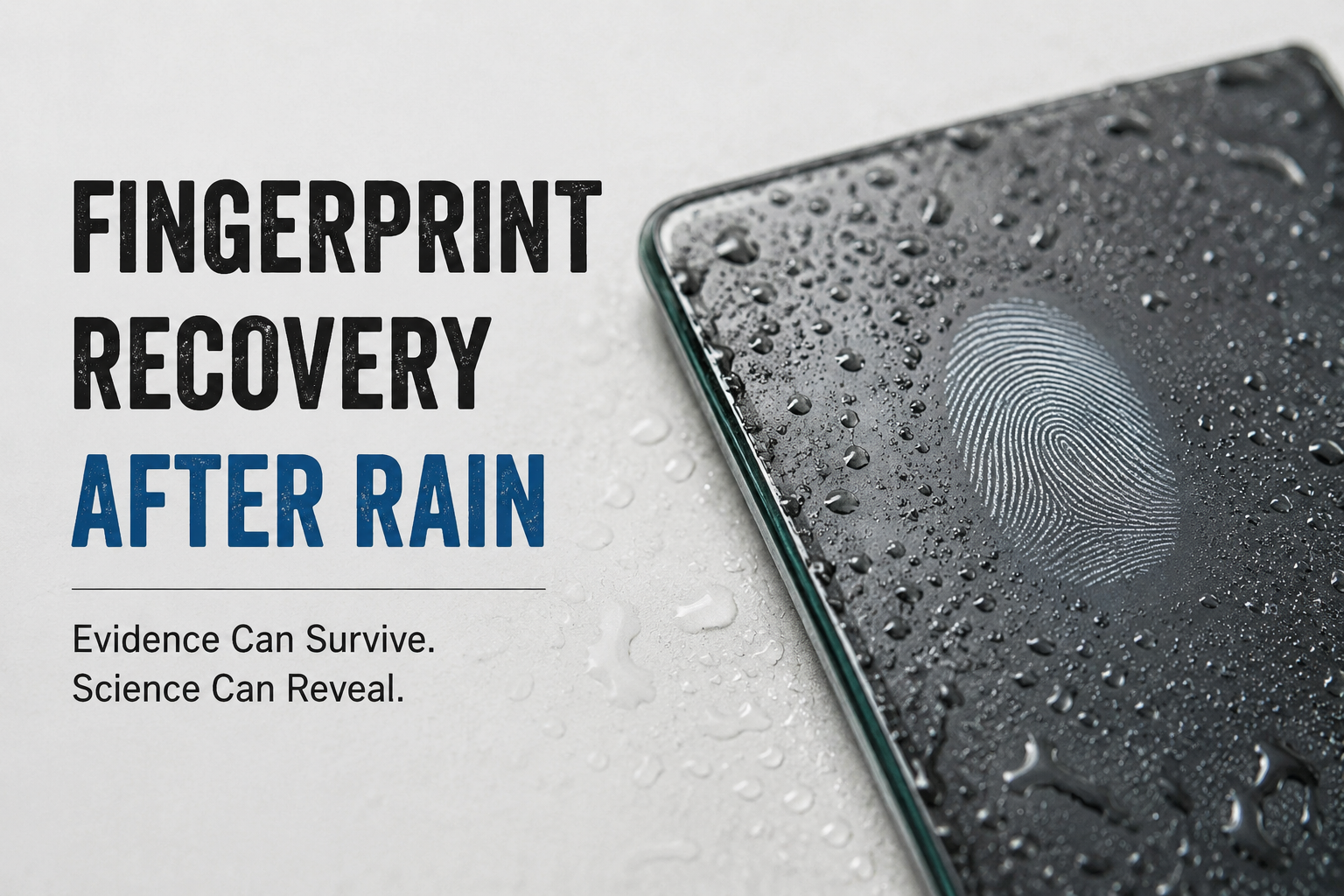
Rain is one of the biggest challenges investigators face at outdoor crime scenes. Many people assume that once it rains, all fingerprint evidence is permanently destroyed. In reality, that is not always true. While rainfall can reduce the quality of latent fingerprints, modern forensic techniques allow experts to recover usable fingerprints from many wet surfaces.
The success of fingerprint recovery depends on several factors, including the type of surface, the duration and intensity of rainfall, and the methods used to develop the prints. With the right approach, valuable fingerprint evidence can still be preserved even after exposure to rain.
How Rain Affects Latent Fingerprints
Latent fingerprints are invisible impressions left behind by the natural secretions of the skin. These residues contain water, salts, amino acids, fatty acids, and oils.
When rain falls on a surface, the water-soluble components such as sweat and salts can dissolve or wash away. However, the oily and lipid-rich components often remain attached to the surface, especially on smooth, non-porous materials. This remaining residue provides forensic investigators with an opportunity to recover ridge detail using specialized development techniques.
Rain does not always erase fingerprints completely. Instead, it may reduce their clarity, making proper evidence handling and advanced forensic methods essential.
Which Surfaces Retain Fingerprints Best After Rain?
The type of surface plays a major role in determining whether fingerprints survive rainfall.
Non-porous surfaces generally offer the best chance of successful recovery because fingerprint residues remain on the surface rather than being absorbed.
Examples include:
- Glass
- Metal
- Plastic
- Painted surfaces
- Ceramic tiles
On the other hand, porous materials absorb both water and fingerprint residues, making recovery much more difficult.
Examples include:
- Paper
- Cardboard
- Untreated wood
- Fabric
For this reason, investigators evaluate the surface before selecting the most appropriate fingerprint development method.
Best Methods for Fingerprint Recovery After Rain
Small Particle Reagent (SPR):
Small Particle Reagent (SPR) is widely regarded as the most effective technique for developing fingerprints on wet, non-porous surfaces.
SPR consists of fine particles suspended in a detergent solution. These particles attach to the oily components of latent fingerprints even when the surface is wet.
It is commonly used on:
- Glass windows
- Vehicle bodies
- Plastic containers
- Metal tools
- Painted objects
One of the greatest advantages of SPR is that it can be applied directly to wet evidence without allowing the item to dry first. This makes it particularly valuable at outdoor crime scenes immediately after rainfall.
Cyanoacrylate (Super Glue) Fuming:
If wet evidence can be transported safely to a forensic laboratory, investigators often allow it to dry naturally before processing.
Once dry, the item can undergo cyanoacrylate fuming, commonly known as super glue fuming. During this process, cyanoacrylate vapors react with the fingerprint residue and form a durable white polymer along the fingerprint ridges.
This technique provides permanent fingerprint development and allows further enhancement using fluorescent dyes if required.
Fluorescent Dye Staining with UV Light:
After cyanoacrylate fuming, fluorescent dyes such as Basic Yellow 40 or Rhodamine 6G can be applied to improve visibility.
When examined using a 365 nm forensic UV light, the treated fingerprints emit fluorescence, making ridge details easier to observe and photograph.
Compared to 395 nm UV lights, 365 nm UV illumination produces stronger fluorescence with less visible purple light, resulting in higher fingerprint contrast and better photographic documentation.
This method is especially useful for dark, patterned, or reflective surfaces where conventional lighting may not reveal sufficient detail.
Vacuum Metal Deposition (VMD):
Vacuum metal deposition is one of the most advanced fingerprint development techniques available.
It involves depositing microscopic layers of metals, typically gold and zinc, under vacuum conditions. The metal adheres differently to fingerprint residues than to the surrounding surface, revealing ridge patterns that other methods may fail to detect.
VMD is particularly effective on:
- Plastic bags
- Glass
- Metal
- Smooth packaging materials
Although highly effective, it requires specialized laboratory equipment and is generally reserved for high-priority investigations.
Physical Developer for Wet Documents:
Paper evidence exposed to rain presents a unique challenge because water often washes away amino acids that traditional reagents like ninhydrin rely upon.
In these cases, forensic laboratories may use physical developer, a silver-based reagent that reacts primarily with lipid components remaining in the fingerprint.
This method is suitable for:
- Wet paper
- Cardboard
- Soaked documents
Physical developer is typically used after other chemical methods have been considered, as it is regarded as a final-stage treatment.
Best Practices at Rain-Exposed Crime Scenes
Proper handling of wet evidence significantly increases the likelihood of successful fingerprint recovery.
Investigators should:
- Photograph evidence before moving it.
- Handle items using gloves to avoid contamination.
- Avoid wiping water from surfaces.
- Never use heat sources such as hair dryers or heat guns to dry evidence.
- Allow evidence to air dry naturally in controlled conditions when required.
- Package wet evidence separately using appropriate containers.
- Select fingerprint development techniques based on the surface type and condition.
Following these procedures helps preserve any remaining fingerprint residue for laboratory examination.
Common Mistakes That Can Destroy Evidence
Several common mistakes can permanently damage fingerprint evidence after rain.
These include:
- Rubbing or cleaning the surface.
- Drying evidence with excessive heat.
- Applying conventional fingerprint powder to soaking wet surfaces.
- Delaying evidence collection for extended periods.
- Improper packaging that causes additional moisture damage.
Avoiding these errors is just as important as selecting the correct development technique.
Conclusion
Rain may complicate fingerprint recovery, but it does not necessarily eliminate valuable forensic evidence. Advances in fingerprint development techniques allow investigators to recover latent fingerprints from many rain-exposed surfaces, particularly smooth, non-porous materials such as glass, metal, and plastic.
Among the available methods, Small Particle Reagent (SPR) remains the preferred choice for wet surfaces, while cyanoacrylate fuming, fluorescent dye enhancement with 365 nm UV light, Vacuum Metal Deposition, and Physical Developer provide additional options depending on the type of evidence.
By understanding how rainfall affects fingerprints and using the appropriate forensic techniques, investigators can recover critical evidence that may otherwise be overlooked. Even after heavy rain, a carefully processed fingerprint can provide the key link between a suspect and the crime scene.



Post comments (0)