Business Email Compromise (BEC) is one of the fastest-growing forms of cybercrime, causing organizations worldwide to lose billions of dollars every year. Unlike traditional phishing attacks that rely on malicious attachments or links, BEC attacks use deception, social engineering, and impersonation to trick victims into transferring money or disclosing sensitive information.
Cybercriminals carefully study an organization’s communication patterns before impersonating executives, vendors, or trusted business partners. Because these emails often appear legitimate, employees may unknowingly authorize fraudulent payments or share confidential data.
This article explores how Business Email Compromise works, common attack techniques, warning signs, investigation methods, and best practices to prevent financial and reputational losses.
What Is Business Email Compromise?
Business Email Compromise (BEC) is a cybercrime in which attackers impersonate a trusted individual or organization to manipulate victims into performing financial transactions or revealing sensitive information.
Unlike mass phishing campaigns, BEC attacks are highly targeted and often involve extensive research on the victim organization.
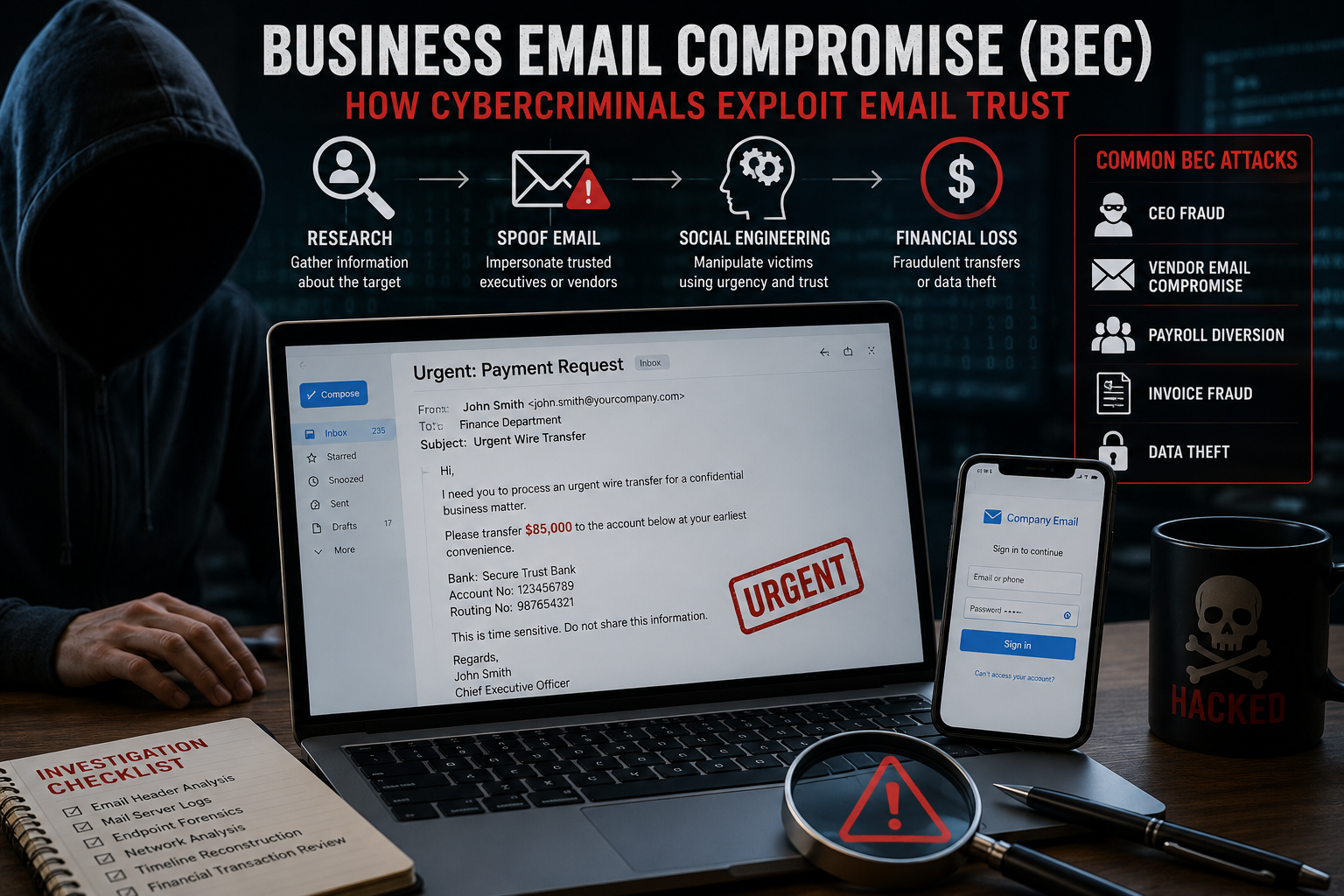
How Business Email Compromise Attacks Work
Most BEC attacks follow a structured process:
1. Information Gathering
Attackers collect publicly available information from:
- Company websites
- LinkedIn profiles
- Social media
- Press releases
- Public email addresses
This information helps them understand the company’s hierarchy and communication style.
2. Email Account Compromise or Spoofing
Cybercriminals may:
- Spoof a legitimate email address
- Register a look-alike domain
- Compromise an employee’s email account
- Use previously stolen credentials
The fraudulent email closely resembles genuine business communication.
3. Social Engineering
The attacker sends convincing emails requesting:
- Urgent wire transfers
- Invoice payments
- Payroll changes
- Bank account updates
- Confidential documents
The request often appears to come from a senior executive or trusted vendor.
4. Financial Loss or Data Theft
If the victim complies, funds are transferred to attacker-controlled accounts, or sensitive business information is exposed.
Common Types of Business Email Compromise
CEO Fraud
Attackers impersonate executives and instruct employees to transfer money urgently.
Vendor Email Compromise
Cybercriminals pose as suppliers and request payment to fraudulent bank accounts.
Payroll Diversion
Attackers convince HR departments to change employee salary account details.
Invoice Fraud
Fake invoices are sent using convincing branding and payment instructions.
Legal or Tax Impersonation
Employees receive urgent requests for confidential financial or employee records.
Warning Signs of a BEC Attack
Organizations should watch for:
- Requests for urgent payments
- Changes in vendor banking details
- Slightly altered email domains
- Unusual writing style
- Confidentiality requests
- Unexpected financial instructions
- Emails sent outside normal working hours
Verifying unusual requests through a secondary communication channel can prevent fraud.
Digital Forensic Investigation of BEC Attacks
Digital forensic investigators analyze multiple sources of evidence.
Email Header Analysis
Investigators examine:
- Sender IP address
- Return path
- Authentication results (SPF, DKIM, DMARC)
- Routing information
- Message identifiers
This helps determine the true origin of an email.
Mail Server Logs
Server logs reveal:
- Login attempts
- Account access history
- IP addresses
- Geographic locations
- Mail forwarding rules
Endpoint Forensics
Computers involved in the incident are examined for:
- Malware
- Credential theft
- Browser history
- Downloaded files
- Email client artifacts
Network Analysis
Investigators analyze network traffic to identify:
- Suspicious connections
- Data exfiltration
- Command-and-control communication
- Unauthorized access
Timeline Reconstruction
Evidence from multiple sources is combined to determine:
- Initial compromise
- Lateral movement
- Email transmission
- Financial transactions
- User activity
Challenges in BEC Investigations
Investigators often face:
- International attackers
- Anonymous cryptocurrency payments
- Compromised cloud email accounts
- Rapid fund transfers
- Deleted emails
- Encrypted communications
Quick incident response is critical to preserve evidence.
Best Practices to Prevent Business Email Compromise
Organizations should:
- Enable Multi-Factor Authentication (MFA).
- Verify payment requests through phone calls.
- Implement SPF, DKIM, and DMARC.
- Train employees to recognize social engineering.
- Monitor unusual login activity.
- Review banking changes carefully.
- Conduct regular cybersecurity awareness training.
- Maintain secure email backups.
Role of Digital Forensics in BEC Cases
Digital forensic experts help organizations by:
- Identifying the source of fraudulent emails
- Recovering deleted evidence
- Tracing attacker activity
- Preserving digital evidence
- Supporting law enforcement investigations
- Preparing forensic reports for legal proceedings
Proper forensic analysis improves the chances of identifying attackers and recovering financial losses.
Conclusion
Business Email Compromise remains one of the most damaging forms of cybercrime because it exploits human trust rather than technical vulnerabilities. As attackers become more sophisticated, organizations must strengthen email security, educate employees, and implement strong verification procedures.
Digital forensic investigations play a crucial role in uncovering how BEC attacks occur, preserving digital evidence, and supporting legal action. A proactive approach to cybersecurity and forensic readiness can significantly reduce the impact of these attacks.



Post comments (0)