Corporate fraud is one of the most significant challenges facing businesses today. From financial embezzlement and insider threats to data theft and unauthorized transactions, fraudulent activities can cause substantial financial losses and damage an organization’s reputation. As businesses increasingly rely on digital systems, fraud leaves behind valuable electronic evidence that investigators can analyze.
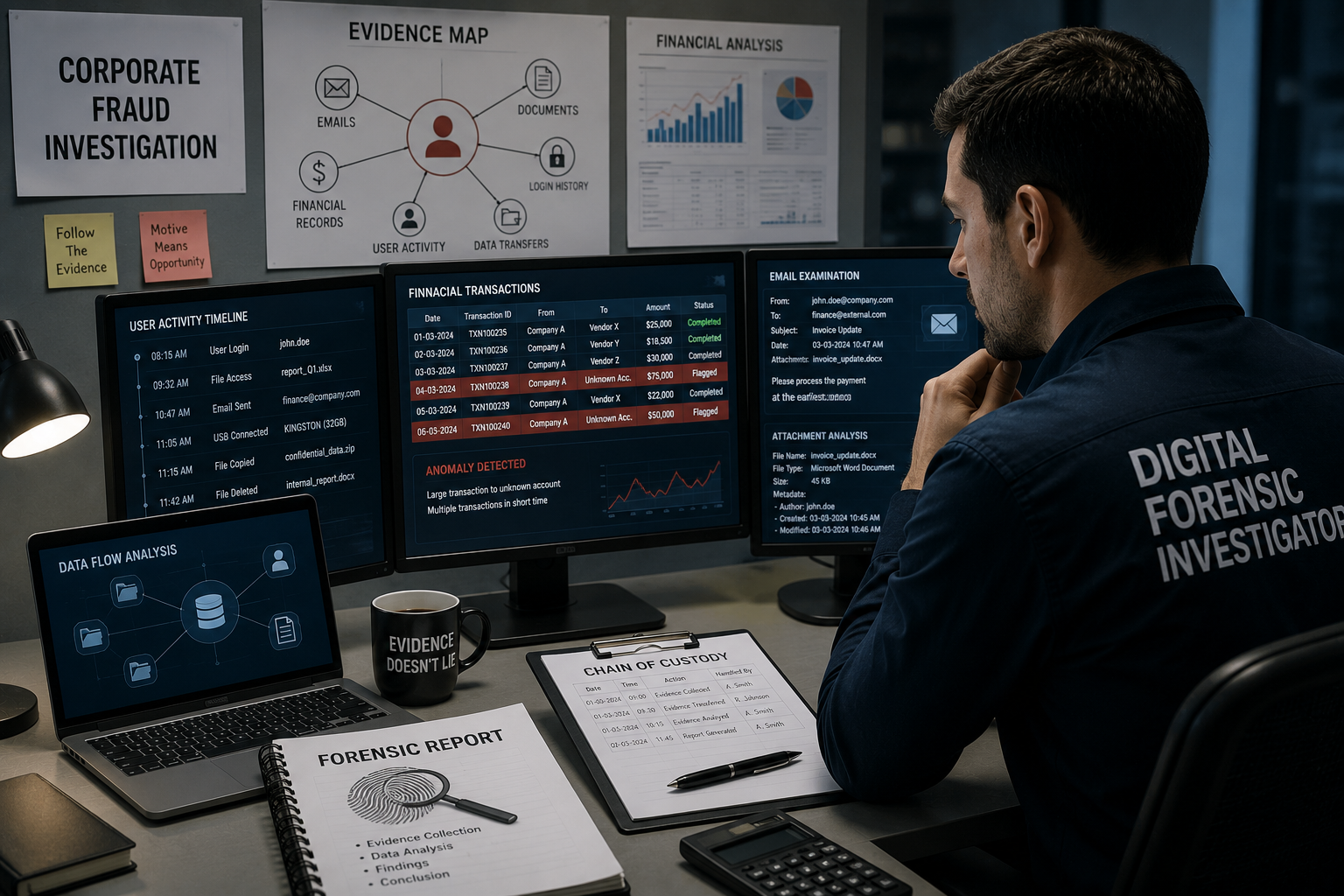
Digital Forensics in Corporate Fraud Investigations plays a critical role in uncovering hidden evidence, identifying those responsible, and supporting legal action. By examining computers, mobile devices, emails, cloud platforms, and network logs, forensic experts can reconstruct events and provide organizations with reliable, court-admissible evidence.
This article explores how digital forensics helps investigate corporate fraud, the types of evidence examined, common investigation techniques, and best practices for businesses.
What Is Digital Forensics in Corporate Fraud Investigations?
Digital Forensics in Corporate Fraud Investigations involves identifying, preserving, collecting, analyzing, and presenting digital evidence related to fraudulent activities within an organization.
Digital forensic experts investigate incidents involving:
- Financial fraud
- Insider threats
- Employee misconduct
- Data theft
- Intellectual property theft
- Business Email Compromise (BEC)
- Payroll fraud
- Procurement fraud
- Unauthorized system access
Furthermore, investigators ensure that all evidence is collected using forensically sound methods to maintain its integrity.
Why Digital Forensics Is Important in Corporate Fraud Cases
Modern businesses store vast amounts of information electronically. Consequently, almost every fraudulent activity leaves behind digital traces.
Digital forensics helps organizations:
- Identify fraudulent activities
- Preserve critical evidence
- Determine how the fraud occurred
- Identify the individuals involved
- Recover deleted information
- Support legal and disciplinary actions
- Reduce future security risks
Moreover, early forensic investigations can prevent further financial losses and preserve crucial evidence before it is deleted or altered.
Common Types of Corporate Fraud
Financial Fraud
Employees or executives may manipulate financial records, create fake invoices, or perform unauthorized fund transfers.
Insider Threats
Trusted employees sometimes misuse their access to steal confidential information or company assets.
Data Theft
Sensitive customer records, trade secrets, or intellectual property may be copied and transferred without authorization.
Business Email Compromise (BEC)
Cybercriminals impersonate executives or vendors through email to trick employees into transferring funds.
Payroll Fraud
Fraudsters manipulate payroll systems to create fake employees or alter salary payments.
Procurement Fraud
Employees may collude with vendors, inflate invoices, or approve fraudulent purchases.
Sources of Digital Evidence
Digital forensic experts analyze multiple sources of evidence during corporate investigations.
Computer Forensics
Investigators examine:
- User activity
- Login history
- Deleted files
- Browser history
- USB device usage
- Windows Event Logs
- Registry artifacts
These records help reconstruct employee activities.
Email Forensics
Emails often contain valuable evidence related to fraud.
Experts analyze:
- Email headers
- Attachments
- Communication history
- Phishing attempts
- Deleted emails
- Sender authentication records
Mobile Device Forensics
Corporate smartphones may reveal:
- Call logs
- SMS messages
- WhatsApp chats
- Email accounts
- Photos
- Documents
- GPS locations
Cloud Forensics
Many organizations use cloud services for collaboration and storage.
Investigators review:
- User login records
- File sharing history
- Cloud backups
- Deleted documents
- Synchronization logs
Network Forensics
Network analysis helps identify:
- Unauthorized logins
- Suspicious IP addresses
- Data transfers
- Remote access sessions
- File downloads
Investigation Process
Evidence Preservation
The first step is securing digital evidence without altering the original data.
Investigators create forensic images of storage devices and maintain a documented chain of custody.
Data Collection
Next, forensic experts collect evidence from:
- Computers
- Mobile devices
- Email servers
- Cloud platforms
- Network equipment
- CCTV systems
Evidence Analysis
Experts analyze digital artifacts to identify suspicious activities, recover deleted information, and establish timelines.
Furthermore, specialized forensic tools help detect hidden or manipulated data.
Timeline Reconstruction
By combining evidence from multiple sources, investigators reconstruct the sequence of events leading to the fraud.
This helps determine who performed specific actions and when they occurred.
Reporting
Finally, investigators prepare a detailed forensic report that documents their findings, methodologies, and conclusions.
These reports often support legal proceedings and internal disciplinary actions.
Challenges in Corporate Fraud Investigations
Corporate fraud investigations often involve:
- Encrypted devices
- Deleted evidence
- Cloud-based data
- Insider knowledge
- Multiple user accounts
- Large volumes of digital information
However, experienced forensic professionals use advanced tools and proven methodologies to overcome these challenges.
Tools Used in Digital Forensics
Digital forensic experts commonly use:
- Magnet AXIOM
- FTK
- EnCase
- Cellebrite
- Belkasoft X
- Autopsy
- X-Ways Forensics
These tools assist investigators in acquiring, analyzing, and preserving digital evidence.
Best Practices for Organizations
Organizations can reduce fraud risks by:
- Implementing strong access controls
- Monitoring user activity
- Maintaining secure backups
- Conducting regular security audits
- Preserving system logs
- Training employees on fraud awareness
- Reporting suspicious incidents promptly
Additionally, organizations should engage digital forensic experts immediately after detecting suspected fraud.
Future of Digital Forensics in Corporate Investigations
As businesses adopt cloud computing, artificial intelligence, and remote work environments, digital investigations continue to evolve.
Future developments include:
- AI-assisted forensic analysis
- Automated fraud detection
- Cloud-native investigations
- Behavioral analytics
- Advanced insider threat detection
- Real-time digital evidence monitoring
These technologies will enable investigators to detect fraud more quickly and improve the accuracy of investigations.
Conclusion
Corporate fraud can have serious financial, operational, and reputational consequences. Fortunately, Digital Forensics in Corporate Fraud Investigations enables organizations to uncover hidden evidence, identify fraudulent activities, and support legal action with scientifically sound methods.
By analyzing computers, mobile devices, emails, cloud services, and network logs, digital forensic experts help organizations understand what happened, who was responsible, and how similar incidents can be prevented in the future. Investing in digital forensic capabilities not only strengthens investigations but also enhances overall cybersecurity and corporate governance.




Post comments (0)