Introduction
Handwriting is more than a collection of letters and words; it is a complex motor activity influenced by an individual’s writing habits, learned patterns, and physical coordination. In forensic science, handwriting examination plays an important role in determining whether a questioned document was written by a particular individual or whether two writing samples share significant similarities and differences.
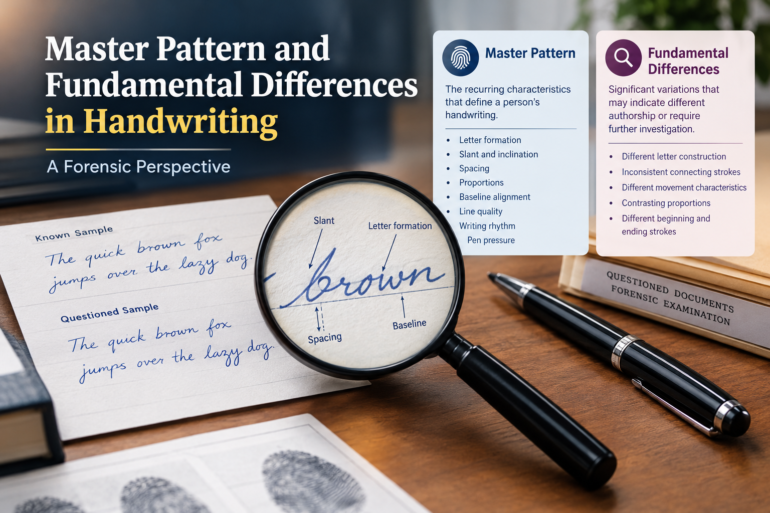
Two important concepts in forensic handwriting examination are the master pattern and fundamental differences. A master pattern represents the recurring characteristics of a person’s handwriting, while fundamental differences are significant variations that may indicate different authorship or require further investigation.
Understanding these concepts helps forensic document examiners evaluate signatures, handwritten notes, disputed agreements, anonymous letters, and other questioned documents.
1. What Is a Master Pattern in Handwriting?
A master pattern in handwriting refers to the habitual combination of writing characteristics that a person develops through repeated practice. Over time, an individual develops relatively consistent ways of forming letters, connecting strokes, spacing words, and moving the writing instrument across a surface.
Although handwriting naturally varies from one occasion to another, certain characteristics tend to remain reasonably stable.
Common features examined when establishing a handwriting master pattern include:
-
Letter formation: The way individual letters are constructed, including their shape, loops, and connecting strokes.
-
Slant and inclination: The direction in which letters lean, such as rightward, leftward, or upright.
-
Spacing: The distance between letters, words, and lines.
-
Proportions: The relative height and width of letters, including the relationship between upper, middle, and lower zones.
-
Baseline alignment: Whether writing follows a straight line, rises, or descends.
-
Line quality: The smoothness, continuity, and natural variation of strokes.
-
Writing rhythm: The coordination, fluency, and movement patterns observed during writing.
-
Pen pressure: Variations in pressure that may influence stroke appearance, where these can be reliably assessed.
No single feature necessarily identifies a writer. Instead, examiners evaluate a combination of characteristics across sufficient writing samples to develop an understanding of the person’s habitual writing pattern.
For example, a writer may consistently form the lowercase letter “g” with a particular loop, use a distinctive capital “S,” and maintain a characteristic relationship between letter height and word spacing. When these traits recur across comparable samples, they can contribute to the writer’s master pattern.
2. What Are Fundamental Differences in Handwriting?
Fundamental differences in handwriting are significant discrepancies between writing samples that cannot be readily explained by normal variation, the writing conditions, or other relevant factors.
In questioned document examination, differences are just as important as similarities. Two people may produce handwriting that looks broadly similar, but closer examination may reveal meaningful differences in their underlying writing habits.
Examples of potentially significant differences include:
-
Different letter construction: A letter is formed using a distinctly different sequence or arrangement of strokes.
-
Inconsistent connecting strokes: Letters that are habitually connected in one sample are formed using a different structural pattern in another.
-
Different movement characteristics: Writing displays substantially different fluency or stroke execution, when supported by adequate evidence.
-
Contrasting proportions: Letter components show persistent, unexplained differences in their relative dimensions.
-
Different beginning and ending strokes: Repeated letters show contrasting entry or terminal strokes that are difficult to reconcile with the writer’s established habits.
However, a visible difference does not automatically prove that two documents were written by different people. Handwriting can change because of age, illness, injury, fatigue, writing posture, writing speed, or the instrument and surface used.
A forensic examiner must determine whether the differences are significant, repeatable, and consistent with the circumstances of the case.
3. How Do Forensic Experts Compare Master Patterns and Fundamental Differences?
The comparison of handwriting requires a systematic examination of questioned writing against known writing samples, often called specimens or standards. The objective is to assess the similarities, differences, and overall significance of the observed characteristics.
A typical examination involves the following steps:
-
Collection of samples: The examiner obtains the questioned document and suitable known handwriting samples from the suspected writer, where available.
-
Preliminary examination: The documents are examined for their condition, writing characteristics, and suitability for comparison.
-
Feature analysis: Individual letters, connecting strokes, spacing, slant, proportions, and other relevant characteristics are examined.
-
Comparison: Corresponding features are compared across the questioned and known writings, taking natural variation into account.
-
Evaluation: The examiner assesses the combined significance of the similarities and differences before reaching an appropriately qualified conclusion.
Established guidance, such as the ENFSI Best Practice Manual for the Forensic Examination of Handwriting, provides a framework for conducting systematic and reliable handwriting examinations.
4. Why Are These Concepts Important in Questioned Document Examination?
The study of master patterns and fundamental differences is especially valuable in cases involving suspected forgery, disputed signatures, fraudulent agreements, altered documents, and anonymous handwritten communications.
For example, consider a disputed signature on a financial agreement. The signature may appear visually similar to the genuine signatures of the alleged writer. However, detailed examination may reveal differences in letter construction, stroke connections, proportions, or writing movement.
Conversely, some genuine signatures may look noticeably different because people do not reproduce their handwriting identically every time. Therefore, forensic experts must distinguish between natural variation and differences that may be significant to authorship.
This approach is also relevant when examining suspected simulated signatures, where someone attempts to imitate another person’s writing. Such imitation may reproduce the general appearance of a signature while introducing inconsistencies in its execution.
The NIST report on forensic handwriting examination and human factors provides further insight into the importance of systematic examination and the management of factors that may influence expert judgments.
5. Limitations and Precautions
Handwriting comparison is not simply a matter of counting similarities or identifying one unusual letter. The reliability of an examination depends on the quality and quantity of the available material, the characteristics being compared, and the examiner’s methodology.
Important precautions include:
-
Avoiding conclusions based on a single handwriting characteristic.
-
Considering natural variation between genuine writing samples.
-
Evaluating whether writing conditions could explain observed differences.
-
Using adequate, comparable specimens whenever possible.
-
Maintaining objectivity and considering alternative explanations for the evidence.
A forensic handwriting opinion should reflect the strength and limitations of the available evidence. It should not claim certainty beyond what the examination supports.




Post comments (0)