Determining Which Stroke Came First
In questioned document examination, small details can reveal important information about how a document was created. Sequence of strokes examination is one such technique. It helps forensic document examiners assess the relative order in which two or more intersecting strokes were produced.
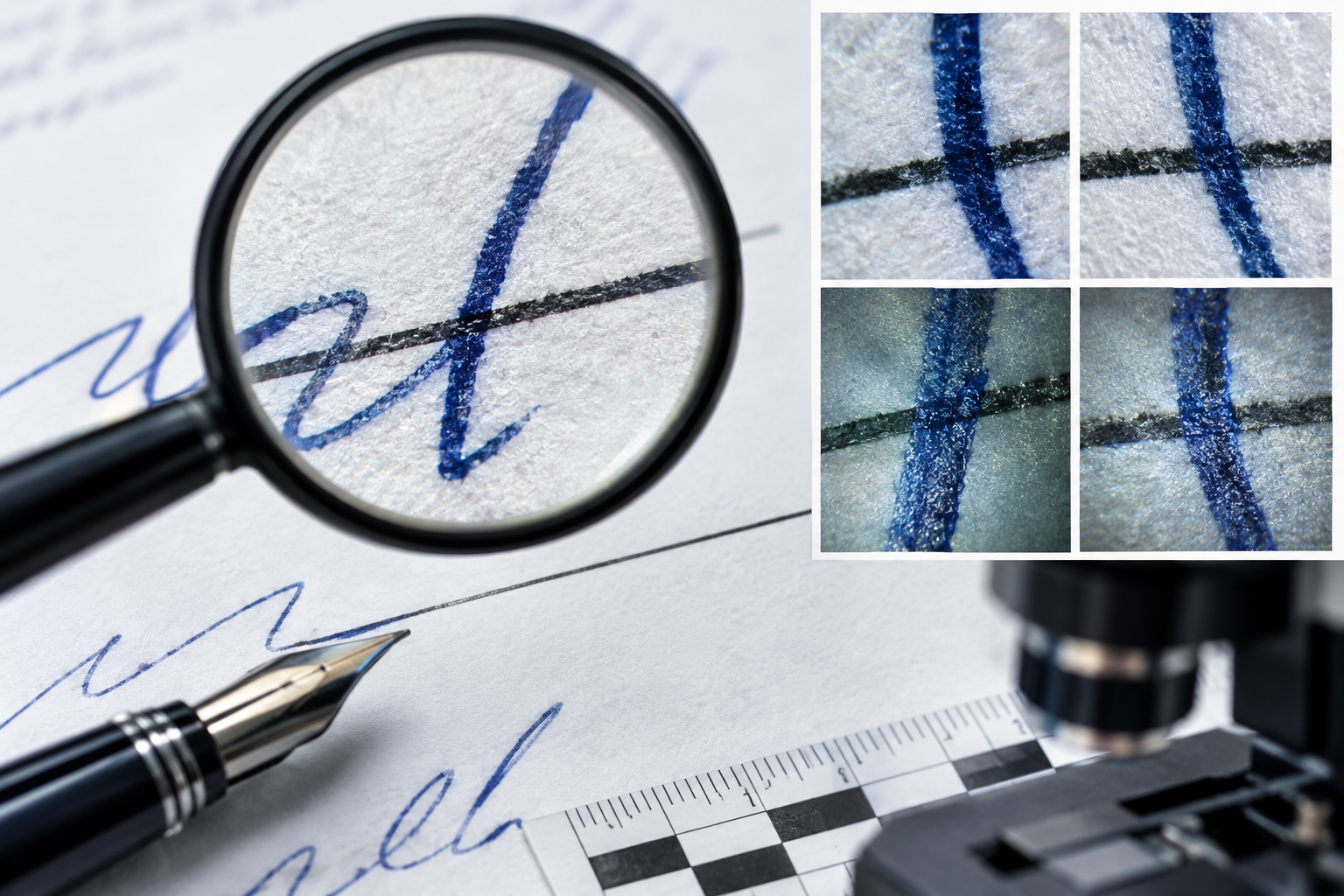
For example, a handwritten entry may cross a signature, printed line, stamp, or another handwritten mark. At the point where these strokes intersect, microscopic and physical features may help the examiner determine which stroke came first.
This examination can prove useful when investigating suspected alterations, additions, overwriting, or disputed documents.
What Is Sequence of Strokes Examination?
Sequence of strokes examination focuses on the relative order of intersecting strokes or markings.
Consider two strokes that cross each other. The examiner examines their intersection to determine whether one stroke lies over or under the other. The examiner may use magnification, microscopy, specialized lighting, and imaging techniques to study the area.
However, not every intersection provides enough information for a reliable conclusion. The type of writing material, paper, stroke characteristics, document condition, and quality of the intersection can all affect the examination.
Therefore, the examiner must evaluate the available evidence carefully rather than rely on the visual appearance alone.
Why Is Stroke Sequence Important?
The order of intersecting strokes can provide useful information about the formation of a document.
For instance, an examiner may need to determine:
- Whether someone added an entry after a signature.
- Whether a handwritten mark came before or after a printed line.
- Whether an apparent addition intersects an existing marking.
- Whether two handwritten strokes follow a particular sequence.
- Whether the physical evidence supports a proposed document-creation sequence.
Consequently, sequence examination can contribute to a broader questioned document investigation.
Common Applications of Sequence of Strokes Examination
1. Signature and Handwriting Intersections
A signature may intersect with another handwritten entry, printed line, or marking. The examiner can study the intersection to assess the relative sequence of the strokes.
This type of examination can become relevant in agreements, forms, receipts, applications, and other signed documents.
2. Suspected Alterations and Additions
A questioned document may contain additional words, numbers, or markings. When an added entry crosses an existing stroke, the intersection may provide information about their relative sequence.
However, sequence findings alone do not automatically establish forgery or alteration. The examiner should consider other document characteristics and examination results as well.
3. Handwriting Crossing Printed Lines
Many forms contain boxes, tables, underlines, and other printed elements. Handwritten entries often cross these features.
In suitable cases, examination of these intersections can help determine the relative sequence of the printed and handwritten markings.
4. Intersecting Handwritten Strokes
Two handwritten strokes may cross at different angles or directions. Their intersection can contain subtle features that help the examiner evaluate which stroke preceded the other.
How Do Forensic Experts Examine Stroke Sequence?
A forensic document examiner generally follows a systematic examination process.
Step 1: Identify the Relevant Intersections
First, the examiner locates the intersections that relate to the forensic question. The examiner also documents the overall condition and appearance of the document.
Step 2: Examine the Area Under Magnification
Next, the examiner studies the intersection using suitable magnification. This examination may reveal details that remain invisible to the naked eye.
The examiner may look for:
- Stroke continuity
- Interruption or displacement
- Ink deposition characteristics
- Physical disturbance
- Relative placement of the markings
- Direction and formation of strokes
Step 3: Use Microscopy and Appropriate Imaging
When necessary, the examiner can use microscopic examination and suitable imaging or illumination techniques. These methods can help reveal features within the intersection that ordinary lighting may not show clearly.
Step 4: Evaluate the Findings
Finally, the examiner considers all relevant observations together. If the evidence supports a sequence determination, the examiner can report the appropriate conclusion. If the evidence does not provide sufficient information, the examiner should clearly report that limitation.
Can Sequence of Strokes Always Be Determined?
No.
Several factors can make sequence determination difficult or impossible. For example:
- The intersection may lack sufficient detail.
- Similar writing materials may overlap.
- Ink may have spread or absorbed into the paper.
- The document may have suffered physical damage.
- Photocopying or scanning may have removed important features.
- The strokes may be too faint or heavily overlapped.
- The available evidence may not support a reliable conclusion.
Therefore, an inconclusive result does not necessarily indicate a problem with the examination. Instead, it can reflect the limitations of the physical evidence.
Sequence of Strokes vs. Ink Dating
People sometimes confuse sequence examination with ink dating. However, the two examinations answer different questions.
Sequence of strokes examination addresses the relative order of intersecting markings.
For example, the examination may support the conclusion that:
Stroke A preceded Stroke B.
Ink dating, in contrast, concerns the age or relative age of writing material.
Therefore, establishing that one stroke came before another does not establish the exact date on which either stroke was written.
Why Is the Original Document Important?
Whenever possible, forensic experts should examine the original document.
A photocopy, photograph, or scanned image may lose subtle physical characteristics present in the original intersection. Reproduction processes can also introduce changes that affect interpretation.
For this reason, investigators should preserve the original document carefully and avoid unnecessary writing, folding, rubbing, chemical treatment, or other handling.
Can Stroke Sequence Prove Forgery?
Sequence examination can provide valuable information in cases involving suspected alteration or forgery. Nevertheless, stroke sequence alone does not automatically prove that a document is forged.
Instead, forensic experts may combine sequence examination with other questioned document examinations, such as:
- Handwriting and signature comparison
- Ink examination
- Alteration examination
- Erasure and overwriting examination
- Indented writing examination
- ESDA examination
- Printing process examination
- Document enhancement
The appropriate examinations depend on the nature of the evidence and the questions raised by the investigation.
What Can a Forensic Report Say?
A forensic report should clearly explain the observations, examination process, interpretation, and conclusion.
Depending on the quality of the evidence, the examiner may reach a conclusion about the relative sequence. Alternatively, the examiner may determine that the available evidence does not permit a reliable sequence determination.
A scientifically responsible report should also explain relevant limitations. This approach helps investigators, legal professionals, and other stakeholders understand exactly what the physical evidence supports.
Sequence of Strokes Examination at Hawk Eye Forensic
At Hawk Eye Forensic, our questioned document examination services address forensic questions involving handwriting, signatures, alterations, and intersecting strokes.
Depending on the case requirements, our examination services can include:
- Sequence of strokes examination
- Handwriting and signature examination
- Suspected alteration examination
- Ink and document examination
- Erasure and overwriting examination
- Indented writing examination
- Other questioned document examinations
Our experts examine the available evidence systematically and prepare professional forensic reports based on the findings. Where the evidence has limitations, the report can also document those limitations rather than extending the conclusion beyond what the evidence supports.
Frequently Asked Questions
What is sequence of strokes examination?
Sequence of strokes examination is a forensic document examination technique that evaluates the relative order of intersecting strokes or markings.
Can a forensic examiner determine which handwriting stroke came first?
In suitable cases, yes. However, the examiner needs sufficient information from the intersection to reach a reliable conclusion.
Can sequence examination prove document forgery?
No. Sequence findings may contribute to an alteration or forgery investigation, but experts should consider the complete forensic evidence before reaching broader conclusions.
Can this examination determine the exact date of writing?
No. Stroke sequence establishes relative order, not the exact date when a stroke was produced.
Is the original document necessary?
The original document is preferable because copies and scans can lose important physical details. Nevertheless, experts can assess the suitability of whatever evidence is available.
Conclusion
Sequence of strokes examination provides a valuable approach for examining the formation and possible alteration of questioned documents. By studying intersecting handwriting, signatures, printed lines, and other markings, forensic document examiners can sometimes determine their relative order.
However, not every intersection provides enough evidence for a definitive conclusion. Therefore, experts must examine the document carefully, use appropriate techniques, and clearly communicate both findings and limitations.
When combined with other questioned document examinations, sequence of strokes analysis can help provide a more complete understanding of how a questioned document was created or modified.
Have a questioned document that requires professional examination? Consult forensic document examination experts for an evidence-based assessment and forensic report.


Post comments (0)