CCTV cameras have become an important source of digital evidence in criminal investigations, civil disputes, workplace incidents, road accidents, theft cases, and many other investigations. However, obtaining a CCTV recording is only the beginning. Investigators must determine whether the footage is authentic, relevant, complete, and suitable for forensic examination.
This is where CCTV forensics plays an important role.
What Is CCTV Forensics?
CCTV forensics, also known as forensic video analysis, is the scientific examination of video recordings obtained from CCTV cameras, DVRs, NVRs, surveillance systems, and other video-recording devices.
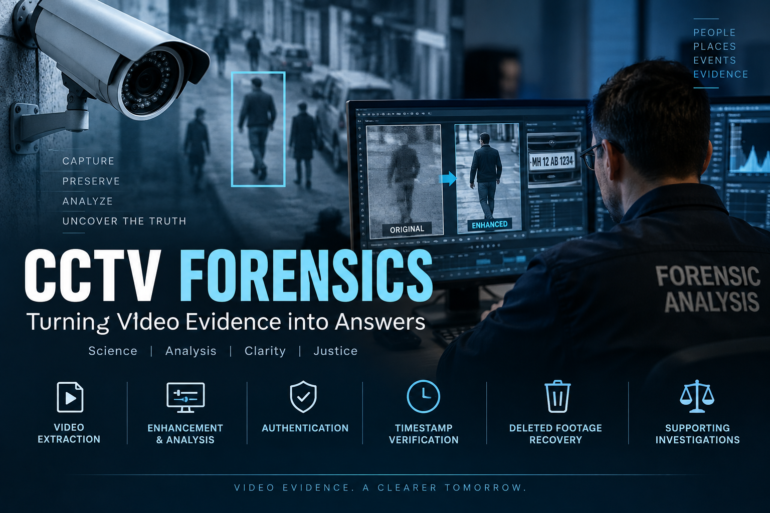
The objective is not simply to watch the recording. A forensic examiner may need to extract footage from a proprietary recording system, preserve the original evidence, examine video characteristics, enhance visibility, verify timestamps, identify possible alterations, and prepare relevant frames or sequences for investigative or legal purposes.
The examination must be conducted while maintaining the integrity of the digital video evidence.
Why Is CCTV Footage Important as Digital Evidence?
CCTV recordings can provide a visual record of events and may help investigators establish important facts such as:
-
Presence or movement of a person or vehicle
-
Sequence and timing of events
-
Entry and exit from a particular location
-
Actions occurring before, during, or after an incident
-
Vehicle movement or visible registration details
-
Corroboration or contradiction of other available evidence
However, the evidentiary value of CCTV footage depends significantly on its quality, authenticity, method of acquisition, and preservation.
Guidance on handling digital evidence can be found through the National Institute of Standards and Technology (NIST), which publishes technical resources relevant to digital evidence and forensic practices.
CCTV Footage Extraction and Preservation
One of the first challenges in a CCTV forensic investigation is obtaining the recording correctly.
Modern surveillance systems may store recordings on DVRs, NVRs, memory cards, cloud platforms, or proprietary storage systems. Some manufacturers use proprietary file formats that cannot be played using ordinary media players.
Where possible, investigators should preserve the original recording and document the extraction process. Relevant information such as the device details, date and time settings, export method, file information, and storage media should also be documented.
Maintaining an appropriate chain of custody is essential when CCTV footage may be presented as evidence.
CCTV Video Enhancement
A common request received by forensic laboratories is: “Can you enhance this CCTV footage?”
Forensic video enhancement can improve the visibility of information that already exists within the recording. Depending on the source footage and investigative requirement, techniques may include:
Brightness and contrast adjustment: Improving visibility in footage recorded under poor lighting conditions.
Noise reduction: Reducing certain types of visual interference that affect image clarity.
Frame stabilization: Reducing unwanted camera movement or vibration to make footage easier to examine.
Frame-by-frame examination: Examining individual frames to identify relevant events or details.
Region-of-interest examination: Focusing analysis on a particular person, object, vehicle, or area within the frame.
Frame extraction: Producing still images from relevant portions of the video for closer examination or presentation.
Enhancement should be performed carefully so that the examiner does not introduce misleading visual information.
Can Every Blurred CCTV Video Be Enhanced?
No. This is one of the most important limitations of forensic video enhancement.
Enhancement cannot reliably recreate information that was never captured by the camera.
For example, if a vehicle registration plate occupies only a few pixels and the characters were never adequately recorded, software cannot scientifically reconstruct the actual registration number with certainty. Similarly, severe motion blur, overexposure, extreme darkness, compression, low resolution, or an obstructed face may significantly limit the information available for examination.
Modern AI-based enhancement technologies can generate visually convincing results, but generated details should not automatically be treated as original evidentiary information. Forensic interpretation must distinguish between information present in the source recording and information inferred or synthesized during processing.
CCTV Video Authentication
Another important area of CCTV forensic analysis is determining whether a recording shows indications of alteration or manipulation.
Depending on the case and available material, an examiner may evaluate:
-
Video and audio streams
-
Metadata and file structure
-
Frame sequence and continuity
-
Encoding and compression characteristics
-
Timestamp information
-
Unexpected discontinuities
-
Signs of editing or re-encoding
-
Relationship between the submitted file and the original recording system
Authentication should not depend on a single observation. Findings are generally interpreted collectively and within the context of how the recording was generated, exported, transferred, and submitted.
Technical information about multimedia formats and video processing is also available through FFmpeg, a widely used multimedia framework that supports numerous video and audio formats.
Timestamp Examination in CCTV Footage
The timestamp displayed on CCTV footage can be highly significant, but it should not automatically be assumed to represent the exact real-world time.
A DVR or NVR may have an incorrectly configured clock, incorrect time zone, synchronization error, or manual time adjustment. Investigators may therefore compare the displayed CCTV time with independently established reference events when accurate timing is important.
This distinction can become critical when reconstructing a sequence of events.
Deleted CCTV Footage and Recovery
In certain investigations, relevant CCTV footage may have been deleted or automatically overwritten by the recording system.
Whether deleted CCTV footage recovery is possible depends on factors such as the storage system, recording format, file system, overwrite mechanism, encryption, time elapsed, and subsequent recording activity.
Forensic examination of the original DVR, NVR, hard disk, or storage media may sometimes identify recoverable video data or remnants. However, recovery cannot be guaranteed, particularly when the relevant storage sectors have already been overwritten.
Role of CCTV Forensics in Investigations
CCTV footage can become powerful evidence when it is properly acquired, preserved, examined, interpreted, and presented. A forensic examiner’s responsibility is not to make poor-quality footage look perfect, but to obtain the maximum scientifically supportable information from the available recording while maintaining evidentiary integrity.
As surveillance systems continue to expand, CCTV forensics, forensic video analysis, CCTV footage authentication, CCTV video enhancement, digital video evidence examination, and deleted CCTV footage recovery are becoming increasingly important components of modern digital forensic investigations.
Ultimately, the value of CCTV evidence depends not only on what the camera recorded, but also on how carefully that recording is handled and scientifically examined.


Post comments (0)