As India becomes increasingly digital, cybercrime, online fraud, data breaches, financial scams, and technology-assisted offences are also becoming more sophisticated. Smartphones, computers, cloud platforms, social media, CCTV systems, and other digital devices can contain crucial evidence during an investigation. This has significantly increased the importance of digital forensics in India.
For students interested in forensic science, cybersecurity, computers, or criminal investigation, digital forensics career opportunities in India are expanding across government forensic laboratories, law enforcement agencies, cybersecurity companies, consulting firms, financial institutions, and private forensic laboratories.
What Is Digital Forensics?
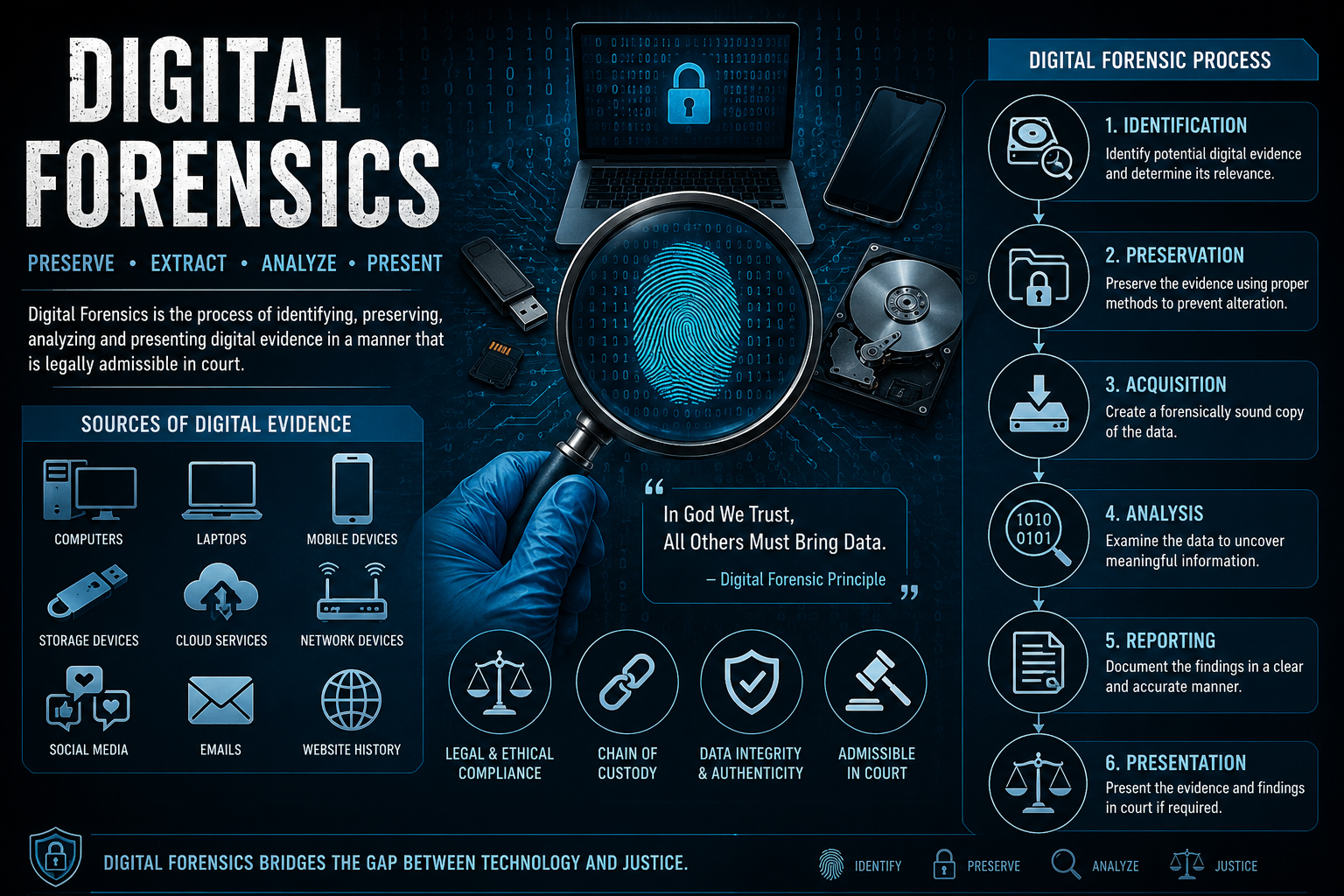
Digital forensics is the scientific process of identifying, acquiring, preserving, examining, analysing, and reporting digital evidence while maintaining its integrity.
A digital forensic examiner may investigate evidence obtained from:
- Computers and laptops
- Smartphones and tablets
- Hard drives, SSDs, and USB devices
- Emails and communication applications
- Social media platforms
- Cloud storage
- CCTV and multimedia systems
- Network logs
- Internet browsing artefacts
- Deleted or hidden data
Digital forensic investigation is not simply about recovering deleted files. Examiners must follow appropriate forensic procedures, document their methodology, preserve evidence integrity, and maintain the chain of custody so that their findings can withstand legal and technical scrutiny.
Why Is Digital Forensics Growing in India?
India’s rapid adoption of digital payments, smartphones, online banking, e-commerce, cloud computing, and social media has created an enormous digital ecosystem.
At the same time, investigators are encountering offences involving phishing, identity theft, UPI and banking fraud, ransomware, cyberstalking, data theft, financial scams, cryptocurrency, and compromised digital accounts.
According to the Indian Cyber Crime Coordination Centre (I4C), cybercrime requires coordinated efforts involving law enforcement agencies and other stakeholders. Citizens can also report cybercrime through the Government of India’s National Cyber Crime Reporting Portal.
This growing dependence on digital evidence is creating greater demand for professionals who understand both forensic investigation and digital technology.
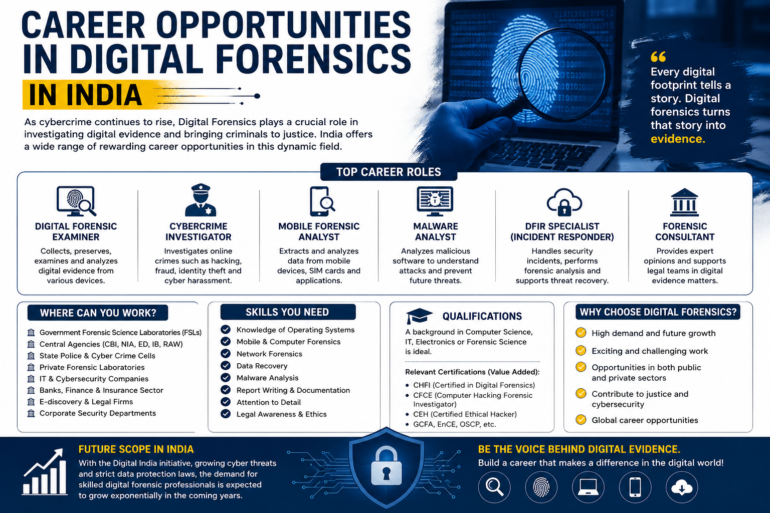
Career Opportunities in Digital Forensics in India
A qualification in forensic science, digital forensics, cybersecurity, computer science, information technology, or a related discipline can lead to several career paths depending on the eligibility requirements of the organisation.
1. Digital Forensic Examiner
Digital forensic examiners acquire and analyse electronic devices to identify potential evidence. Their work can involve forensic imaging, file-system examination, deleted-data recovery, timeline analysis, application artefacts, browser history, user activity, and preparation of forensic reports.
2. Mobile Forensic Examiner
Smartphones can contain call records, messages, photographs, videos, application data, location-related artefacts, browser information, and other valuable evidence.
A mobile forensic examiner specialises in the acquisition and examination of Android and iOS devices using appropriate forensic methodologies and tools.
3. Cybercrime Investigator
Cybercrime investigators work on cases involving online fraud, phishing, account compromise, cyber harassment, impersonation, malware incidents, financial fraud, and other technology-enabled offences.
Opportunities may exist within police cybercrime units, specialised investigation teams, government organisations, and private-sector investigation or consulting firms.
4. Computer Forensic Analyst
Computer forensic analysts primarily examine computers and storage media. Their work may include analysing operating-system artefacts, user accounts, file systems, external device activity, deleted files, metadata, logs, and application traces.
5. Incident Response & DFIR Analyst
Digital Forensics and Incident Response (DFIR) combines forensic examination with cybersecurity incident investigation.
DFIR professionals investigate security breaches, malware infections, ransomware attacks, insider threats, and unauthorised system access. They may reconstruct an attack timeline, identify compromised systems, determine the initial attack vector, and assess the extent of an incident.
The CERT-In website is an important resource for information regarding cybersecurity incidents, advisories, vulnerabilities, and cyber threats affecting India.
6. Malware Forensics and Analysis
Professionals with stronger cybersecurity and programming skills can specialise in malware analysis and forensics.
They analyse suspicious executables, scripts, malicious applications, persistence mechanisms, network behaviour, and other indicators to understand how malicious software operates and affects a system.
7. Government Forensic Science Laboratories
Government Forensic Science Laboratories (FSLs) at the central and state levels can provide career opportunities in cyber and digital forensic divisions.
Recruitment criteria vary considerably depending on the post and recruiting authority. Candidates should therefore check official notifications for educational qualifications, experience requirements, examinations, age limits, and other eligibility conditions.
The Directorate of Forensic Science Services (DFSS) under the Ministry of Home Affairs is a useful official source for information about forensic science services in India.
8. Private Digital Forensic Laboratories
Private forensic laboratories provide another career pathway. Professionals may work on digital evidence acquisition, mobile and computer examination, cyber fraud investigations, corporate investigations, data recovery, forensic reporting, and litigation-support matters.
Private laboratories can also provide students with exposure to practical case workflows that complement academic knowledge.
9. Corporate and Cybersecurity Forensics
Banks, IT companies, consulting organisations, financial institutions, and large enterprises may employ professionals for:
- Incident response
- Insider-threat investigations
- Employee misconduct investigations
- Data breach investigations
- E-discovery
- Fraud investigations
- Cybersecurity investigations
- Digital evidence preservation
This area can be particularly attractive to candidates who combine digital forensic skills with cybersecurity knowledge.
Skills Required for a Career in Digital Forensics
Academic qualifications provide a foundation, but practical competency is extremely important in digital forensics.
Students should develop knowledge of operating systems, computer hardware, Android and iOS, Windows artefacts, file systems such as NTFS and FAT/exFAT, networking fundamentals, forensic imaging, hashing, data recovery, metadata, log analysis, chain of custody, and forensic reporting.
Familiarity with tools and frameworks such as Autopsy, FTK Imager, Wireshark and Volatility can also be useful. Commercial forensic platforms are widely encountered in professional environments, although access will depend on the organisation and licensing.
Basic knowledge of Python, Linux, SQL, PowerShell, networking and cybersecurity can further strengthen a candidate’s technical profile.
How Can Students Prepare for Digital Forensic Jobs?
Students who want to build a career in digital forensics in India should focus on practical competency rather than relying only on theoretical coursework.
Build a laboratory environment, practise forensic acquisition and analysis, work on simulated cases, learn to document every examination step, understand evidence integrity, and prepare structured forensic reports.
Internships and hands-on training can be particularly valuable because forensic work requires disciplined evidence handling in addition to technical analysis.
Students should also maintain a portfolio of permissible practice projects, such as forensic examination of test disk images, memory analysis, network traffic analysis, malware-analysis exercises, and documented case simulations.
Future Scope of Digital Forensics in India
The scope of digital forensics in India is likely to continue expanding as more human activity generates electronic evidence.
Emerging areas include cloud forensics, IoT forensics, cryptocurrency investigations, vehicle forensics, drone forensics, memory forensics, malware analysis, artificial-intelligence-assisted investigations, and advanced mobile-device examination.
As digital systems become more deeply integrated into everyday life and business operations, organisations will increasingly require professionals capable of collecting and interpreting digital evidence using technically defensible methods.

Post comments (0)