Counterfeit currency remains one of the most persistent financial crimes worldwide. Fake banknotes not only cause economic losses but also undermine trust in national financial systems. To combat this, forensic experts, financial institutions, and law enforcement agencies use advanced counterfeit currency detection techniques to distinguish genuine notes from fraudulent ones.
Understanding how counterfeit notes are detected is essential for investigators, businesses, and even ordinary citizens handling cash transactions.
What is Counterfeit Currency?
Counterfeit currency refers to illegally produced imitation banknotes designed to resemble genuine money closely enough to deceive users. Counterfeiters use increasingly sophisticated printing methods, making detection more challenging than ever.
Modern forensic science combines visual inspection, physical examination, and technological analysis to identify fake currency.
1. Visual Inspection of Security Features
The first line of defense against counterfeit money is careful visual examination.
Watermarks
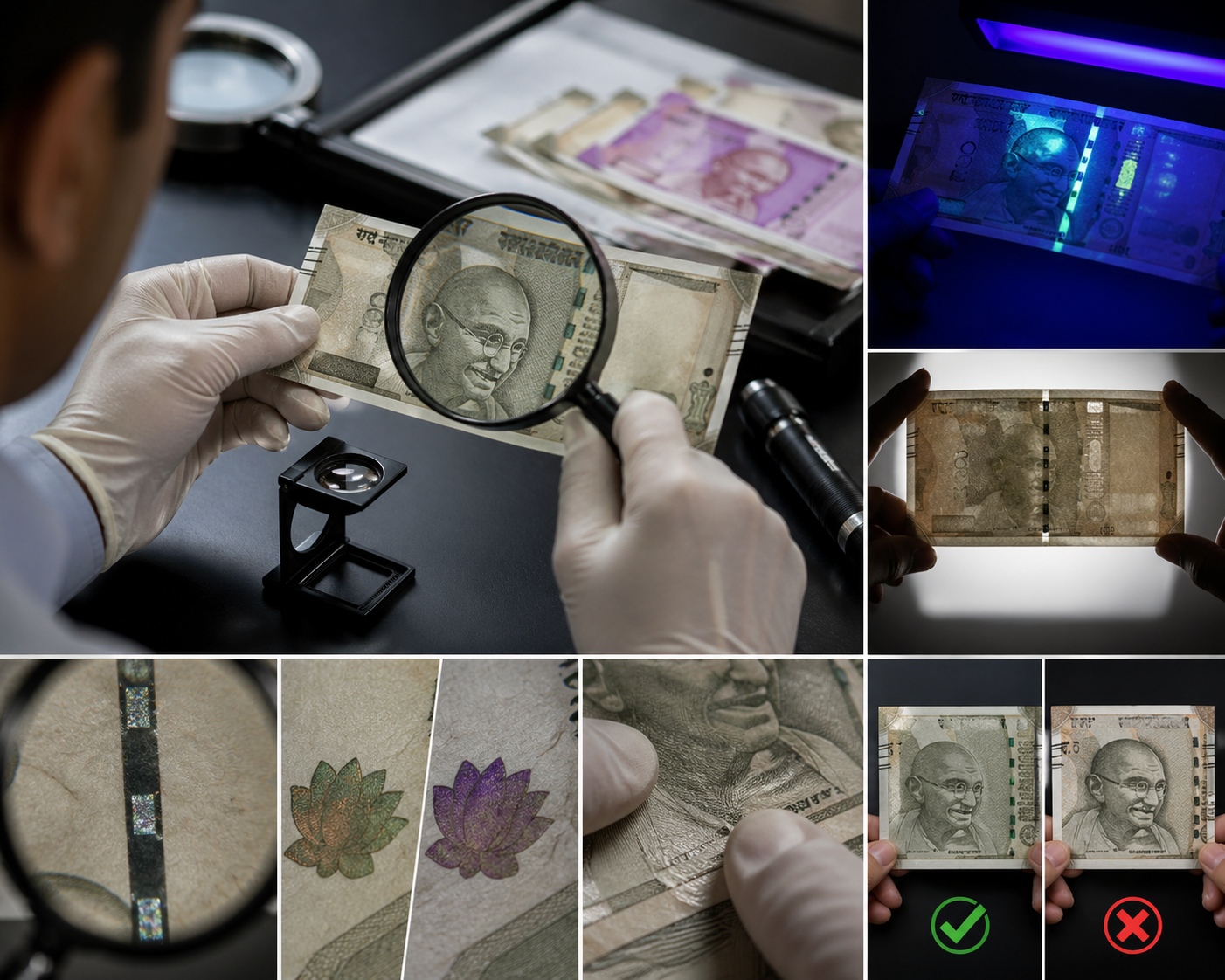
Authentic currency contains embedded watermarks visible when held against light. Counterfeit notes often reproduce these poorly through surface printing rather than embedding them into the paper.
Security Thread
A genuine note contains a security thread woven into the paper. Under light, it appears as a continuous embedded strip, often with microprinted text.
Fake notes may show printed imitations rather than true embedded threads.
Color-Shifting Ink
Many currencies use optically variable ink that changes color when viewed from different angles.
Counterfeit versions often fail to replicate this dynamic effect accurately.
Microprinting
Tiny text printed with high precision appears crisp under magnification in genuine notes.
Counterfeit reproductions typically appear blurred or broken.
2. Paper Quality Examination
Authentic banknotes are printed on specially manufactured paper composed of cotton fibers or polymer materials.
Forensic experts assess:
- Texture and crispness
- Fiber composition
- Surface durability
- Embedded fluorescent fibers
Counterfeit notes printed on ordinary paper often feel smoother or excessively glossy.
The “touch test” is often enough for trained professionals to identify suspicious notes.
3. Ultraviolet (UV) Light Examination
UV light reveals hidden fluorescent features built into authentic currency.
Under UV examination, genuine notes may display:
- Fluorescent serial numbers
- Embedded glowing fibers
- Hidden patterns and symbols
Counterfeit notes often either glow entirely (due to common paper bleaching agents) or fail to display expected fluorescent features.
UV examination is one of the most widely used counterfeit detection tools in forensic labs and retail settings.
4. Magnification and Microscopic Analysis
Microscopes reveal subtle printing differences invisible to the naked eye.
Experts inspect:
- Ink spread patterns
- Line sharpness
- Dot matrix consistency
- Printing alignment
Authentic currency is produced using highly precise intaglio and offset printing methods.
Counterfeit notes usually show irregular ink deposition and pixelated edges due to digital reproduction methods.
5. Infrared (IR) Detection Techniques
Many modern banknotes include infrared-reactive elements visible only under IR scanners.
During forensic analysis, investigators examine:
- Selective ink absorption
- Hidden denomination markers
- Pattern disappearance under IR exposure
Counterfeit notes often fail because standard printers cannot replicate IR-sensitive inks.
6. Serial Number Verification
Every genuine note has a unique serial number with precise alignment, font consistency, and spacing.
Investigators check for:
- Duplicate serial numbers
- Incorrect font styles
- Uneven placement
- Printing defects
Counterfeit operations often repeat serial numbers across multiple fake notes.
7. Chemical Ink Analysis
Forensic laboratories perform chemical analysis to identify ink composition.
Techniques include:
- Thin-layer chromatography (TLC)
- Raman spectroscopy
- Gas chromatography-mass spectrometry (GC-MS)
These methods reveal whether inks match those used by official currency printing authorities.
8. Machine-Based Detection Systems
Banks and businesses increasingly rely on automated counterfeit detection systems.
These machines analyze:
- Magnetic ink properties
- Infrared response
- UV fluorescence
- Note dimensions and thickness
Machine learning-enhanced systems now detect highly sophisticated counterfeit attempts with remarkable accuracy.
Why Counterfeit Detection Matters
Effective counterfeit detection protects:
- Economic stability
- Public confidence
- Financial institutions
- Businesses from financial loss
- Criminal investigations
Forensic currency examination also provides critical evidence in fraud and organized crime investigations.
Final Thoughts
Counterfeiters continue evolving their methods, but forensic science advances just as rapidly. From UV analysis and microscopic examination to chemical spectroscopy and machine-learning detection, modern counterfeit currency detection combines science and technology to protect financial systems.
Awareness is the first defense. Whether you are a forensic professional, cashier, banker, or consumer, understanding these detection techniques helps identify suspicious notes before damage occurs.


Post comments (0)