Introduction: Why Email Headers Matter in Cybercrime
Email remains one of the most common tools used in cybercrime. Criminals use phishing, spoofing, business email compromise (BEC), and malware attachments to deceive victims. While the email body may appear convincing, the real evidence often lies hidden in the email header.
Email header analysis plays a crucial role in cybercrime investigations. It helps digital forensic experts trace the true origin of an email, detect spoofing attempts, and identify suspicious server activity. As a result, investigators rely heavily on header examination to uncover digital trails.
What Is an Email Header?
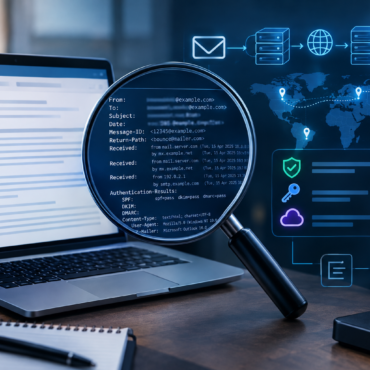
An email header contains technical information that travels with every email message. Although most users only see the sender name and subject line, the full header includes detailed routing and authentication data.
It typically contains:
-
Sender’s email address
-
Recipient’s email address
-
Sending mail server details
-
Receiving mail server details
-
IP addresses of servers involved
-
Date and time stamps
-
Authentication results (SPF, DKIM, DMARC)
-
Message ID
Unlike the visible email content, this data cannot be easily altered without leaving traces.
Key Components Investigators Analyze
Digital forensic experts focus on specific header fields to determine authenticity and origin.
1. Received Fields
The “Received” lines show the path the email took from sender to recipient. Each mail server adds its own entry. Investigators read these lines from bottom to top to trace the email’s journey.
If inconsistencies appear in the routing sequence, it may indicate spoofing or manipulation.
2. IP Address Tracing
Each mail server entry usually includes an IP address. Investigators extract the originating IP and perform geolocation analysis to identify the probable source location.
However, attackers may use VPNs, proxies, or compromised systems. Therefore, IP analysis must be combined with other evidence.
3. SPF, DKIM, and DMARC Authentication
Authentication protocols help verify whether the email was authorized by the sending domain:
-
SPF (Sender Policy Framework)
-
DKIM (DomainKeys Identified Mail)
-
DMARC (Domain-based Message Authentication, Reporting & Conformance)
If these checks fail, the email may be spoofed.
4. Message-ID Examination
The Message-ID is a unique identifier assigned by the sending server. Its domain structure often reveals whether the email genuinely originated from the claimed organization.
A mismatch between the sender domain and Message-ID domain raises suspicion.
Common Cybercrimes Detected Through Header Analysis
Email header analysis plays a critical role in investigating:
In many financial fraud investigations, header examination provides the first technical lead.
Challenges in Email Header Investigation
Although header analysis is powerful, investigators face several challenges:
-
Use of anonymization services
-
Botnets and compromised servers
-
Cloud-based email relays
-
Encrypted email services
-
International jurisdiction issues
Therefore, experts must correlate header findings with server logs, device forensics, and network analysis.
Legal Importance of Email Header Analysis
Courts increasingly accept properly collected digital evidence. However, investigators must maintain:
-
Proper forensic acquisition
-
Documented chain of custody
-
Verified extraction methods
-
Technical explanation of findings
When handled correctly, email header analysis can strongly support cybercrime prosecution.
Best Practices for Digital Forensic Experts
To ensure reliable results, investigators should:
-
Preserve the original email in raw format
-
Avoid forwarding before extraction
-
Use forensic tools for header parsing
-
Document every analytical step
-
Correlate with other digital artifacts
These steps improve evidentiary integrity and courtroom admissibility.
Conclusion: Small Data, Powerful Evidence
Although email headers appear technical and complex, they often contain the most valuable evidence in cybercrime investigations. By carefully analyzing routing paths, authentication results, and IP data, digital forensic experts can uncover deception and trace digital footprints.
In many cases, the truth is not in what the email says — but in how it traveled.



Post comments (0)