Live Forensics vs Dead Forensics: When and Why
Digital forensics plays a critical role in modern criminal, civil, and corporate investigations. As digital devices become central to human activity, forensic experts must decide the most appropriate method to examine electronic evidence. Two fundamental approaches dominate digital forensic investigations: Live Forensics and Dead Forensics. Although both aim to extract reliable digital evidence, they differ significantly in methodology, application, and forensic value. Therefore, understanding when and why to use each approach is essential for maintaining evidence integrity and ensuring legal admissibility.
Understanding Live Forensics
Live forensics refers to the forensic examination of a powered-on system. In this approach, the investigator collects volatile and non-volatile data while the system remains operational. Unlike traditional methods, live forensics focuses heavily on volatile memory, such as RAM, running processes, network connections, logged-in users, and encryption keys.
Because volatile data disappears once the system shuts down, live forensic analysis becomes critical in cases involving active cyberattacks, malware infections, insider threats, and ransomware incidents. For instance, encryption keys stored in RAM may be the only way to access protected data. Consequently, live forensics often provides evidence that dead forensics cannot recover.
However, live forensics introduces certain risks. Since interacting with a live system can alter data, the investigator must follow strict protocols and use trusted forensic tools. Even minor system interactions may modify timestamps or system logs. Therefore, proper documentation and justification are crucial to defend the examination process in court.
Understanding Dead Forensics
Dead forensics, also known as static forensics, involves the examination of a powered-off device. In this method, the system is shut down, and storage media such as hard disks, SSDs, USB drives, or memory cards are forensically imaged. The investigator then performs analysis on the forensic copy rather than the original evidence.
This approach remains the most widely accepted method in digital forensic laboratories. It minimizes the risk of evidence alteration and supports strong chain of custody practices. Moreover, dead forensics allows thorough examination of file systems, deleted data, logs, registry entries, and application artifacts.
Dead forensic analysis is particularly suitable for cases involving post-incident investigations, such as financial fraud, intellectual property theft, document forgery, and offline data analysis. Since the device is no longer active, investigators can work without time pressure, ensuring a systematic and reproducible examination.
Nevertheless, dead forensics has its limitations. Once the system is powered off, volatile data is permanently lost. As a result, crucial evidence related to active sessions, malware behavior, or encryption mechanisms may become inaccessible.
Key Differences Between Live and Dead Forensics
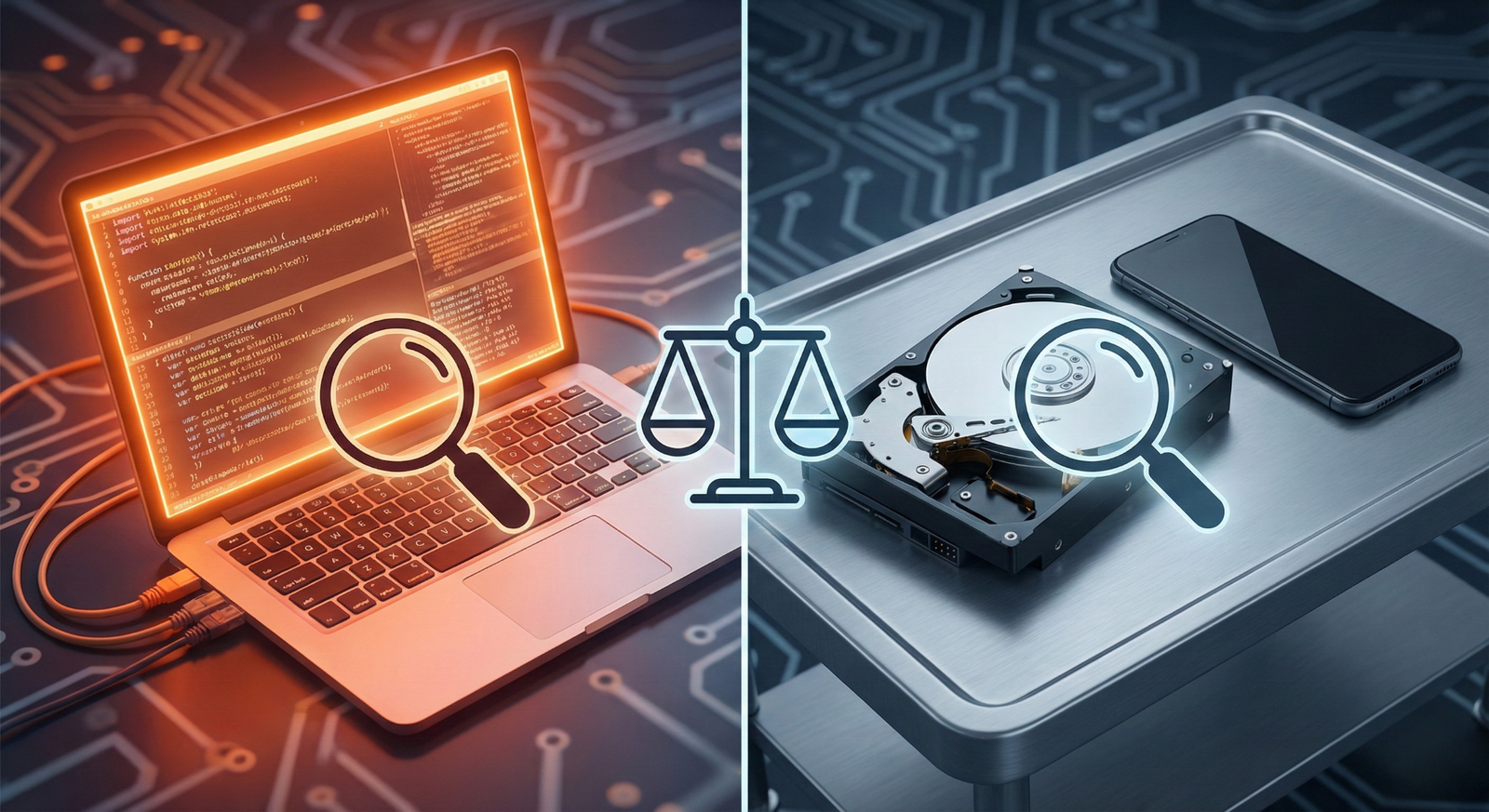
The primary distinction between live and dead forensics lies in the state of the system during examination. Live forensics prioritizes volatile evidence and real-time system behavior, whereas dead forensics focuses on persistent storage data.
Additionally, live forensics demands advanced technical expertise and rapid decision-making. Investigators must carefully balance evidence preservation with the need to capture volatile data. In contrast, dead forensics offers a more controlled environment and is easier to defend legally.
From a legal standpoint, courts often scrutinize live forensic procedures more closely due to the higher risk of data modification. Therefore, examiners must clearly explain their methodology and tools used during live acquisition.
When to Use Live Forensics
Live forensics should be used when shutting down the system would result in loss of critical evidence. This includes scenarios such as:
-
Active network intrusions or hacking incidents
-
Malware or ransomware investigations
-
Encrypted systems requiring live decryption keys
-
Insider threat cases involving ongoing access
-
Cloud-connected systems with volatile session data
In such situations, the forensic value of volatile data outweighs the risks associated with live examination.
When to Use Dead Forensics
Dead forensics is preferable when evidence preservation, reproducibility, and legal defensibility are the primary concerns. Typical situations include:
-
Seized computers and storage devices
-
Financial and corporate fraud investigations
-
Document and email forensic analysis
-
Historical data recovery and timeline reconstruction
-
Cases requiring extensive laboratory examination
Because dead forensics minimizes system interaction, it remains the gold standard for most forensic investigations.
Why the Choice Matters in Forensic Investigations
Choosing between live and dead forensics directly affects the quality, completeness, and admissibility of digital evidence. An incorrect approach may result in evidence loss, contamination, or legal challenges. Therefore, forensic experts must assess the case circumstances, system state, legal requirements, and investigative objectives before selecting a method.
In practice, many complex cases require a hybrid approach, where live forensic acquisition precedes dead forensic analysis. This combined strategy ensures maximum evidence collection while maintaining forensic integrity.
Conclusion
Live forensics and dead forensics are not competing techniques but complementary tools within the digital forensic framework. Live forensics enables the capture of volatile, real-time evidence, while dead forensics ensures detailed, legally robust analysis of persistent data. Understanding when and why to apply each method empowers forensic professionals to conduct scientifically sound and court-admissible investigations. Ultimately, the effectiveness of a digital forensic examination depends not only on tools but on informed forensic judgment.

Post comments (0)