Digital evidence has become one of the most critical forms of evidence in modern investigations. Mobile phones, computers, CCTV systems, cloud storage, emails, social media accounts, GPS data, and messaging applications frequently contain information that can establish timelines, identify suspects, and corroborate witness statements. However, simply obtaining digital evidence does not guarantee that it will be accepted in court.
Courts evaluate not only the relevance of digital evidence but also its authenticity, integrity, reliability, and the manner in which it was collected and preserved. Even highly incriminating evidence can be rejected if proper forensic procedures are not followed.
In this article, we examine the most common reasons why digital evidence gets rejected in court and discuss best practices to ensure its admissibility.

1. Improper Collection of Digital Evidence
One of the most frequent reasons digital evidence is challenged is improper collection. Investigators sometimes access a device without following established forensic procedures, unintentionally altering or deleting valuable information.
Examples include:
- Opening files directly on the original device
- Connecting storage devices without write blockers
- Booting a computer normally instead of using forensic acquisition techniques
- Failing to document the initial condition of the device
Any modification to the original evidence may raise doubts regarding its authenticity.
Best Practice: Follow internationally accepted forensic acquisition procedures and document every action performed during evidence collection.
https://csrc.nist.gov/publications/detail/sp/800-86/finaL
2. Broken Chain of Custody
The Chain of Custody documents every individual who handled the evidence from the time it was seized until it is presented in court. Missing entries, incomplete documentation, or unexplained transfers can significantly weaken the credibility of the evidence.
A proper Chain of Custody should include:
- Date and time of seizure
- Name of the officer collecting the evidence
- Description of the evidence
- Evidence seal numbers
- Every transfer of possession
- Storage location
- Final presentation before the court
Without proper documentation, the defense may argue that the evidence was tampered with.
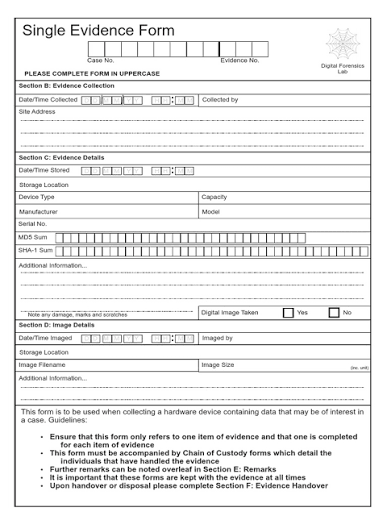
Reference: ISO/IEC 27037 provides internationally recognized guidelines for identifying, collecting, acquiring, and preserving digital evidence:
https://www.iso.org/standard/44381.html
3. Failure to Preserve Evidence Integrity
Digital evidence must remain exactly as it existed at the time of seizure. Even a minor alteration may affect admissibility.
Forensic investigators verify integrity using cryptographic hash values such as:
The hash generated before examination should exactly match the hash generated after analysis.
If no hash values are recorded, it becomes difficult to prove that the evidence remained unchanged.
4. Inadequate Documentation
Digital forensic investigations require meticulous documentation.
Courts expect investigators to clearly explain:
- How the evidence was identified
- How it was collected
- Which forensic tools were used
- Examination methodology
- Findings
- Limitations
Poor or incomplete documentation makes it difficult for another expert to reproduce the examination, reducing the credibility of the investigation.
5. Use of Unvalidated or Unreliable Forensic Tools
Courts increasingly expect investigators to use reliable and validated forensic software.
Using unknown, outdated, or improperly configured tools may lead to questions regarding the accuracy of the findings.
Widely accepted forensic tools include:
- Cellebrite UFED
- Magnet AXIOM
- Oxygen Forensic Detective
- FTK (Forensic Toolkit)
- EnCase
Regardless of the tool used, investigators should understand its limitations and verify important findings independently whenever possible.
6. Lack of Investigator Competency
Digital forensic tools generate reports, but they do not replace expert interpretation.
If an investigator cannot explain:
- How evidence was acquired
- Why a specific tool was used
- The meaning of artifacts
- Possible limitations of the examination
the court may give less weight to the evidence or the expert testimony.
Continuous training and certification are essential in the rapidly evolving field of digital forensics.
7. Questions Regarding Authenticity
Courts must be satisfied that the digital evidence is genuine.
For example:
- Screenshots can be edited.
- Chat messages can be fabricated.
- Images may be manipulated using AI.
- Metadata can sometimes be modified.
Therefore, investigators should rely on original forensic acquisitions rather than screenshots whenever possible.
Supporting artifacts such as metadata, logs, timestamps, and server records help establish authenticity.
8. Violation of Legal Procedures
Digital evidence obtained without following applicable legal procedures may become inadmissible.
Examples include:
- Unauthorized searches
- Improper seizure of electronic devices
- Failure to obtain necessary warrants where required
- Exceeding the scope of authorized searches
Investigators must always comply with applicable laws and procedural requirements in their jurisdiction.
9. Incomplete Timeline Reconstruction
Many digital investigations depend on accurate timelines.
Incorrect system time, timezone mismatches, daylight saving adjustments, or unsynchronized clocks may produce misleading conclusions.
Professional investigators verify:
- Device timezone
- Network time synchronization
- System clock accuracy
- File timestamps
- Application timestamps
A well-documented timeline strengthens the reliability of digital evidence.
10. Poor Expert Witness Testimony
Even technically sound evidence can lose credibility if the expert witness cannot clearly explain the findings.
Courts expect experts to:
- Explain technical concepts in simple language
- Describe forensic methodology
- Demonstrate impartiality
- Acknowledge limitations
- Support conclusions with objective evidence
An expert’s role is to assist the court, not advocate for either party.
How to Ensure Digital Evidence is Admissible
Investigators can improve the likelihood of admissibility by following these best practices:
- Secure the crime scene before collecting digital evidence.
- Document every action taken during seizure and examination.
- Maintain an unbroken Chain of Custody.
- Create forensic images instead of working on original media.
- Verify integrity using cryptographic hash values.
- Use validated forensic tools.
- Preserve original evidence securely.
- Prepare comprehensive forensic reports.
- Remain current with legal requirements and technological developments.




Post comments (0)