Falcon Neo vs TX1: Which Forensic Imaging Tool Is Better for Field Investigations?
Introduction
Forensic imaging is a critical step in digital investigations, as it ensures the accurate preservation of electronic evidence without altering the original data. In field investigations—such as crime scenes, corporate raids, or incident response operations—investigators require imaging tools that are portable, reliable, fast, and legally defensible. Choosing the right forensic imaging device can directly impact the integrity of evidence and its admissibility in court.
Among the commonly used forensic imaging tools, Falcon Neo and TX1 Forensic Imager stand out for their performance and reliability. While both tools are designed to create forensically sound copies of digital storage media, they differ in design philosophy, usability, and ideal use cases. This blog provides an in-depth comparison of Falcon Neo and TX1 to determine which tool is better suited for field investigations.
Understanding Field Investigation Requirements
Field investigations differ significantly from laboratory examinations. Investigators often work under time constraints, unpredictable environments, and limited access to power or additional equipment. An ideal field imaging tool should offer:
-
Portability and rugged design
-
Minimal setup time
-
Support for commonly encountered storage interfaces
-
Reliable write-blocking
-
Accurate hash verification
-
Simple user interface for quick operation
Both Falcon Neo and TX1 meet forensic standards, but their effectiveness varies depending on how well they address these practical field requirements.
Portability and Design
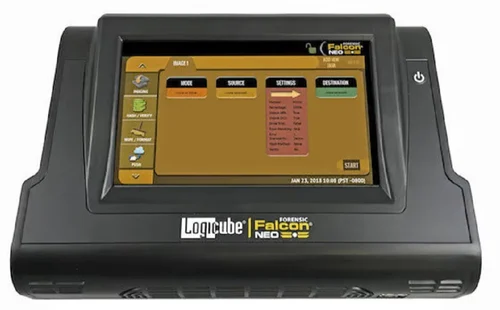
Falcon Neo is specifically designed with field deployment in mind. It features a compact, lightweight form factor with an integrated display and control buttons. This all-in-one design allows investigators to perform imaging tasks without relying heavily on external systems such as laptops. Its portability makes it suitable for on-site evidence acquisition where space and time are limited.
In contrast, TX1 Forensic Imager is portable but comparatively bulkier. While it can be used in the field, it often requires additional accessories or a connected system for optimal operation. This may increase setup time during on-site investigations.
Verdict: Falcon Neo offers superior portability and is more convenient for quick field deployments.
Imaging Speed and Performance
Speed is an important consideration, particularly when dealing with large storage devices. TX1 is known for its high imaging speeds and efficient data throughput. It performs exceptionally well when imaging large-capacity drives and supports advanced workflows suitable for extended operations.
Falcon Neo, while capable of delivering reliable imaging speeds, prioritizes ease of use and stability over maximum throughput. Its performance is sufficient for most field scenarios involving laptops, desktops, and external storage devices.
Verdict: TX1 has an advantage in raw imaging speed, especially for large or complex storage media.
Interface and Device Compatibility
Field investigators frequently encounter a variety of storage interfaces. TX1 offers extensive compatibility, supporting SATA, USB, NVMe, and other advanced interfaces. This versatility makes it suitable for handling modern storage technologies and enterprise-level devices.
Falcon Neo supports commonly encountered interfaces such as SATA and USB, which are adequate for most field cases. Additional adapters can be used to expand compatibility, though this may require prior planning.
Verdict: TX1 provides broader interface support, making it more adaptable to diverse storage environments.
Data Integrity and Forensic Soundness
Both Falcon Neo and TX1 are designed to meet forensic standards and ensure data integrity. They support:
-
Hardware-based write-blocking
-
Cryptographic hash generation (MD5, SHA-1, SHA-256)
-
Detailed activity logs and reports
Falcon Neo allows for quick log generation and export, which is beneficial during field documentation. TX1 produces comprehensive reports suitable for laboratory records and court presentation.
Verdict: Both tools are equally reliable in maintaining forensic integrity when used correctly.
Ease of Use in Field Conditions
Ease of use is a critical factor during field investigations, especially when investigators must act quickly or operate in stressful conditions. Falcon Neo features an intuitive interface with minimal configuration steps, reducing the likelihood of user error. This makes it suitable for investigators with varying levels of technical expertise.
TX1, while powerful, offers more advanced configuration options that may require additional training. Its complexity can be advantageous in controlled environments but may slow down rapid field operations.
Verdict: Falcon Neo is more user-friendly for field investigators.
Cost and Practical Value
From a cost perspective, Falcon Neo is generally positioned as a mid-range forensic imager that delivers strong value for field-focused operations. TX1 represents a higher investment but justifies its cost through advanced features, speed, and interface flexibility.
Verdict: Falcon Neo offers better value for investigators primarily conducting field imaging, while TX1 is more suitable for hybrid field-lab workflows.
Conclusion
Both Falcon Neo and TX1 are capable forensic imaging tools that meet professional and legal standards. However, their suitability for field investigations depends on operational priorities.
Falcon Neo is better suited for investigators who require a portable, easy-to-use, and reliable imaging solution for rapid on-site evidence acquisition. Its compact design and intuitive operation make it ideal for fieldwork.
TX1, on the other hand, excels in performance, speed, and interface versatility, making it more appropriate for complex cases involving large or advanced storage devices.



Post comments (0)